
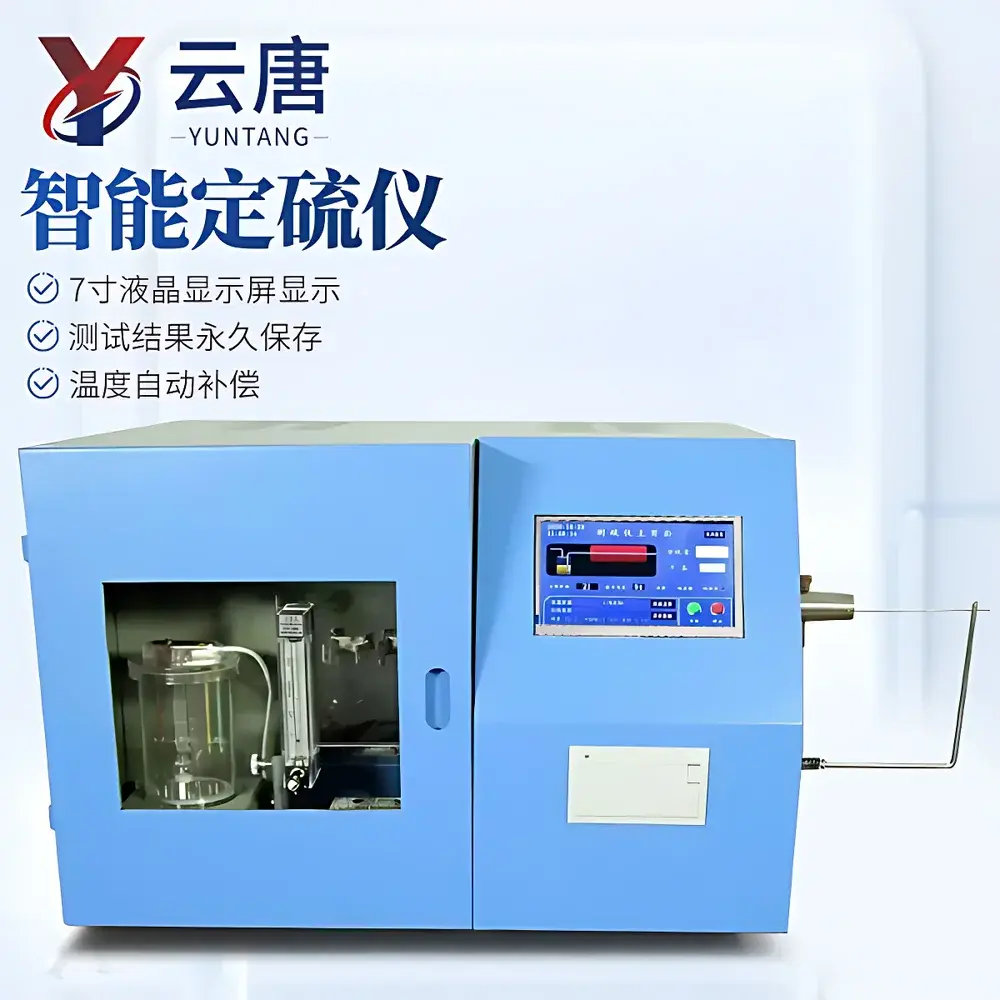
Yuntang YT-CSL Automatic Coulometric Sulfur Determinator for Coal and Solid Fuels
| Brand | Yuntang |
|---|---|
| Origin | Shandong, China |
| Manufacturer Type | Direct Manufacturer |
| Country of Origin | China |
| Model | YT-CSL |
| Power Supply | AC 220 V ±10%, 50 Hz |
| Max. Power Consumption | ≤3 kW |
| Dimensions (L×W×H) | 770×460×410 mm |
| Sample Capacity | 1–15 samples per run (continuous loading enabled) |
| Sulfur Measurement Range | 0–40 wt% |
| Combustion Time per Sample | ~5–7 min (including 45 s at 500 °C and 4 min 45 s at 1050 °C) |
| Temperature Control Accuracy | ±5 °C |
| High-Temperature Zone | ≥90 mm length, stabilized at 1050 °C ±5 °C |
| Thermocouple Class | 0.5 |
| Electrolytic Cell Volume | 450 mL |
| Platinum Electrode Area | 150 mm² |
| Heating Rate | 20–25 °C/min (reaches 1050 °C in ~30 min) |
| Repeatability (St,ad) | ≤0.05% (St <1%), ≤0.10% (1%≤St≤4%), ≤0.20% (St >4%) |
| Reproducibility (St,d) | ≤0.10% (St <1%), ≤0.20% (1%≤St≤4%), ≤0.30% (St >4%) |
| Temperature Compensation | Automatic |
| Data Storage | Permanent digital archive with query & print capability |
| Multi-PC Data Sharing | Supported |
| Safety Protections | Silicon Carbide Tube Auto-Protection, Overcurrent Protection |
Overview
The Yuntang YT-CSL Automatic Coulometric Sulfur Determinator is a fully automated, microprocessor-controlled instrument engineered for precise quantitative determination of total sulfur content in solid fuels—primarily coal, coke, and petroleum coke—according to standardized coulometric titration principles. The system operates on the ASTM D3177, ISO 4295, and GB/T 214 methodologies, where sample combustion in a high-purity oxygen stream converts sulfur compounds into sulfur dioxide (SO₂), which is then quantitatively absorbed and electrolytically titrated in a buffered iodide–iodine redox system. The instrument features a dual-zone furnace with a silicon carbide heating element, enabling rapid and stable temperature ramping to 1050 °C ±5 °C across a ≥90 mm active heating zone. Real-time thermocouple feedback ensures dynamic temperature compensation, minimizing thermal drift and supporting consistent SO₂ release kinetics across heterogeneous fuel matrices.
Key Features
- Fully automated batch processing: Accepts 1–15 samples per sequence with continuous loading capability—no interruption required between insertions.
- Coulometric detection architecture: Uses a 450 mL electrolytic cell with 150 mm² platinum electrodes, delivering high-resolution charge integration and sub-milligram sulfur sensitivity.
- Intelligent calibration and error correction: Built-in algorithm adjusts for electrode polarization, electrolyte depletion, and baseline drift using reference standards and internal blank cycles.
- Robust thermal management: Integrated overcurrent protection and silicon carbide tube auto-shutdown prevent thermal runaway during extended operation or abnormal load conditions.
- Digital data integrity: All results—including raw current-time integrals, temperature profiles, and calibration logs—are timestamped, stored permanently in non-volatile memory, and exportable via USB or network interface.
- Multi-station compatibility: Supports centralized data aggregation from multiple YT-CSL units onto a single laboratory information management system (LIMS) or QA/QC server.
Sample Compatibility & Compliance
The YT-CSL is validated for use with pulverized coal (particle size ≤0.2 mm), metallurgical coke (crushed to ≤1 mm), and petroleum coke. It complies with critical regulatory and quality assurance frameworks including ISO/IEC 17025:2017 (general requirements for testing laboratories), ASTM D3177-22 (standard test method for total sulfur in coal), and China’s GB/T 214-2007. Its coulometric measurement protocol satisfies GLP audit requirements through full traceability of calibration events, operator ID logging, and immutable result archives. While not FDA 21 CFR Part 11 certified out-of-the-box, the instrument’s data structure supports integration with compliant LIMS platforms that enforce electronic signature, audit trail, and access control policies.
Software & Data Management
The embedded control software provides real-time visualization of electrolysis current, furnace temperature ramp, and cumulative charge (in coulombs). Users configure method parameters—including target combustion temperatures, hold durations, and electrolyte refresh intervals—via an intuitive touchscreen interface. All analytical records are stored in a structured SQLite database with indexed fields for sample ID, date/time, operator, sulfur result (wt%), standard deviation, and pass/fail status against predefined acceptance criteria. Export options include CSV, PDF reports, and XML for LIMS ingestion. Remote diagnostics and firmware updates are supported via Ethernet or Wi-Fi, ensuring long-term maintainability without on-site service visits.
Applications
- Coal quality control in mining and power generation facilities—monitoring sulfur compliance prior to blending or combustion.
- ISO-certified third-party testing laboratories performing contract analysis for ASTM D3177, ISO 4295, or national coal specifications.
- R&D environments evaluating desulfurization efficiency of coal washing processes or sorbent-based flue gas treatment systems.
- Metallurgical coke producers verifying sulfur limits for blast furnace feedstock (typically requiring St,d ≤0.8 wt%).
- Environmental monitoring agencies conducting emissions inventory modeling based on fuel sulfur content inputs.
FAQ
What combustion gases are required for operation?
High-purity oxygen (≥99.995%) is mandatory; argon or nitrogen may be used as carrier gas only in specific low-sulfur validation protocols.
Is routine electrolyte replacement required?
Yes—the iodide–iodine electrolyte must be refreshed after every 50–80 analyses or when baseline current exceeds 10 µA to maintain coulometric accuracy.
Can the instrument measure sulfur in liquid fuels such as diesel or fuel oil?
No. The YT-CSL is optimized for solid, dry, combustible samples. Liquid fuels require ASTM D129 or D2622 methods using different instrumentation.
How is calibration verified between sample batches?
Each run includes at least one certified coal reference material (CRM) with traceable sulfur content; system software automatically flags deviations exceeding ±2σ of CRM certified value.
What maintenance intervals are recommended for the silicon carbide tube and ceramic boat?
Silicon carbide tubes should be inspected visually after every 500 cycles; ceramic boats require cleaning with dilute HCl after each use and replacement after 200–300 firings due to thermal degradation.





