
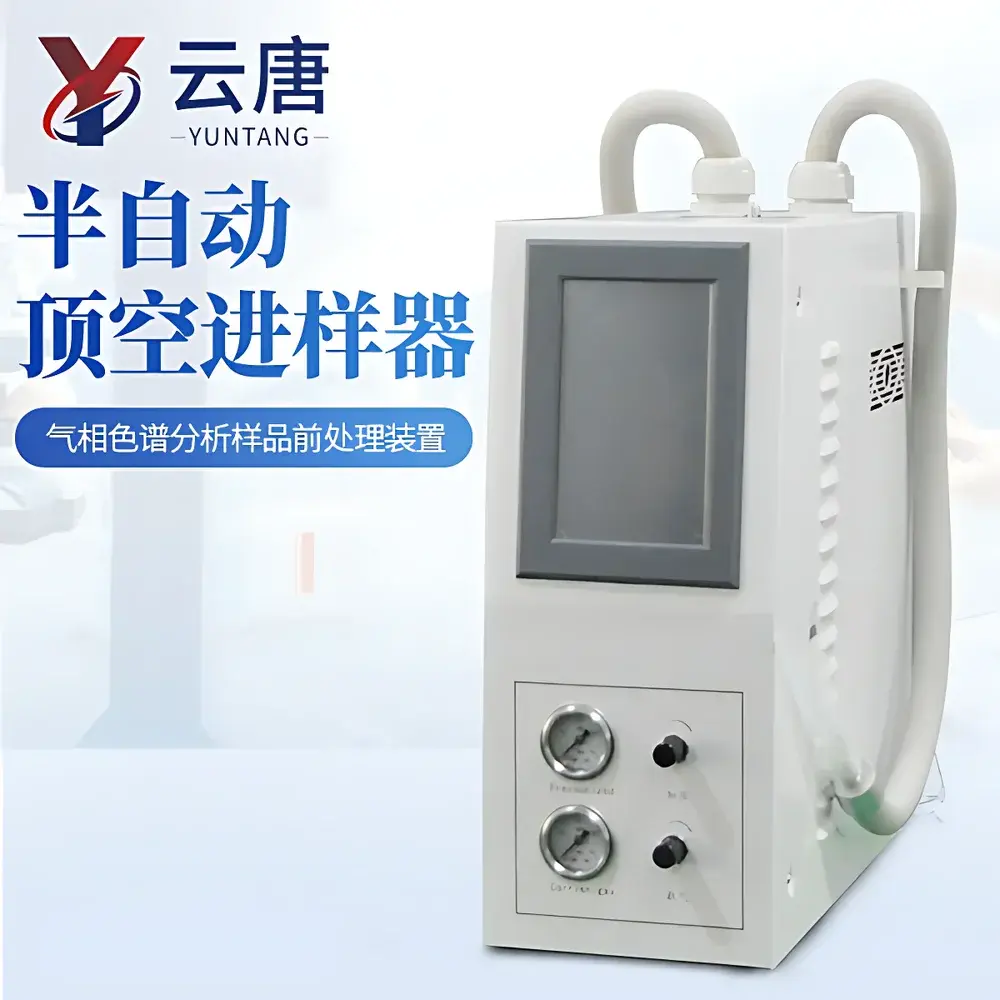
Yuntang YT-D-12 Semi-Automatic Headspace Sampler
| Brand | Yuntang |
|---|---|
| Origin | Shandong, China |
| Manufacturer Type | Direct Manufacturer |
| Country of Origin | China |
| Model | YT-D-12 |
| Heating Zones | 3 (Headspace Oven, Transfer Line, Six-Port Valve) |
| Temperature Range (Headspace Oven) | Ambient to 260 °C (1 °C adjustable increment) |
| Temperature Range (Transfer Line & Valve) | Ambient to 220 °C (1 °C adjustable increment) |
| Temperature Accuracy | ±0.1 °C |
| Sample Capacity | 12 × 10 mL or 20 mL vials |
| Pressurization Range | 0–0.4 MPa (continuously adjustable) |
| Precision (RSD) | <1.5% for 200 ppm ethanol in water |
| Power Consumption | 1000 W |
| Input Voltage | AC 220 V, 50 Hz |
| Dimensions (W×D×H) | 420 mm × 180 mm × 500 mm |
| Weight | ~17.5 kg |
Overview
The Yuntang YT-D-12 Semi-Automatic Headspace Sampler is a dedicated sample introduction system engineered for gas chromatography (GC) analysis of volatile and semi-volatile organic compounds in solid, liquid, or heterogeneous matrices. It operates on the principle of phase equilibrium partitioning: analytes are thermally equilibrated between the sample matrix and the headspace vapor phase above it; the vapor is then pressurized and transferred directly into the GC injector via a heated transfer line and precision six-port valve. This technique eliminates solvent use, minimizes matrix interference, and significantly reduces carryover compared to direct liquid injection—making it particularly suitable for residual solvent analysis, environmental monitoring (e.g., VOCs in water or soil), pharmaceutical stability testing (ICH Q2(R2)), and forensic toxicology workflows.
Key Features
- Triple-zone independent temperature control: headspace oven (ambient to 260 °C), transfer line (ambient to 220 °C), and six-port valve (ambient to 220 °C), each with ±0.1 °C accuracy and 1 °C programmable resolution.
- 12-position sample carousel accommodating standard 10 mL or 20 mL crimp-top headspace vials—compatible with widely adopted ASTM D3699, USP <467>, and ISO 11843-2 vial formats.
- Digitally controlled pressurization system (0–0.4 MPa, continuously adjustable) ensures consistent vial pressurization across all positions, critical for reproducible quantitative transfer.
- Integrated LCD interface displays real-time operational parameters—including method configuration, elapsed run time, ambient temperature, and date/time stamp (YYYY-MM-DD HH:MM)—enabling traceable manual operation without external PC dependency.
- Robust thermal architecture with rapid heat-up and stable soak performance supports method development under ISO/IEC 17025-compliant validation protocols, including repeatability assessment per ICH Q2(R2) guidelines.
Sample Compatibility & Compliance
The YT-D-12 supports aqueous, viscous, particulate-laden, and polymer-bound samples—including pharmaceutical excipients, food extracts, wastewater, and packaged consumer goods. Its inert, heated flow path (from vial crimp seal to GC inlet) prevents condensation and adsorption losses of polar or high-boiling volatiles. The device meets fundamental design requirements for GLP-compliant laboratories: all temperature setpoints and run timestamps are locally logged and viewable on-device; no proprietary firmware lock-in impedes audit readiness. While not certified to UL/CE standards out-of-the-box, its electrical architecture (AC 220 V, 50 Hz, 1000 W) aligns with industrial-grade instrumentation safety expectations in ISO 13849-1 Category 3 environments.
Software & Data Management
As a semi-automatic platform, the YT-D-12 does not include embedded data acquisition or instrument control software. It is designed for seamless integration with third-party GC systems (Agilent, Thermo Fisher, Shimadzu, PerkinElmer) via standard TTL or relay-triggered start signals. All method parameters—including equilibration time, oven ramp rates, pressurization duration, and loop fill volume—are manually configured on-device and retained in non-volatile memory. For laboratories requiring full 21 CFR Part 11 compliance, external LIMS or chromatography data systems (CDS) such as OpenLab CDS or Chromeleon may be used to log method execution metadata, operator ID, and audit trails—provided the GC controller initiates the sampler trigger and records the corresponding event timestamp.
Applications
- Residual solvent quantification in active pharmaceutical ingredients (APIs) and final drug products per USP <467> and ICH Q3C(R8).
- Volatile organic compound (VOC) profiling in drinking water, groundwater, and leachate per EPA Method 502.2 and ISO 15681-1.
- Flavor and fragrance release kinetics in beverages, dairy, and confectionery products.
- Off-gas analysis from packaging materials (e.g., PET bottles, laminated films) per ASTM F2496.
- Quality control of ethanol content in disinfectants, hand sanitizers, and tinctures per pharmacopoeial monographs.
FAQ
Is the YT-D-12 compatible with split/splitless GC injectors?
Yes—the heated transfer line and pressure-controlled injection mechanism ensure compatibility with both split and splitless modes, provided the GC inlet temperature is ≥ transfer line temperature and the septum purge flow is optimized to avoid dilution.
Can it handle viscous or sediment-containing samples?
Yes—headspace analysis inherently bypasses physical handling of the matrix; however, excessive particulates may compromise vial crimp seal integrity. Pre-filtration or centrifugation is recommended for slurry-like samples prior to vial loading.
What maintenance is required for long-term precision?
Routine cleaning of the six-port valve rotor seal and transfer line ferrules every 200–300 runs is advised; replacement of silicone/PTFE septa after each batch; and annual calibration verification of all three temperature zones using NIST-traceable dry-block calibrators.
Does it support dynamic headspace (purge-and-trap) mode?
No—the YT-D-12 is strictly a static headspace sampler. Dynamic headspace functionality requires additional hardware (e.g., purge gas manifold, trap cooling, desorption oven), which is outside its mechanical and firmware scope.
Related Products





