
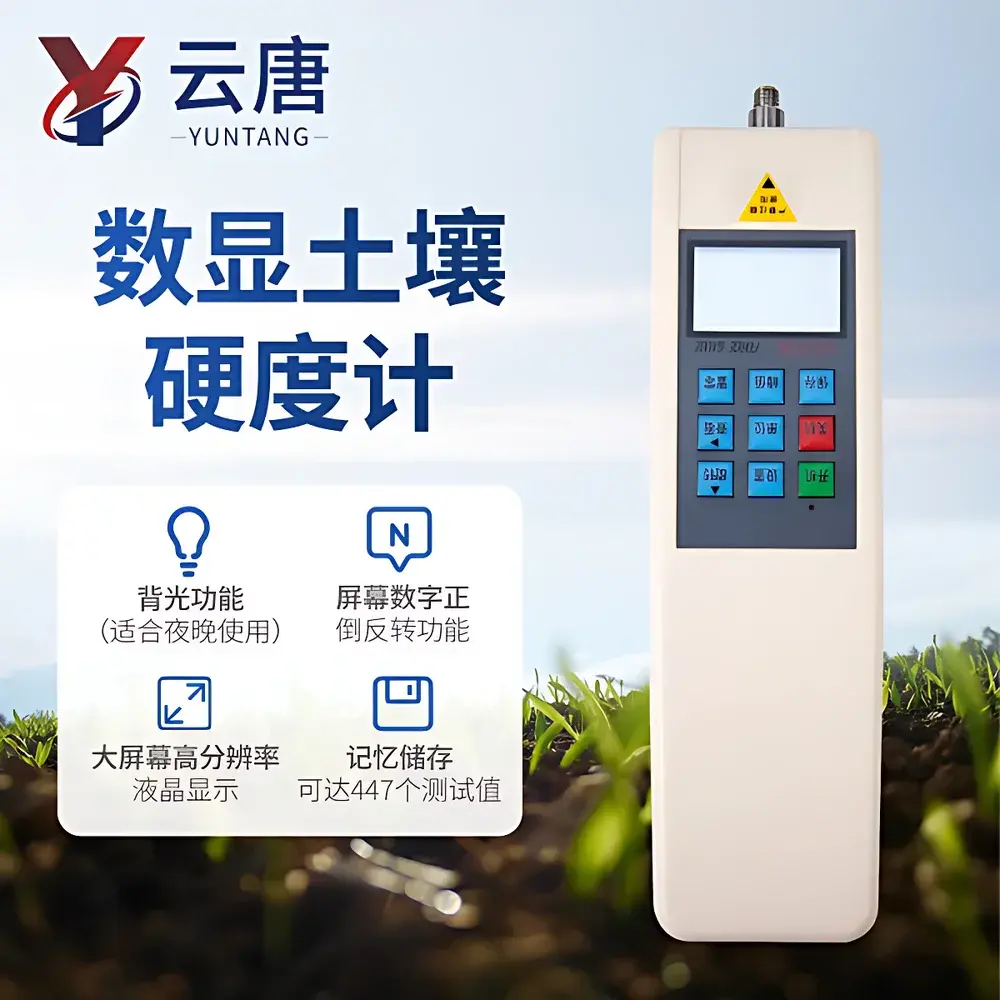
Yuntang YT-JSD2 Digital Soil Penetrometer
| Brand | Yuntang |
|---|---|
| Origin | Shandong, China |
| Manufacturer Type | OEM Manufacturer |
| Country of Origin | China |
| Model | YT-JSD2 |
| Max Load | 100 kg (also displayable in N and lb) |
| Resolution | 0.01 kg |
| Accuracy | ±1% FS |
| Measurement Depth | 0–450 mm |
| Power Supply | Rechargeable Ni-MH battery pack |
| Battery Runtime | 6–8 hours continuous operation |
| Temperature Drift | 0.2 µV/°C (0–60 °C) |
| Zero Drift | ≤0.1 %FS / 8 h |
| Calibration Range | Full-scale calibration |
| Operating Temperature | 0–60 °C |
| Operating Humidity | ≤80 % RH (non-condensing) |
| Overload Capacity | 150 % FS |
| Data Storage | 447 values |
| Auto-Power-Off | Adjustable from 10 to 90 minutes |
| Gravity Compensation | User-configurable local g-value |
| Peak Hold & Auto-Peak Modes | Yes |
| USB Data Export | Yes |
| Backlit LCD Display with Invert Function | Yes |
| Battery Level Indicator | 3-level icon |
Overview
The Yuntang YT-JSD2 Digital Soil Penetrometer is a field-deployable, microprocessor-controlled mechanical penetrometer engineered for quantitative assessment of soil mechanical resistance—commonly referred to as soil compaction or soil hardness. It operates on the principle of axial force penetration: a standardized stainless-steel probe (typically 1.27 cm diameter, conical tip angle 30°) is driven vertically into undisturbed soil at a controlled rate (manually or via optional motorized drive), and the resistive force required to advance the probe over a defined depth interval is measured in real time using a high-stability load cell. This measurement—expressed in kilogram-force (kgf), newtons (N), or pounds-force (lbf)—serves as a direct proxy for soil bulk density, shear strength, and root growth impedance. The instrument complies with widely referenced field protocols including ASTM D5321 (Standard Test Method for Determining the Angle of Internal Friction of Soils by Direct Shear) and ISO 23470:2007 (Soil quality — Field measurement of soil penetration resistance). Its design emphasizes repeatability under variable ambient conditions, making it suitable for longitudinal monitoring across agricultural plots, ecological restoration sites, and construction-related soil verification.
Key Features
- High-resolution load sensing: 0.01 kg resolution with ±1 % full-scale accuracy, traceable via internal full-span calibration routine.
- Multi-unit display capability: Real-time switching among kgf, N, and lbf without recalibration.
- User-adjustable gravitational acceleration compensation: Enables geographically precise force normalization for field deployments across diverse latitudes and elevations.
- Dual peak capture modes: Manual peak hold for instantaneous reading retention; programmable auto-peak duration (1–30 seconds) for transient resistance events during dynamic probing.
- Backlit, invertible LCD interface: Supports low-light fieldwork and accommodates operator preference or ergonomic constraints.
- Robust data management: On-device storage of up to 447 discrete penetration readings, each tagged with timestamp and depth index (where depth encoder is integrated).
- USB-based data export: Compatible with Windows-based analysis software for post-processing, statistical summarization (e.g., mean resistance per 5-cm depth layer), and spatial interpolation mapping.
- Intelligent power architecture: Dual-mode supply—rechargeable Ni-MH battery pack (4–6 h charging time, 6–8 h field runtime) and universal AC adapter (100–240 VAC, 50/60 Hz), enabling global deployment without voltage conversion hardware.
- Environmental resilience: Rated for operation from 0 °C to +60 °C and ≤80 % RH (non-condensing); thermal drift compensated to ≤0.2 µV/°C over full range.
Sample Compatibility & Compliance
The YT-JSD2 is validated for use in mineral soils (sand, loam, clay), organic-rich topsoils, and compacted subsoils. It is not intended for saturated, frozen, or highly gravelly matrices (>15 % stones >2 cm), where probe deflection or inconsistent contact may compromise measurement fidelity. Probe insertion requires minimal site preparation—no pre-drilling unless encountering surface crust or stony horizons. The device meets CE marking requirements for electromagnetic compatibility (EN 61326-1) and safety (EN 61010-1). While not certified to GLP or GMP standards out-of-the-box, its audit-ready features—including timestamped data logs, user-defined gravity input, and full-scale calibration traceability—support integration into ISO/IEC 17025-accredited environmental testing workflows when paired with documented SOPs and periodic external verification.
Software & Data Management
Data retrieval is performed via standard USB 2.0 interface using vendor-provided PC application (Windows 7–11 compatible). The software supports batch export to CSV and Excel formats, depth-resolved profile visualization, and statistical summary generation (mean, SD, CV, max/min per layer). All stored records include probe depth (if depth encoder option installed), test date/time, unit selection, and applied g-value. Audit trail functionality includes automatic logging of calibration events and battery status at time of measurement. The system does not implement FDA 21 CFR Part 11 electronic signature controls; however, raw data files are unencrypted and human-readable, facilitating third-party validation and long-term archival in institutional repositories.
Applications
- Agricultural soil health assessment: Mapping compaction layers to guide subsoiling, tillage optimization, and cover crop selection.
- Ecological restoration monitoring: Quantifying recovery of soil mechanical properties following reclamation or erosion control interventions.
- Forestry site evaluation: Screening root zone resistance prior to afforestation or thinning operations.
- Civil engineering QA/QC: Verifying compaction efficacy in engineered fill, road base, or landfill cap soils per ASTM D698 or D1557.
- Research-grade phenotyping: Correlating soil resistance profiles with root architecture traits in controlled-environment or field trials.
- Environmental impact studies: Detecting anthropogenic compaction gradients near access roads, machinery traffic zones, or livestock concentration areas.
FAQ
What is the recommended probe insertion speed for consistent results?
Manual insertion should maintain a steady rate of approximately 2–3 cm/s. Excessive speed introduces inertial artifacts; too-slow advancement increases soil relaxation effects. Motorized drive accessories (optional) ensure compliance with ISO 23470’s 1 cm/s nominal rate.
Can the YT-JSD2 be used in wet or saturated soils?
It is not recommended for saturated conditions. Water lubrication reduces apparent resistance, and probe slippage may occur. Wait until soil moisture reaches field capacity (typically 1–3 days after rainfall or irrigation) for representative measurements.
How often should calibration be performed?
Perform full-scale calibration before first use, after any physical impact or repair, and at least once per field season. Annual verification against NIST-traceable deadweight standards is advised for regulatory or publication-grade work.
Is depth measurement integrated or optional?
The base YT-JSD2 model relies on manual depth marking. An optional rotary encoder module (YT-JSD2-DE) provides automatic depth tracking synchronized with force acquisition, enabling true depth-resolved resistance profiles.
Does the device support Bluetooth or wireless data transfer?
No. Data transfer is exclusively via USB cable. Wireless connectivity is omitted to preserve battery life, reduce EMI susceptibility in field environments, and ensure deterministic data integrity.







