
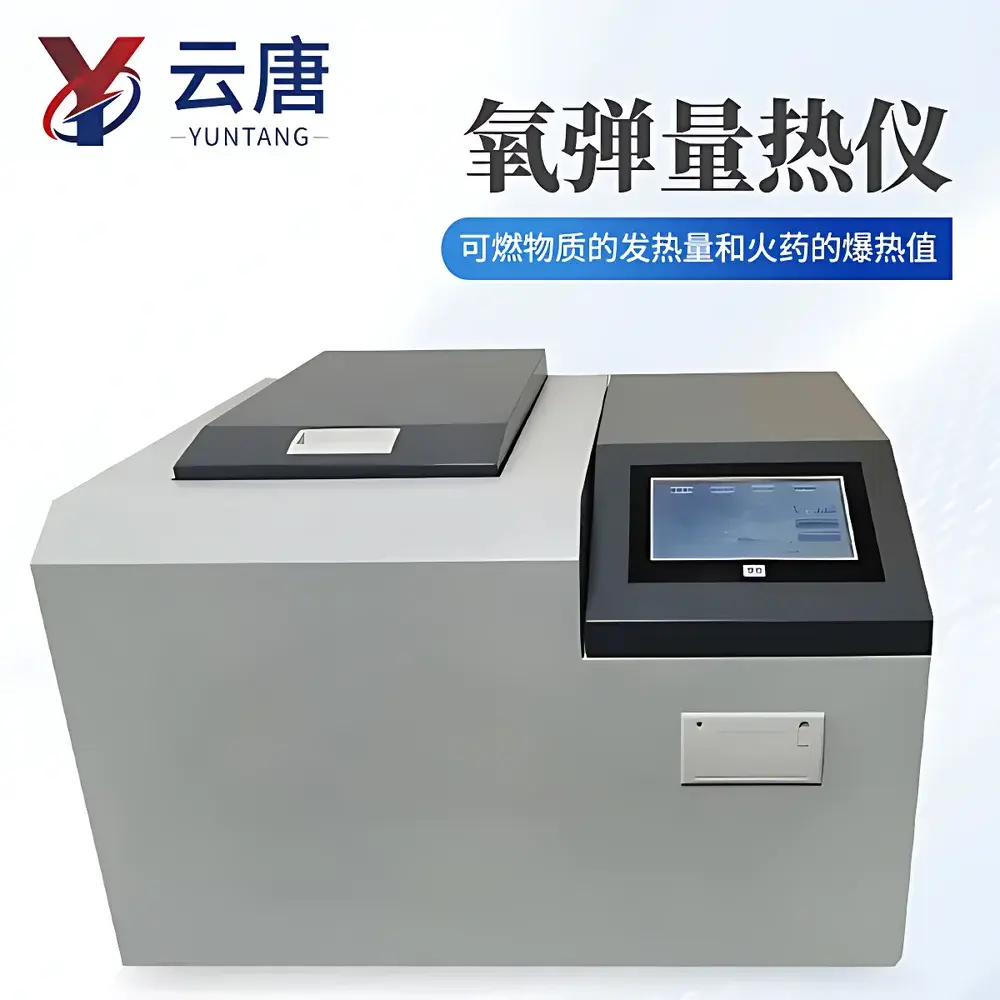

Yuntang YT-LR1 Automated Oxygen Bomb Calorimeter
| Brand | Yuntang |
|---|---|
| Origin | Shandong, China |
| Manufacturer Type | Direct Manufacturer |
| Country of Origin | China |
| Model | YT-LR1 |
| Price Range | USD 1,600 – 5,300 (FOB) |
| Heat Capacity | 10,500 J/K |
| Ambient Temperature Range | 5–35 °C |
| Ignition Voltage | 24 V DC |
| Ignition Duration | 5 s |
| Temperature Measurement Range | 0–40 °C |
| Temperature Resolution | 0.0001 K |
| Power Consumption | ≤80 W |
| Supply Voltage | AC 220 V ±10 %, 50 Hz ±1 Hz |
| Net Weight | 35 kg |
| Dimensions (W×D×H) | 420 × 600 × 470 mm |
| Packaged Weight | 45 kg |
| Packaged Dimensions | 470 × 650 × 500 mm |
Overview
The Yuntang YT-LR1 Automated Oxygen Bomb Calorimeter is a precision instrument engineered for the accurate determination of gross calorific value (GCV), also known as higher heating value (HHV), of solid and liquid combustible materials—primarily coal, coke, biomass fuels (e.g., wood, agricultural residues), feedstuffs, chemical compounds, and propellants. It operates on the fundamental principle of adiabatic or near-adiabatic bomb calorimetry: a precisely weighed sample is combusted in a high-pressure oxygen atmosphere inside a stainless-steel oxygen bomb; the heat released is fully absorbed by a known mass of water in a thermally insulated jacket, and the resulting temperature rise is measured with high-resolution thermometry. The instrument applies standardized thermal correction algorithms—including the widely adopted Regnault-Pfaundler or ASTM D240-based cooling correction—to compensate for heat exchange between the calorimeter system and its surroundings, ensuring compliance with ISO 1928, ASTM D5865, and GB/T 213–2008.
Key Features
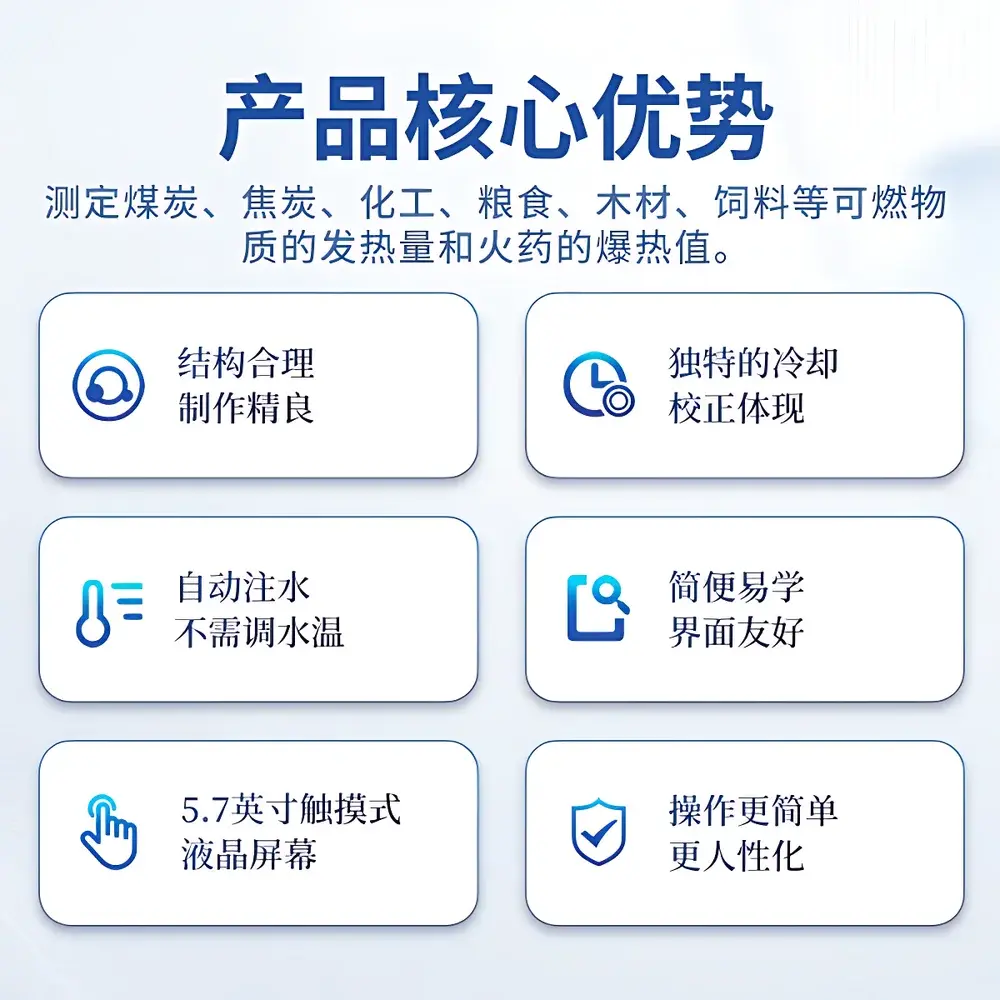
- Integrated 5.7-inch resistive touchscreen display with CRT-grade optical film and multi-layer protective coating—enabling high contrast, low reflectivity, 90% active touch area, and ≥10-year operational lifespan without external PC dependency.
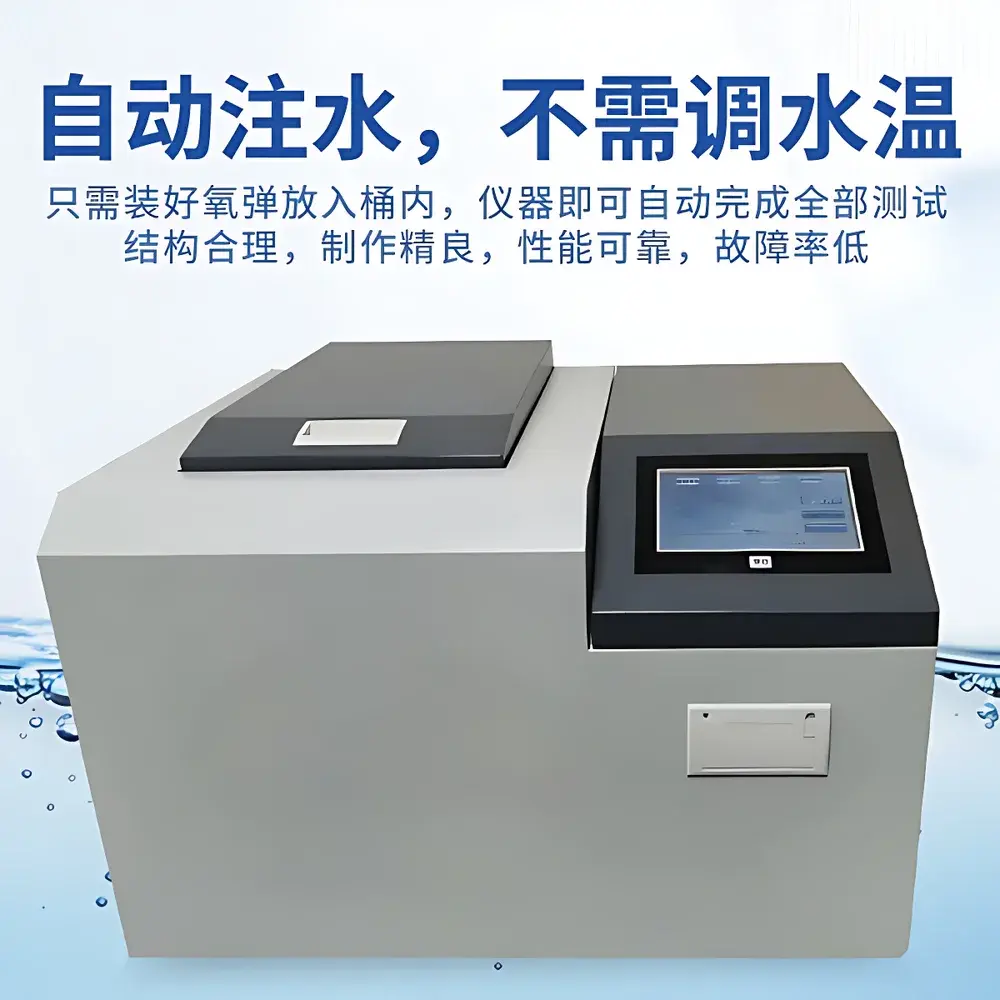
- Fully automated water handling: automatic filling, leveling, and drainage eliminate manual water temperature adjustment; users only load the sealed oxygen bomb into the bucket to initiate the full test sequence.
- High-stability thermal architecture: calibrated heat capacity of 10,500 J/K ensures minimal drift across extended operation; optimized insulation and thermal shielding maintain internal temperature stability within ±1 K during measurement cycles.
- Robust ignition subsystem: 24 V DC pulse delivery for 5 seconds ensures reliable, repeatable combustion initiation—even for low-reactivity samples such as anthracite or aged explosives.
- Ultra-high temperature resolution: 0.0001 K digital thermometry enables sub-millikelvin detection of ΔT, directly contributing to <0.15% RSD in replicate GCV measurements per GB/T 213–2008 requirements.
- Self-contained firmware with embedded error-handling logic, intuitive Chinese/English bilingual interface, and context-sensitive prompts—reducing operator training time and minimizing procedural missteps.
Sample Compatibility & Compliance
The YT-LR1 accommodates standard 305 mm³ or 250 mL stainless-steel oxygen bombs compliant with ASTM D5865 and GB/T 213 specifications. It supports heterogeneous solid fuels—including bituminous coal, lignite, petroleum coke, sawdust pellets, corn stover, and animal feed—as well as liquid hydrocarbons and nitrocellulose-based propellants. All measurement protocols align with internationally recognized standards: ISO 1928 (Solid mineral fuels — Determination of gross calorific value), ASTM D5865 (Standard Test Method for Gross Calorific Value of Coal and Coke), and GB/T 213–2008 (Method for Determination of Calorific Value of Coal). The system meets GLP documentation requirements through timestamped, non-editable result logs stored locally; optional RS232/USB output enables integration with LIMS platforms supporting 21 CFR Part 11 audit trails.
Software & Data Management
The onboard firmware provides complete test lifecycle control—from sample ID entry and moisture/ash input (for net calorific value derivation) to real-time ΔT plotting, correction coefficient application, and final GCV reporting in MJ/kg or kcal/kg. Each test record includes ambient temperature, ignition status, water equivalent, temperature rise, and calculated uncertainty. Data export is supported via USB flash drive in CSV format, preserving column headers compatible with Excel, MATLAB, or statistical process control (SPC) software. No proprietary drivers or cloud dependencies are required; all calibration constants and method parameters reside in protected EEPROM memory with write-protection logic to prevent accidental modification.
Applications
This calorimeter serves quality control laboratories in coal mining enterprises, power generation facilities, cement plants, and national commodity inspection agencies requiring traceable, auditable energy content data. It is routinely deployed for: (1) incoming coal lot acceptance testing per contractual GCV thresholds; (2) optimization of boiler combustion efficiency; (3) regulatory reporting under China’s Energy Conservation Law and IEA coal quality databases; (4) R&D of alternative fuels including torrefied biomass and waste-derived fuels; and (5) safety-critical evaluation of energetic materials where precise explosive heat output must be quantified per MIL-STD-1751 or GB/T 213–2008 Annex C.
FAQ
What standards does the YT-LR1 comply with for coal analysis?
It conforms to GB/T 213–2008, ASTM D5865, and ISO 1928 for gross calorific value determination.
Is external computer hardware required to operate the instrument?
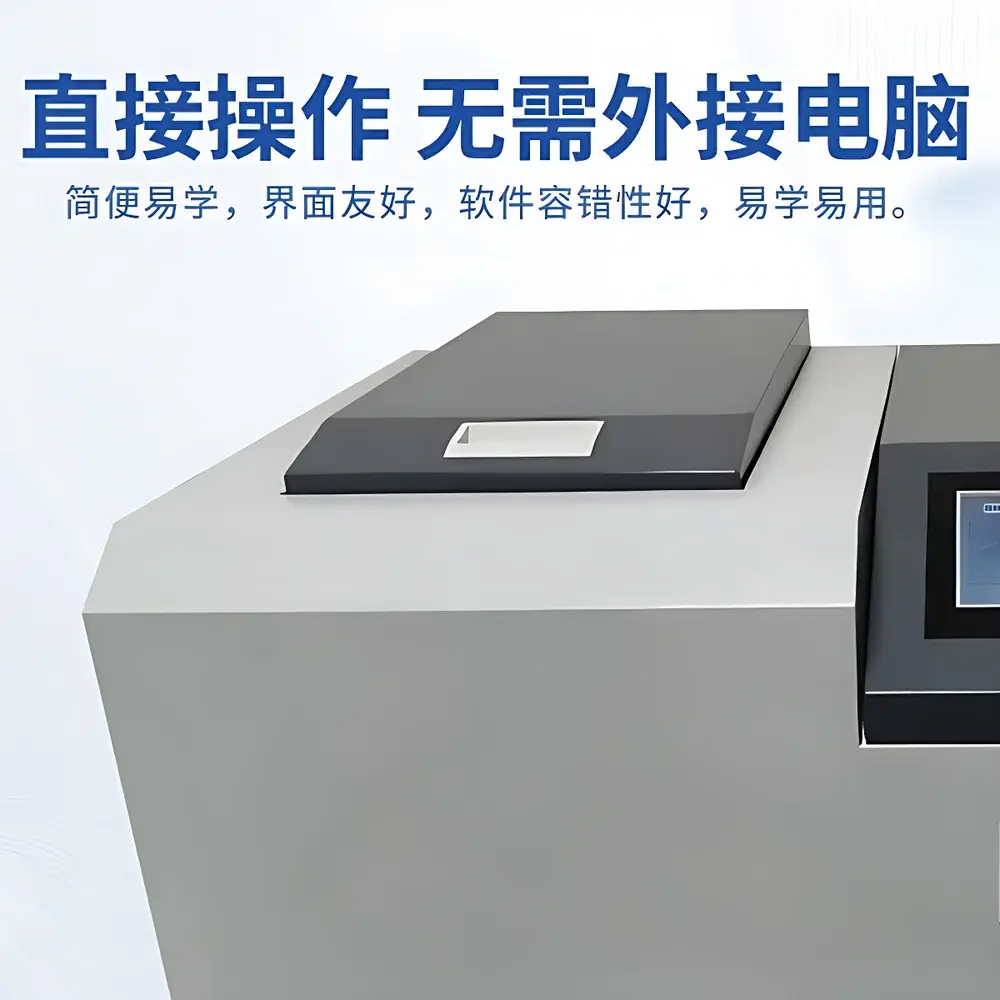
No—the integrated touchscreen interface and embedded controller enable standalone operation without any PC or peripheral devices.
How is thermal drift corrected during long-duration testing?
The system employs a dynamic cooling correction algorithm based on the temperature decay curve post-combustion, referenced to the initial and final equilibrium periods, in accordance with ASTM D240 methodology.
Can the instrument measure net calorific value (NCV)?
Yes—when user-input values for total moisture, hydrogen, and ash content are provided, the firmware automatically calculates NCV using the standard IAPWS-derived formula per ISO 1928 Annex B.
What maintenance is required for the oxygen bomb and ignition circuit?
The bomb requires periodic hydrostatic testing per manufacturer guidelines (typically every 2 years); the ignition electrodes should be cleaned after every 50 tests, and the O-rings replaced biannually or after visible compression set.




