
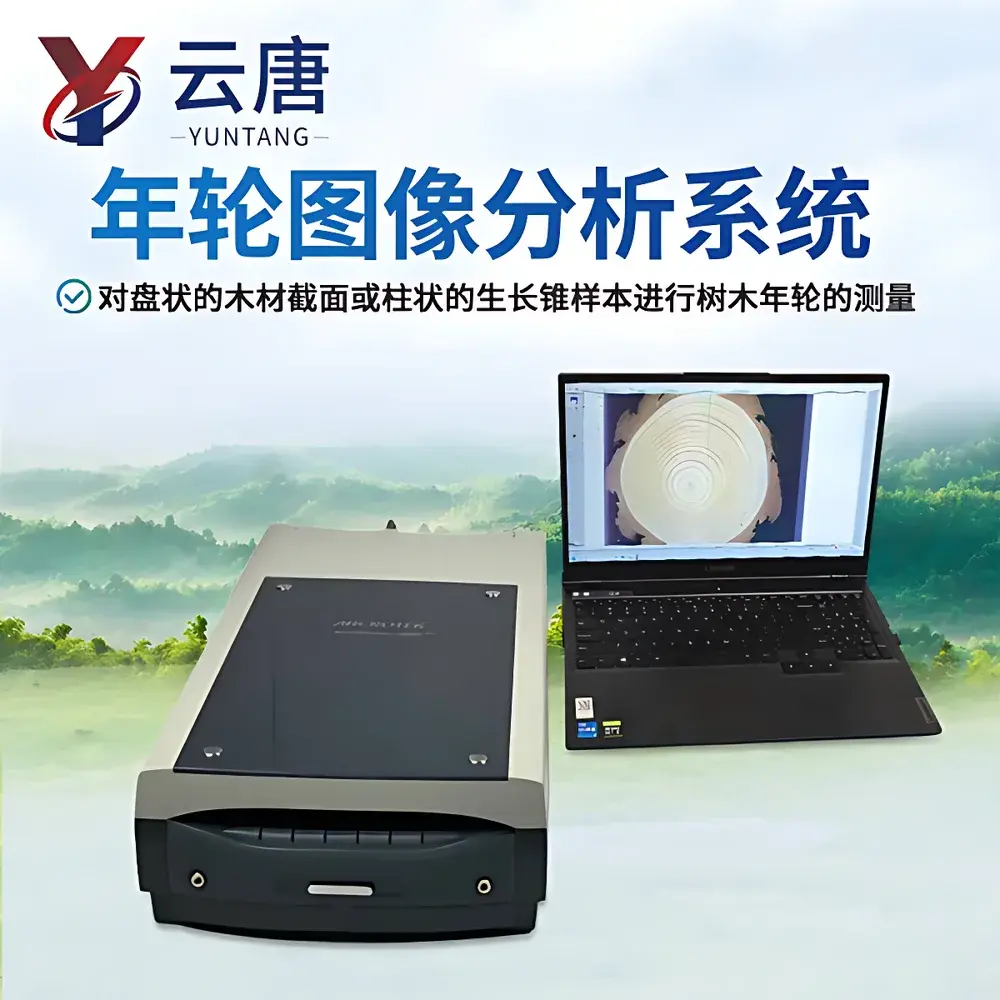

Yuntang YT-NLA3 Dendrochronological Analysis System for Tree-Ring Measurement and Growth Ring Quantification
| Brand | Yuntang |
|---|---|
| Origin | Shandong, China |
| Manufacturer Type | Direct Manufacturer |
| Region of Origin | Domestic (China) |
| Model | YT-NLA3 |
| Price | USD 6,300 (FOB) |
Overview
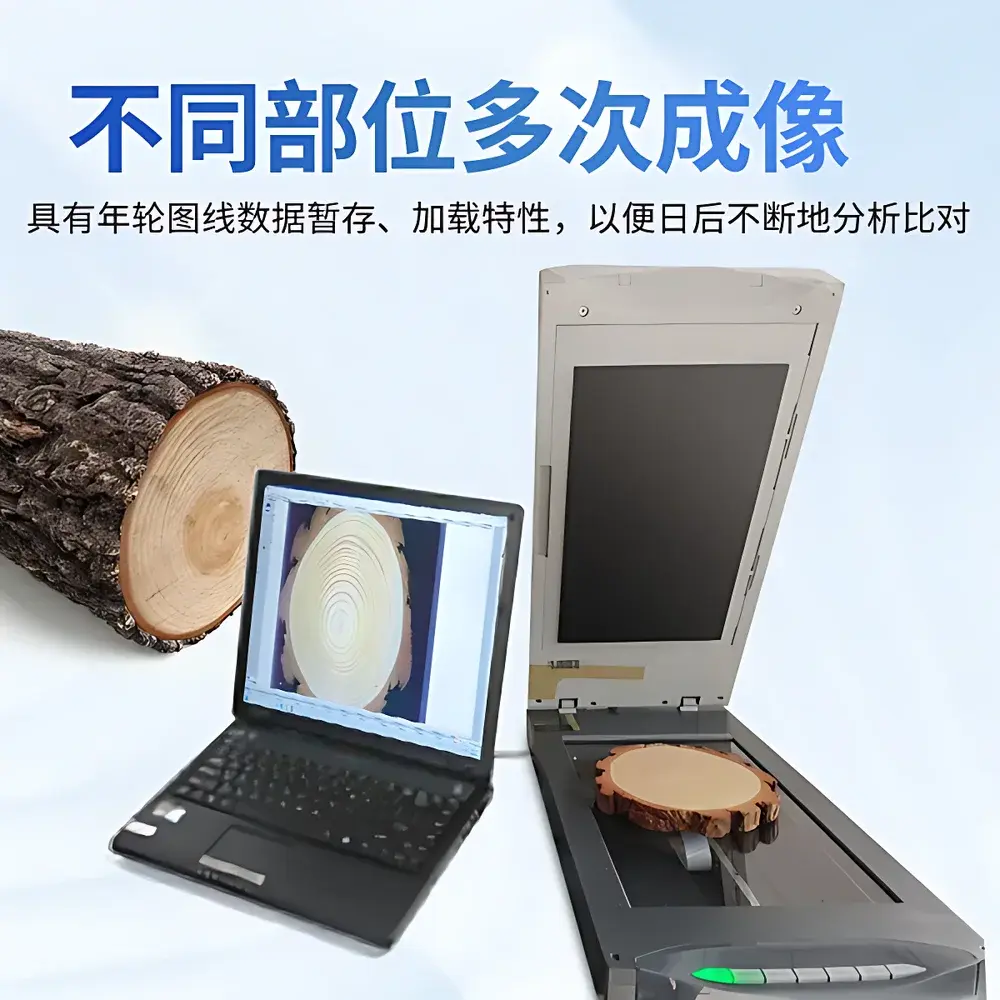
The Yuntang YT-NLA3 Dendrochronological Analysis System is a precision image-based measurement platform engineered for high-resolution tree-ring analysis of wood cross-sections and increment cores. It operates on the principle of digital optical densitometry and geometric segmentation of grayscale intensity profiles along user-defined or algorithmically optimized radial paths. Designed in accordance with dendroecological best practices, the system supports both semi-automated ring detection—based on local contrast gradients and edge continuity—and manual refinement workflows essential for species with indistinct boundaries, false rings, or compression wood artifacts. The instrument integrates calibrated flatbed scanning hardware with a dedicated analytical software suite to deliver traceable, reproducible measurements compliant with ITRDB (International Tree-Ring Data Bank) metadata standards and FAO Forestry Guidelines for growth ring quantification.
Key Features
- Two-tier scanning configuration: A4-format scanner (22 × 30 cm scan area, 4800 DPI resolution, 5 µm minimum resolvable feature size) and A3-format scanner (31 × 44 cm scan area, 2400 DPI, 11 µm resolution), both equipped with optical calibration targets and XY-axis independent scaling correction
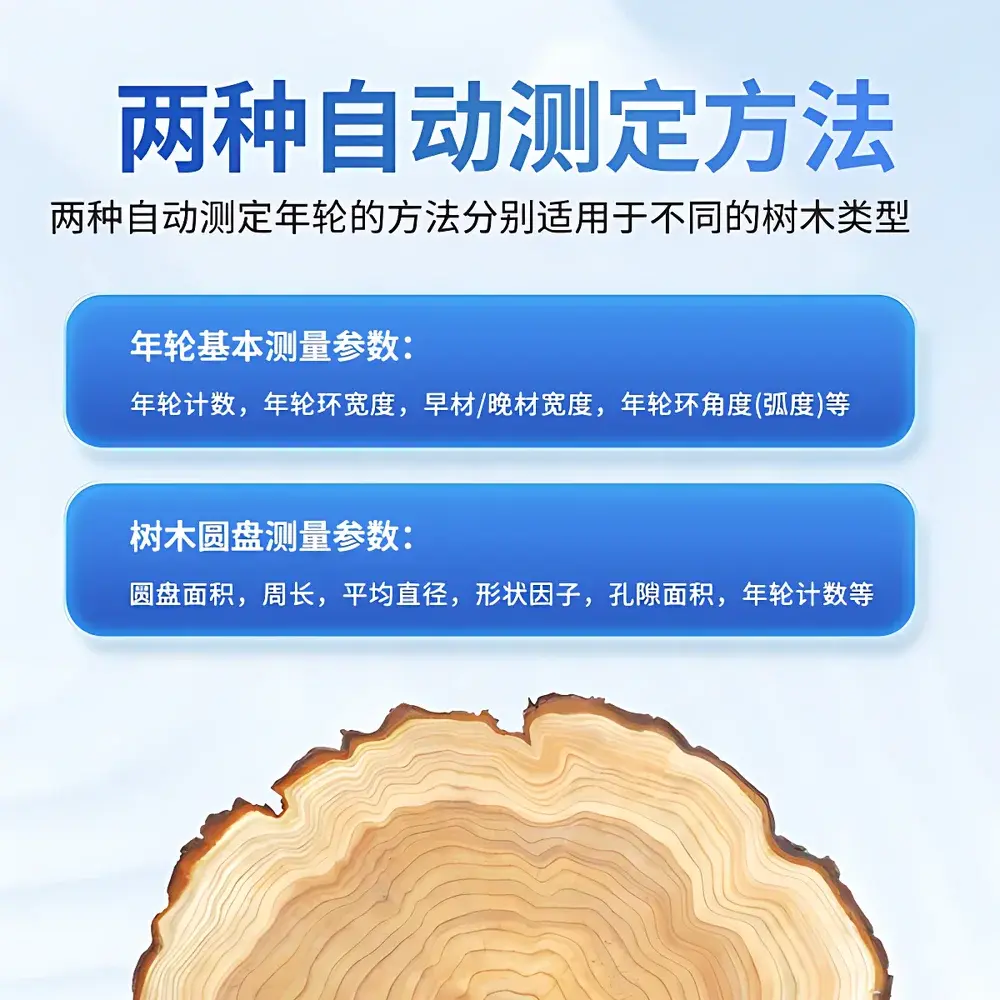
- Dual-mode ring detection algorithms: Intensity-gradient thresholding for diffuse-pored hardwoods and edge-continuity interpolation for conifers with abrupt latewood transitions
- Interactive path editing tools including endpoint snapping, segment deletion/insertion, tangent-line auto-fitting across cracks or resin canals, and angular deviation compensation for oblique core sections
- Sub-0.2 mm ring width resolution capability, validated against NIST-traceable micrometer standards and certified reference wood samples (e.g., NOAA/NCEI dendrochronology test sets)
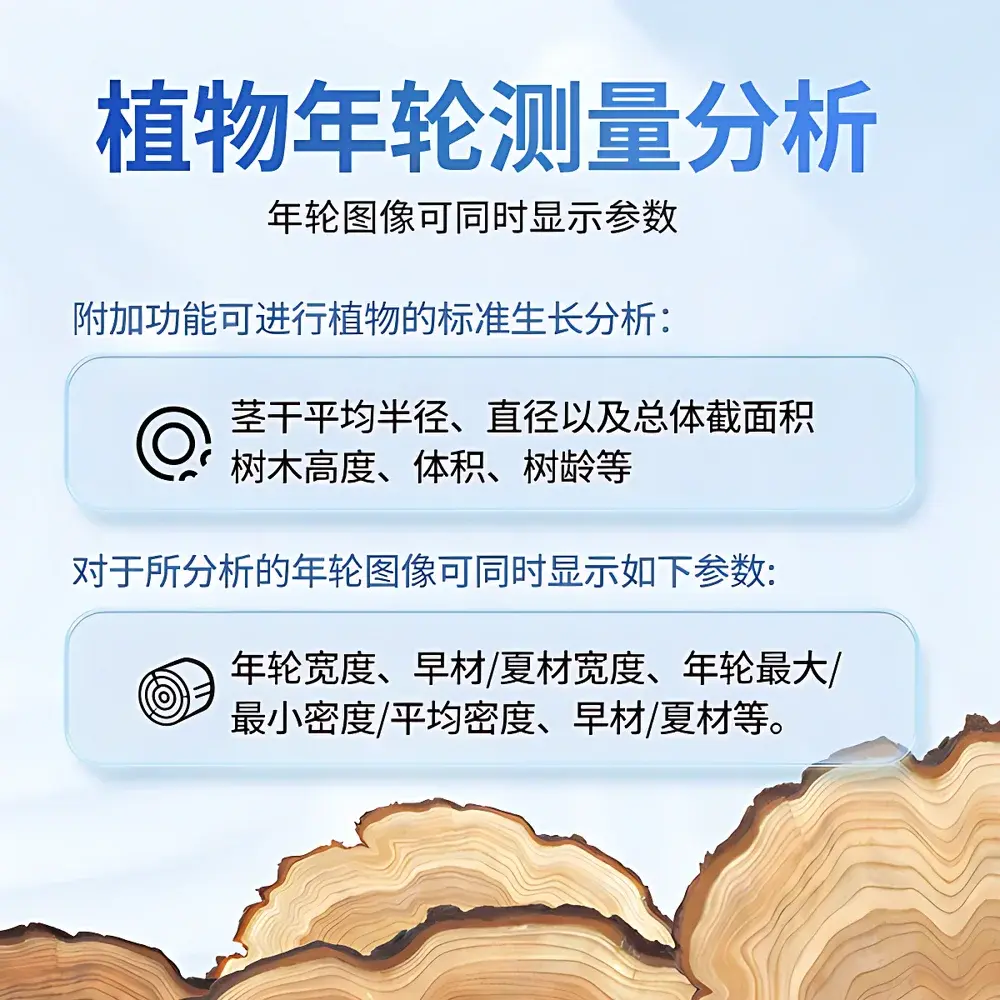
- Integrated densitometric analysis: per-ring maximum, minimum, and mean grayscale reflectance values; earlywood/latewood boundary delineation; relative density ratio calculation
- Structural morphometrics module: disk area, perimeter, mean radius, diameter at breast height (DBH) estimation, shape factor (circularity index), porosity mapping, and pith-centered coordinate transformation
Sample Compatibility & Compliance
The YT-NLA3 accommodates solid wood disks up to 44 cm in diameter and increment cores (1–12 mm diameter) mounted in custom aluminum core holders with axial alignment guides. Sample preparation follows ISO 13067:2015 (Wood — Determination of growth ring width) and ASTM D143-22 (Standard Test Methods for Small Clear Specimens of Timber). Software output formats—including CSV, Excel (.xlsx), TIFF, PNG, BMP, and JPEG—support long-term archival per FAO’s Forest Resource Assessment (FRA) data submission protocols. All measurement logs include embedded timestamps, operator ID fields, and audit-ready metadata tags compliant with GLP documentation requirements for environmental research applications.
Software & Data Management
The proprietary DendroSoft™ v4.2 analysis engine provides cross-dating readiness via built-in COFECHA-compatible chronology builder, detrending options (negative exponential, spline, ARSTAN-style), and correlation matrix visualization. It supports batch processing of ≥100 images with customizable QC flags (e.g., ring count variance > ±3%, boundary confidence score < 0.75). Each session generates an encrypted .dendro project file containing raw image references, path coordinates, measurement vectors, and user annotations. Export modules produce publication-ready figures (SVG/PDF), statistical summaries (mean sensitivity, Gini coefficient, autocorrelation), and ITRDB-compliant ASCII files. Audit trails record all edits—including ring insertion/deletion events—with operator signature and timestamp, satisfying 21 CFR Part 11 electronic record integrity criteria.
Applications
This system serves quantitative dendrochronological research in forest ecology, paleoclimatology, timber provenance studies, and post-disturbance recovery assessment. Typical use cases include: reconstructing historical drought indices from Pinus ponderosa chronologies; validating fire-scar dating in mixed-conifer stands; calibrating UAV-derived canopy height models against ground-truthed age structures; analyzing urban tree stress responses using street-side Acer platanoides cores; and supporting CITES timber forensics through anatomical ring-pattern matching. It is routinely deployed by national forest inventories (e.g., China State Forestry Administration), university dendro labs (e.g., ETH Zurich, University of Arizona Laboratory of Tree-Ring Research), and UNESCO biosphere reserve monitoring programs.
FAQ
Does the YT-NLA3 support automated cross-dating?
Yes—the software includes a COFECHA-integrated cross-dating assistant that computes interseries correlation coefficients, identifies mismatched years, and highlights potential misdated rings based on pointer-year synchronization.
Can it process scanned images from third-party scanners?
Yes—TIFF, PNG, BMP, and JPEG files are fully supported, provided they contain embedded or separately supplied calibration scale information (µm/pixel) and orientation metadata.
Is the system validated for regulatory submissions?
The measurement traceability framework—including hardware calibration certificates, software version control (v4.2.1), and audit-log export—meets documentation standards required for peer-reviewed publications and national forest inventory reporting under GB/T 26424-2010 (Chinese National Standard for Forest Inventory).







