
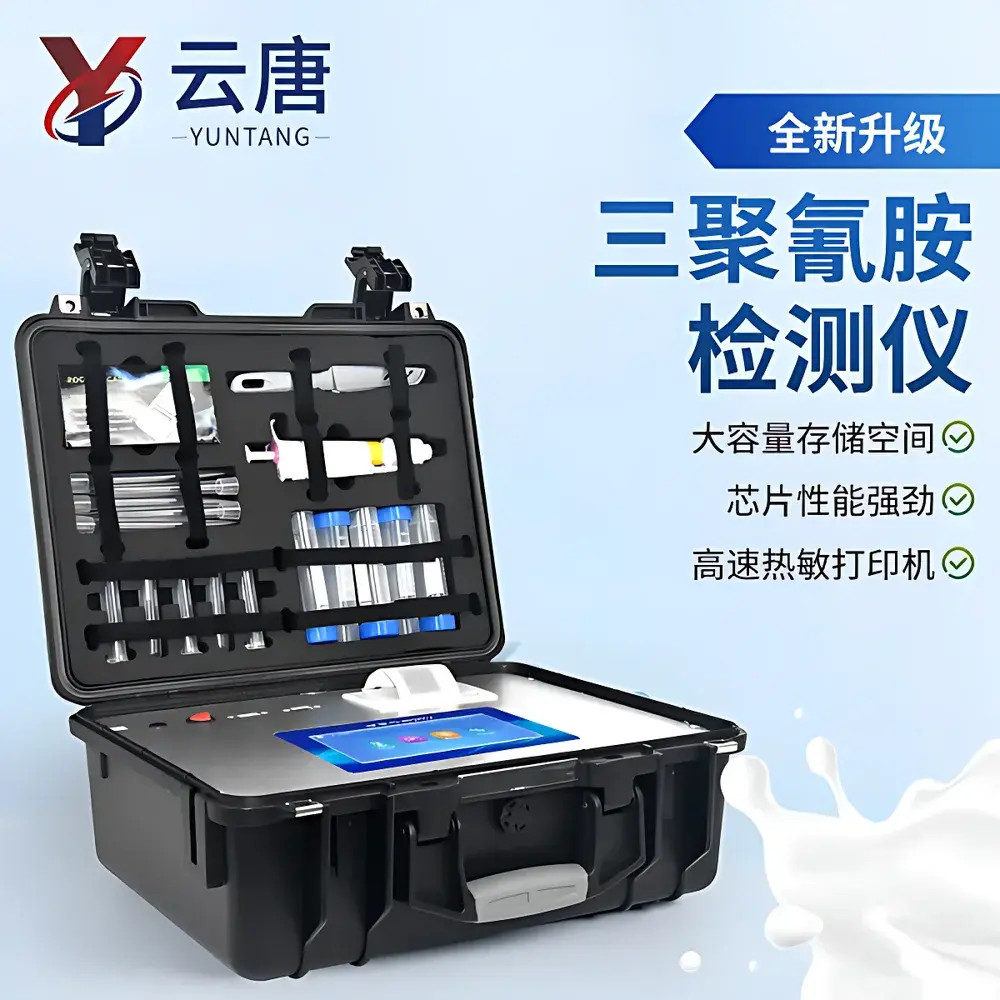
Yuntang YT-SJ12 Colloidal Gold-Based Rapid Melamine Analyzer for Food and Feed Samples
| Brand | Yuntang |
|---|---|
| Origin | Shandong, China |
| Manufacturer Type | Direct Manufacturer |
| Regional Classification | Domestic (China) |
| Model | YT-SJ12 |
| Price | USD 850 (approx.) |
Overview
The Yuntang YT-SJ12 is a field-deployable, colloidal gold immunochromatographic assay (CGIA) analyzer engineered for rapid, semi-quantitative detection of melamine in complex food and feed matrices. It operates on the principle of competitive immunoassay: melamine in the sample competes with melamine–bovine serum albumin (BSA) conjugates immobilized on the test strip for binding to anti-melamine monoclonal antibodies labeled with colloidal gold nanoparticles. The intensity of the test (T) line inversely correlates with melamine concentration, while the control (C) line confirms assay validity. Integrated optical scanning, real-time image capture, and automated CT-line quantification eliminate subjective visual interpretation—delivering objective, traceable results in under 10 minutes per sample. Designed for regulatory compliance workflows, the instrument supports audit-ready data handling aligned with GLP principles and facilitates integration into national food safety surveillance networks.
Key Features
- ARM Cortex-A7 RK3288 quad-core processor (1.88 GHz) enabling real-time image analysis and multi-channel batch processing
- 7-inch capacitive touchscreen with intuitive English-language GUI; supports offline operation and on-device data entry (sample ID, testing unit, analyte, timestamp)
- Multi-mode connectivity: Wi-Fi, 4G LTE, GPRS, and Ethernet—enabling encrypted data transmission to centralized food safety platforms (e.g., provincial CDC dashboards or municipal market supervision systems)
- Auto-calibrating optical system with thermally stabilized LED source and high-sensitivity CMOS sensor; eliminates photometric drift during extended field use
- Motorized track-based strip loader with automatic insertion, scanning, and ejection—ensuring consistent positioning and minimizing operator variability
- Onboard thermal printer generating tamper-evident reports with QR-coded result metadata (including calibration status, lot number, and operator ID)
- Expandable assay library supporting ≥50 preloaded food/feed sample types; customizable thresholds and limit-of-quantitation (LOQ) settings per matrix
- Built-in database storing up to 200,000 test records; USB 2.0 interface for direct export to CSV/Excel without driver installation
- Dual-power architecture: 12 V DC input (compatible with vehicle power systems) + optional 6 Ah Li-ion battery pack for >8 hours continuous operation
- User access control with password-protected admin mode, firmware lock, factory reset, and configurable result-lock functions
Sample Compatibility & Compliance
The YT-SJ12 is validated for use with liquid and homogenized solid samples including infant formula, pasteurized milk, yogurt, fermented dairy products, animal feed, and grain-based supplements. Sample preparation follows AOAC Official Method 2008.05–based extraction protocols (e.g., acetonitrile/water acidification, centrifugation, filtration). Instrument performance meets ISO/IEC 17025:2017 requirements for field screening devices when operated within defined environmental conditions (10–35 °C, ≤80% RH). Detection range: 0.5–5.0 mg/kg (ppm) in milk; LOD: 0.2 mg/kg. Results are directly comparable against China’s GB 2761–2017 and EU Commission Regulation (EU) No 2023/1379 maximum residue limits. Data logs include full audit trail (user login, calibration events, result modifications), satisfying foundational elements of FDA 21 CFR Part 11 for electronic records.
Software & Data Management
Firmware v3.2+ includes embedded regulatory database with auto-updating MRLs per jurisdiction (CNCA, EFSA, FDA). All measurements generate structured JSON metadata containing raw pixel intensity values, CT ratio, confidence score, and environmental sensor readings (ambient temperature/humidity). Data sync supports HTTPS POST to RESTful APIs or SFTP push to designated servers. Local storage retains full-resolution strip images and processed curves for retrospective review. Batch export functionality enables seamless ingestion into LIMS environments via standardized CSV templates compliant with FAO/WHO Codex Alimentarius Annex VII reporting conventions.
Applications
- Routine incoming inspection of dairy raw materials at processing plants
- Field-based surveillance by municipal food safety enforcement teams
- Pre-shipment verification for export-oriented feed manufacturers
- Emergency response screening during contamination incidents
- Quality assurance auditing in contract laboratories serving GMP-certified facilities
- Training and capacity building for regional agricultural extension services
FAQ
What sample preparation is required prior to analysis?
Standardized extraction using 1% trichloroacetic acid in acetonitrile, followed by vortex mixing, centrifugation (10,000 × g, 5 min), and membrane filtration (0.45 µm). Full SOPs are included in the user manual.
Does the instrument require external calibration standards for each test?
No—factory-installed reference curves are pre-loaded. On-site recalibration uses only one certified melamine standard (1.0 mg/kg) to verify optical baseline and sensitivity drift.
Can third-party lateral flow strips be used with this analyzer?
Yes. The optical module and software support universal strip dimensions (300 × 75 mm) and accommodate variable T/C line spacing; no proprietary consumables are mandated.
How is data integrity maintained during offline operation?
All results—including timestamps, operator IDs, and image hashes—are cryptographically signed before local storage. Sync conflicts are resolved via version-stamped merge logic upon reconnection.
Is remote firmware update supported?
Yes. Over-the-air (OTA) updates are delivered via secure TLS channel; rollback capability ensures system stability during deployment cycles.





