
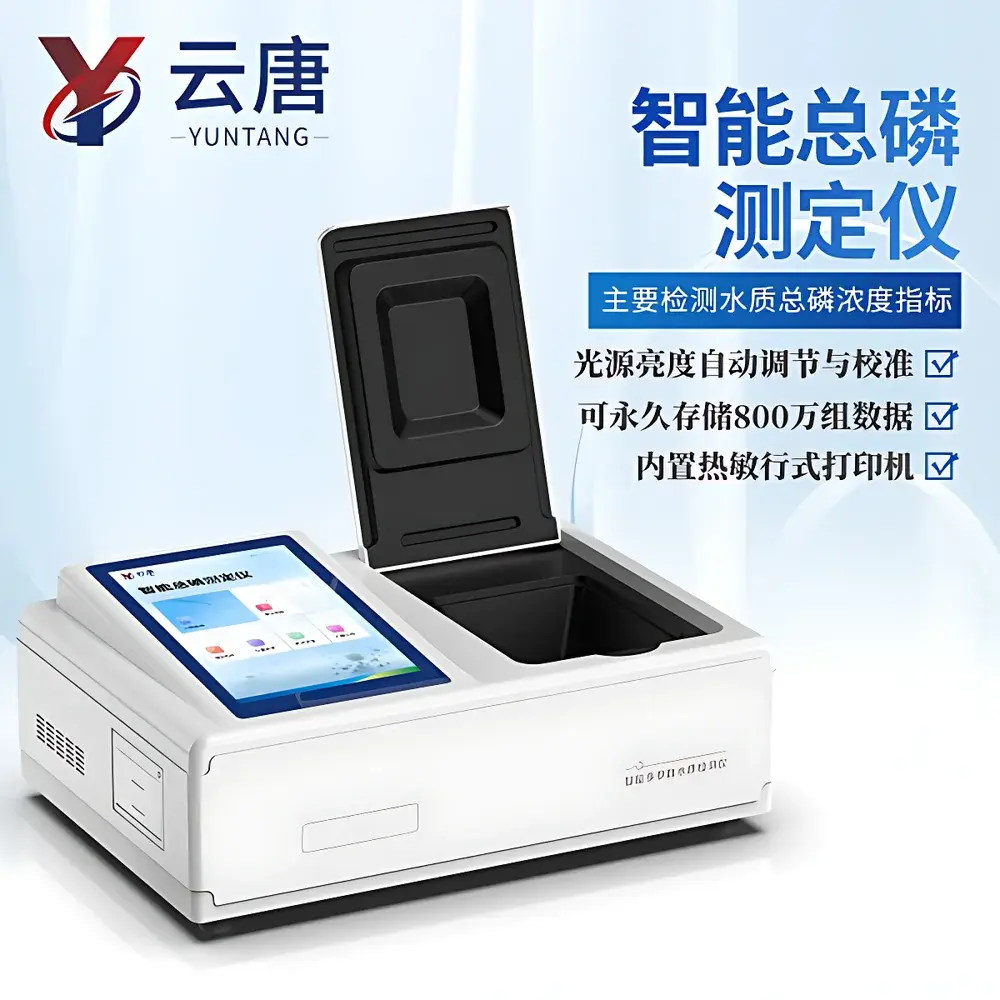
Yuntang YT-TP Portable Total Phosphorus Analyzer
| Brand | Yuntang |
|---|---|
| Origin | Shandong, China |
| Manufacturer Type | Manufacturer |
| Country of Origin | China |
| Model | YT-TP |
| Detection Parameter | Total Phosphorus |
| Instrument Type | Portable |
| Measurement Principle | Spectrophotometry (Ammonium Molybdate Method per GB 11893-89) |
| Detection Range | 0–30 mg/L (segmented) |
| LOD | 0.02 mg/L |
| Accuracy | ±5% FS |
| Stability | <0.5% / 20 min |
| Repeatability | <0.5% RSD |
| Optical Drift | ≤0.002 A within 20 min |
| Light Source | High-brightness imported LED with auto-calibration |
| Display | 10.1″ color TFT touchscreen |
| OS | Android 7.1.1 |
| Data Storage | 8 million records with time-based indexing |
| Connectivity | Wi-Fi, RJ45, Bluetooth, mobile hotspot, USB 2.0 |
| Power Supply | AC 220 V ±10%, 50 Hz |
| Dimensions | 444 × 303 × 173 mm |
| Weight | 5.2 kg (net, excluding battery/adapter) |
| Operating Environment | 5–40 °C, RH <85% (non-condensing) |
| Printer | Built-in thermal line printer with QR code support |
| Compliance | GB 11893-89 |
Overview
The Yuntang YT-TP Portable Total Phosphorus Analyzer is a field-deployable, laboratory-grade spectrophotometric instrument engineered for precise quantification of total phosphorus (TP) in aqueous environmental samples. It implements the standardized ammonium molybdate spectrophotometric method specified in GB 11893-89 — China’s national standard equivalent to ISO 6878 and aligned with EPA Method 365.3 for orthophosphate determination following persulfate digestion. The system integrates a thermally stabilized optical path, precision-matched cuvette and tube holders (10 mm, 30 mm, 50 mm cuvettes and φ16 mm tubes), and an auto-calibrating high-luminance LED light source to ensure long-term photometric consistency (<0.002 A drift over 20 min). Designed for regulatory compliance and operational robustness, the YT-TP delivers trace-level sensitivity (LOD: 0.02 mg/L) and reproducible results across its full 0–30 mg/L segmented range, making it suitable for routine monitoring in wastewater treatment plants, surface water surveillance programs, and industrial effluent compliance verification.
Key Features
- Android 7.1.1 operating system with intuitive bilingual (English/Chinese) GUI and responsive 10.1″ capacitive touchscreen interface
- Dual-mode sample handling: supports both cuvette-based and tube-based measurements to accommodate diverse field sampling protocols
- Integrated thermal line printer enabling on-site documentation with customizable output—including embedded QR codes linking to raw data and metadata
- Onboard data management: stores up to 8 million test records with timestamp, sample ID, operator ID, and method parameters; searchable via date/time filters
- Multi-protocol connectivity: Wi-Fi, Ethernet (RJ45), Bluetooth, and mobile hotspot support for real-time synchronization with local networks or cloud-based environmental data platforms
- Field-ready power architecture: operates from AC mains (220 V ±10%, 50 Hz) or optional 6 Ah lithium-ion battery pack (≥8 h continuous use)
- Firmware-upgradable architecture with secure OTA update capability to maintain alignment with evolving analytical standards and regulatory requirements
- Built-in instructional video library accessible during operation—reducing training burden and improving procedural adherence in multi-user environments
Sample Compatibility & Compliance
The YT-TP is validated for use with raw and digested water matrices including municipal wastewater, industrial effluents (e.g., from pulp/paper, food processing, fertilizer manufacturing), and natural surface waters (rivers, lakes, reservoirs). Sample preparation follows standard digestion protocols per GB 11893-89, utilizing alkaline potassium persulfate oxidation to convert all phosphorus species (orthophosphate, condensed phosphates, organically bound P) into measurable orthophosphate. The analyzer meets key performance criteria for field instruments under ISO/IEC 17025:2017 clause 7.2.2 (method validation), demonstrates stability and repeatability compliant with EPA SW-846 Chapter 4 quality control guidelines, and supports audit-ready data integrity through built-in electronic logs. Its cloud platform integration enables direct submission to provincial/municipal environmental monitoring information systems (EMIS), satisfying data traceability requirements under China’s Environmental Protection Law and supporting GLP-aligned workflows.
Software & Data Management
Data acquisition, processing, and reporting are managed through a purpose-built Android application featuring dual-language UI, configurable report templates, and export to .XLSX format via USB 2.0. All measurements include embedded metadata: GPS coordinates (when enabled), ambient temperature/humidity, operator ID, calibration status, and digestion batch ID. The onboard regulatory cloud platform supports TLS-encrypted transmission to designated servers and provides role-based access control, user activity logging, and versioned data archiving—facilitating 21 CFR Part 11–compatible audit trails when deployed in regulated QA/QC environments. Offline operation is fully supported; synchronized data merges seamlessly upon network reconnection without duplication or loss.
Applications
- Regulatory compliance monitoring at wastewater treatment plant outfalls and industrial discharge points
- Surface water quality assessment in watershed management and ecological restoration projects
- Process control in phosphate removal units and tertiary treatment systems
- Field screening for eutrophication risk evaluation in lakes and reservoirs
- Educational use in environmental science laboratories requiring portable, standards-compliant instrumentation
- Emergency response deployments for post-spill or agricultural runoff assessment
FAQ
What digestion method is required prior to analysis?
Sample digestion must follow GB 11893-89 using alkaline potassium persulfate under controlled heating (120–124 °C, 30 min) to achieve complete oxidation of all phosphorus forms.
Does the instrument support automatic wavelength selection?
Yes—the optical module is fixed at 700 nm, optimized for the molybdenum blue complex formed in the ammonium molybdate reaction; no manual wavelength adjustment is required.
Can calibration curves be customized or imported?
The system allows manual entry of multi-point calibration coefficients and supports import of pre-validated curve sets via USB for method-specific configurations.
Is the thermal printer compatible with third-party label formats?
Print output is limited to internal template-driven layouts; custom label design is not supported, but QR-encoded reports enable external database linking.
How is data security maintained during cloud transmission?
All data transfers use TLS 1.2+ encryption; device authentication is enforced via certificate-based handshake, and no credentials are stored locally in plaintext.







