
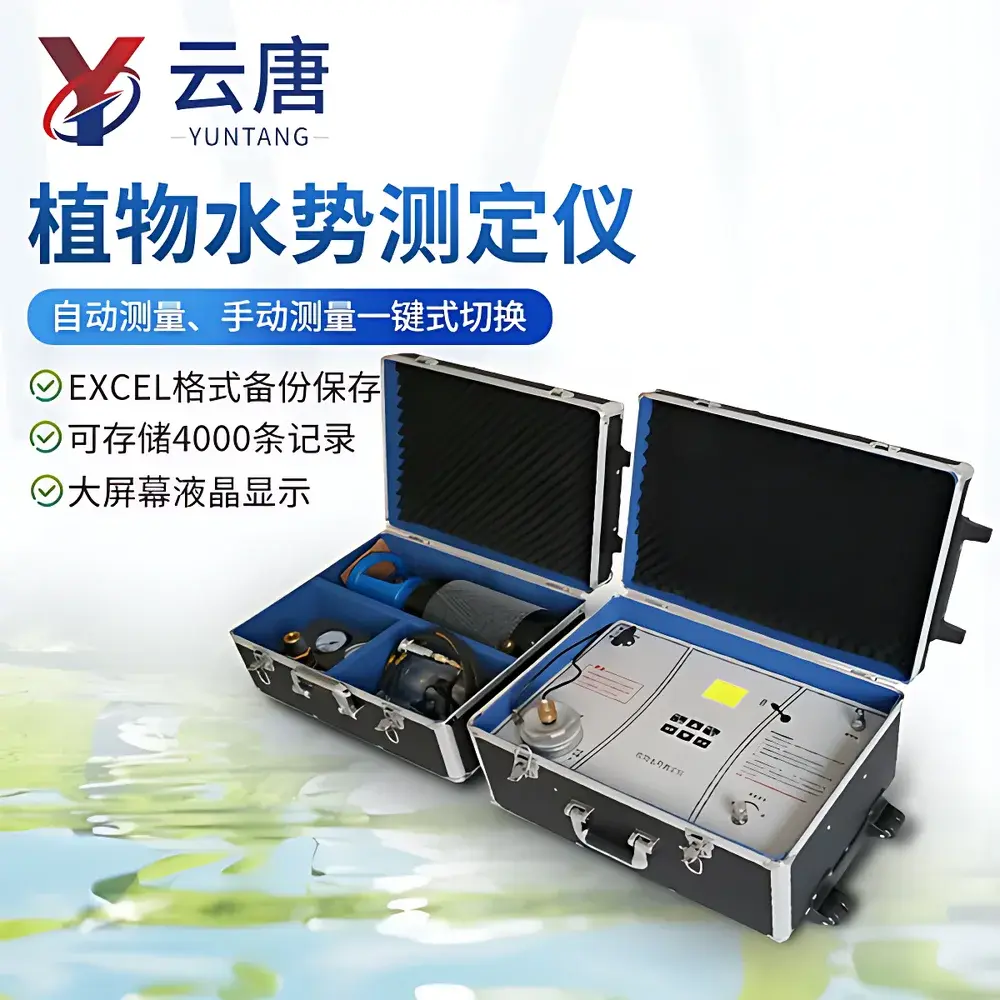
Yuntang YT-ZSS Automatic Plant Water Potential Meter (Pressure Chamber System)
| Brand | Yuntang |
|---|---|
| Origin | Shandong, China |
| Manufacturer Type | Direct Manufacturer |
| Country of Origin | China |
| Model | YT-ZSS |
| Measurement Range | 0–3.5 MPa |
| Display | Backlit LCD with Chinese/English bilingual interface |
| Resolution | 0.01 MPa |
| Units | MPa and bar selectable |
| Data Storage | 4,000 records |
| Power Supply | 12 V / 2.5 Ah rechargeable lithium battery with real-time clock |
| Dimensions (Case 1) | 560 × 400 × 280 mm |
| Dimensions (Case 2) | 630 × 400 × 310 mm |
| Net Weight | ~15 kg per case |
| Connectivity | USB 2.0 for data export |
| Software | PC-based analysis suite supporting Excel export, time-range filtering, and report generation |
Overview
The Yuntang YT-ZSS Automatic Plant Water Potential Meter is a calibrated pressure chamber system engineered for precise, field-deployable measurement of plant water potential (Ψleaf) in situ. It operates on the fundamental principle of the Scholander pressure chamber technique—based on thermodynamic equilibrium restoration within the xylem tension column. When a leaf or stem segment is excised, the metastable water column under negative pressure (tension) recoils from the cut surface. The instrument applies controlled nitrogen or compressed air pressure to the sample chamber until xylem sap is just forced to reappear at the cut surface—a visual endpoint detected by an integrated optical moisture sensor. At this equilibrium point, the applied pressure equals the magnitude of the original xylem tension, reported directly as water potential in MPa (negative values indicate tension; e.g., –1.2 MPa). This method is widely accepted in plant hydraulics research and aligns with standard protocols described in ASTM D7577-21 (Standard Guide for Determining Plant Water Status) and ISO 13041:2019 (Plant physiology — Measurement of leaf water potential).
Key Features
- Fully automated pressure ramping and endpoint detection via high-sensitivity optical drip sensor, eliminating subjective visual judgment and improving inter-operator reproducibility.
- Dual-mode operation: switch seamlessly between automatic endpoint capture and manual pressure hold mode for method validation or non-standard tissue types.
- Backlit monochrome LCD with bilingual (English/Chinese) menu navigation—designed for usability under variable ambient light conditions, including full sunlight in field settings.
- Real-time unit selection between MPa and bar, with automatic conversion and display synchronization.
- Onboard clock and timestamping for every measurement, ensuring traceability in longitudinal studies across diurnal cycles or irrigation treatments.
- Ruggedized dual-casing design optimized for transport to remote field sites; each case meets IP54 dust/moisture resistance specifications for outdoor deployment.
- Integrated rechargeable 12 V / 2.5 Ah lithium battery supports ≥8 hours of continuous operation and retains calibration memory during power-off intervals.
Sample Compatibility & Compliance
The YT-ZSS accommodates a broad range of plant tissues—including intact leaves, petioles, small branches (up to 12 mm diameter), and herbaceous stems—across angiosperm and gymnosperm species. Chamber seals are compatible with standard O-ring gaskets and adaptable to custom sample holders for irregular morphologies. All pressure components conform to ISO 8503-2 surface roughness standards for pressure integrity testing. Data acquisition complies with GLP documentation requirements: each record includes operator ID (configurable), sample ID, date/time stamp, environmental notes field, and instrument serial number. While not FDA 21 CFR Part 11 certified out-of-the-box, audit-trail functionality (via exported CSV/Excel logs with immutable timestamps) supports GxP-aligned workflows when deployed under institutional SOPs.
Software & Data Management
The included Windows-compatible desktop application enables secure data ingestion via USB 2.0 connection. Raw measurements are stored in a structured SQLite database with optional encryption. Users can filter records by date range, sample group, or operator; generate comparative graphs (Ψleaf vs. time, treatment, or VPD); and export annotated reports in PDF or editable Excel (.xlsx) format. All exports include metadata headers compliant with FAIR data principles (Findable, Accessible, Interoperable, Reusable). Batch export supports integration with R, Python (pandas), or MATLAB for advanced statistical modeling of stomatal conductance correlations or drought response curves.
Applications
This instrument serves core functions in academic and applied plant science: quantifying drought stress thresholds in crop breeding programs (e.g., maize, wheat, grapevine); validating irrigation scheduling models using real-time Ψleaf feedback; evaluating hydraulic vulnerability curves in forest ecophysiology; assessing transplant shock recovery in nursery stock; and calibrating remote-sensing indices (e.g., NDVI–Ψ relationships) for precision agriculture platforms. Its portability and battery operation make it suitable for transect-based monitoring in rangeland ecology, alpine botany, and restoration ecology projects where grid power is unavailable.
FAQ
What is the physical basis of water potential measurement in this system?
It relies on mechanical restoration of xylem tension equilibrium—the applied external pressure counterbalances the native negative pressure in the vascular system, with the endpoint defined by sap exudation at the cut surface.
Can the YT-ZSS measure root or soil water potential?
No—it is specifically validated for aboveground plant tissues (leaves, stems, petioles). Soil or root Ψ requires thermocouple psychrometry or tensiometric methods.
Is calibration traceable to NIST or other national standards?
The pressure transducer is factory-calibrated against a deadweight tester traceable to CNAS-accredited metrology labs (China National Accreditation Service); certificate provided with each unit.
How often does the system require maintenance?
Annual verification of pressure seal integrity and transducer linearity is recommended; O-rings should be inspected before each field season and replaced if cracked or deformed.
Does the software support multi-user access with role-based permissions?
The standalone desktop application does not include networked user management; however, exported datasets integrate natively with LIMS platforms supporting RBAC architectures.




