
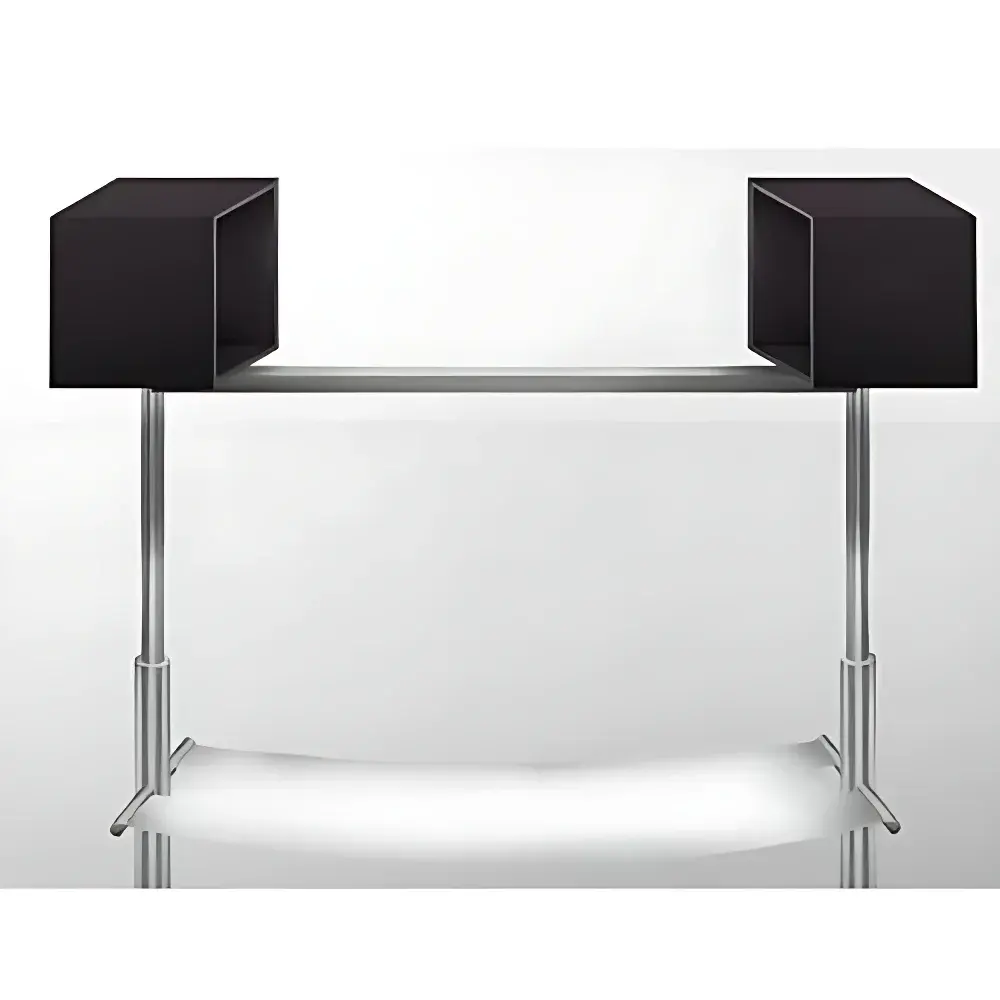
YUYANBIO Balance Beam Apparatus for Rodent Behavioral Assessment
| Brand | YUYANBIO |
|---|---|
| Origin | Shanghai, China |
| Manufacturer Type | Direct Manufacturer |
| Model | YB-BB-1100 |
| Price Range | USD 1,400 – 7,000 |
| Beam Length | 1100 mm |
| Beam Width | 10 mm |
| Beam Thickness | 30 mm |
| Height Above Floor | 1000 mm |
| Illumination | Fluorescent Light Panel (>200 lux) |
| Optional Auditory Stimulus | Piezoelectric Buzzer |
| Dark Chamber | Top-Access Enclosure (1 or 2 units configurable) |
| Structural Frame | Stainless Steel Support Stand |
Overview
The YUYANBIO Balance Beam Apparatus is a standardized, manually operated behavioral testing platform engineered for quantitative assessment of motor coordination, balance, and sensorimotor integration in rodent models—particularly in preclinical studies of traumatic brain injury (TBI), cerebellar dysfunction, stroke, neurodegenerative disorders, and pharmacological interventions. The apparatus operates on the principle of aversive motivation: rodents are naturally motivated to escape bright light or acoustic stimuli and seek refuge in a dark chamber. This ethologically relevant paradigm elicits voluntary locomotion across an elevated narrow beam, thereby challenging postural control, limb placement accuracy, and dynamic gait stability. Unlike forced-swim or rotarod paradigms, the balance beam test imposes minimal physical stress while providing high-resolution temporal and qualitative metrics—including latency to reach the dark chamber and number of foot slips—both of which demonstrate strong correlation with histopathological and electrophysiological markers of cortical, striatal, and cerebellar integrity.
Key Features
- Precision-machined acrylic or stainless-steel beam (1100 mm × 10 mm × 30 mm) mounted at a consistent height of 1000 mm above floor level to ensure uniform biomechanical challenge across subjects and sessions.
- Top-access dark chamber with opaque walls and controlled internal dimensions (standard: 150 mm × 150 mm × 150 mm), designed to minimize external visual cues and provide unambiguous endpoint detection.
- Integrated fluorescent light panel delivering >200 lux illumination across the full beam surface—calibrated to meet ISO 8596 and ASTM E1293-18 guidelines for photometric consistency in behavioral assays.
- Optional piezoelectric buzzer module (1–5 kHz sweep, 85 dB SPL at 10 cm) compliant with ANSI S3.4-2018 for calibrated auditory stimulation, enabling multimodal aversive conditioning protocols.
- Modular stainless-steel support frame with non-slip rubber feet and adjustable leveling feet—engineered for long-term dimensional stability and vibration damping during video-based motion tracking.
- Configurable chamber layout: single-chamber (beam-to-dark-box) or dual-chamber (bidirectional escape) configurations support both habituation protocols and comparative inter-hemispheric asymmetry analysis.
Sample Compatibility & Compliance
The apparatus is validated for use with adult mice (C57BL/6, BALB/c, CD-1) and rats (Sprague-Dawley, Wistar), with beam width optimized to induce measurable deficits without excessive attrition. Protocols align with NIH Office of Laboratory Animal Welfare (OLAW) standards and comply with the ARRIVE 2.0 guidelines for reproducible behavioral phenotyping. All hardware materials meet USP Class VI biocompatibility requirements; no leachable compounds are introduced during standard operation. Data collection workflows are compatible with GLP-compliant environments when paired with timestamped video recording systems and audit-trail-enabled observation logs.
Software & Data Management
While the YUYANBIO Balance Beam Apparatus is a hardware-only platform (no embedded electronics or proprietary software), it is fully interoperable with third-party behavioral analysis suites including EthoVision XT (Noldus), ANY-maze (Stoelting), and open-source tools such as DeepLabCut and Bonsai. Video recordings synchronized with stimulus onset (light/buzzer activation) enable automated slip detection via pixel-difference algorithms and precise latency measurement to ±0.05 s. Experimental metadata—including subject ID, trial number, beam configuration, stimulus modality, and observer blinding status—can be exported in CSV or JSON format for integration into LIMS or electronic lab notebooks (ELNs) compliant with 21 CFR Part 11 requirements.
Applications
- Quantitative longitudinal monitoring of motor recovery following controlled cortical impact (CCI) or fluid-percussion injury (FPI) in TBI models.
- Dose-response evaluation of neuroprotective agents targeting dopaminergic, GABAergic, or glutamatergic pathways.
- Phenotypic screening of transgenic lines with mutations affecting Purkinje cell development (e.g., Lurcher, Hotfoot) or corticospinal tract maturation.
- Validation of non-invasive neuromodulation techniques (e.g., tDCS, focused ultrasound) on fine motor execution.
- Standardized endpoint in regulatory toxicology studies assessing CNS adverse effects per OECD Test Guideline 426 (Neurotoxicity Study).
FAQ
Is the beam surface textured or smooth?
The standard beam features a matte-finish acrylic surface with micro-roughness (Ra ≈ 0.8 µm) to provide consistent tactile feedback without introducing confounding grip variables.
Can the apparatus be sterilized between subjects?
Yes—non-porous components (beam, chamber, frame) are compatible with 70% ethanol wipe-downs, UV-C irradiation (254 nm, 30 min), and low-temperature hydrogen peroxide vapor cycles.
What is the recommended acclimation protocol prior to testing?
Animals should undergo two days of habituation (3 trials/day, 2 h inter-trial interval) under dim red-light conditions (≤5 lux) to minimize stress-induced performance variance.
Does YUYANBIO provide protocol SOPs or validation data?
Yes—comprehensive user manuals include IACUC-reviewed SOPs, inter-rater reliability benchmarks (Cohen’s κ ≥ 0.92), and published reference datasets from peer-reviewed TBI studies.
Is custom beam geometry available?
Yes—custom lengths (800–1500 mm), widths (5–20 mm), and cross-sectional profiles (square, round, tapered) are available upon request with lead time of 4–6 weeks.




