
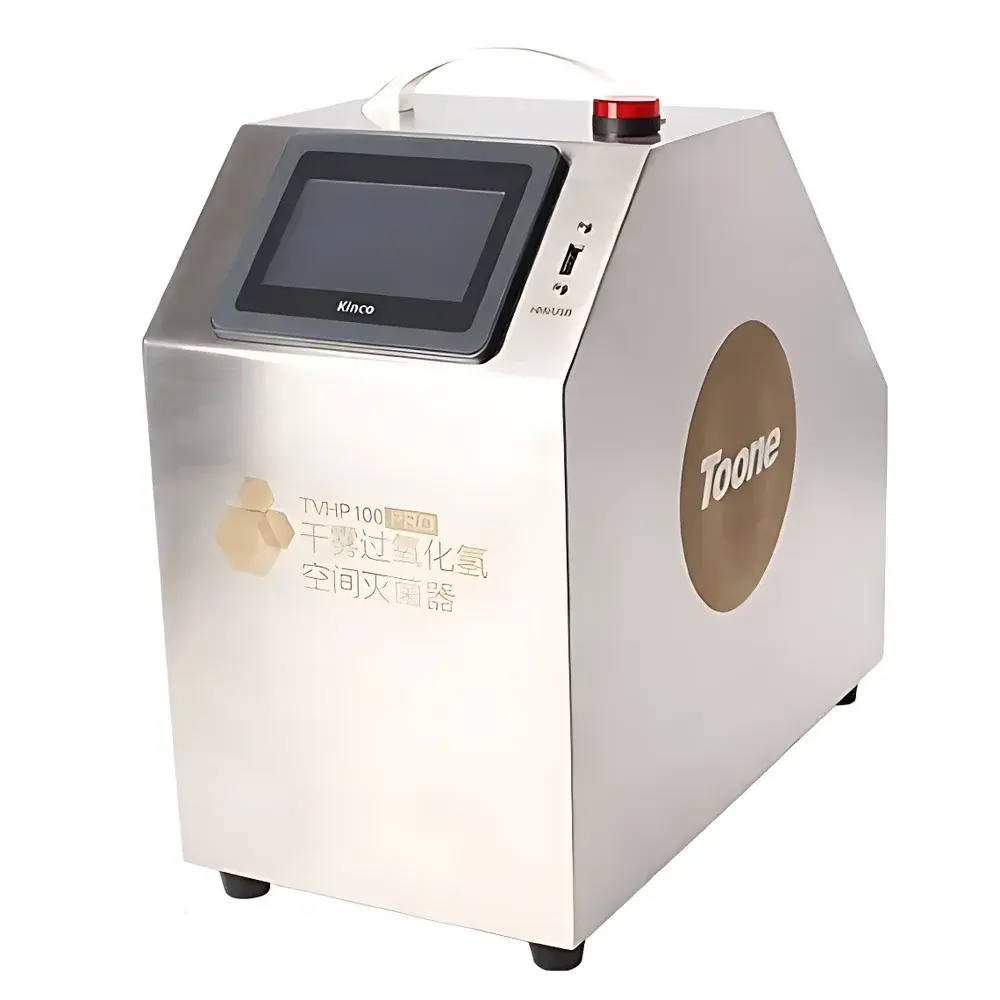
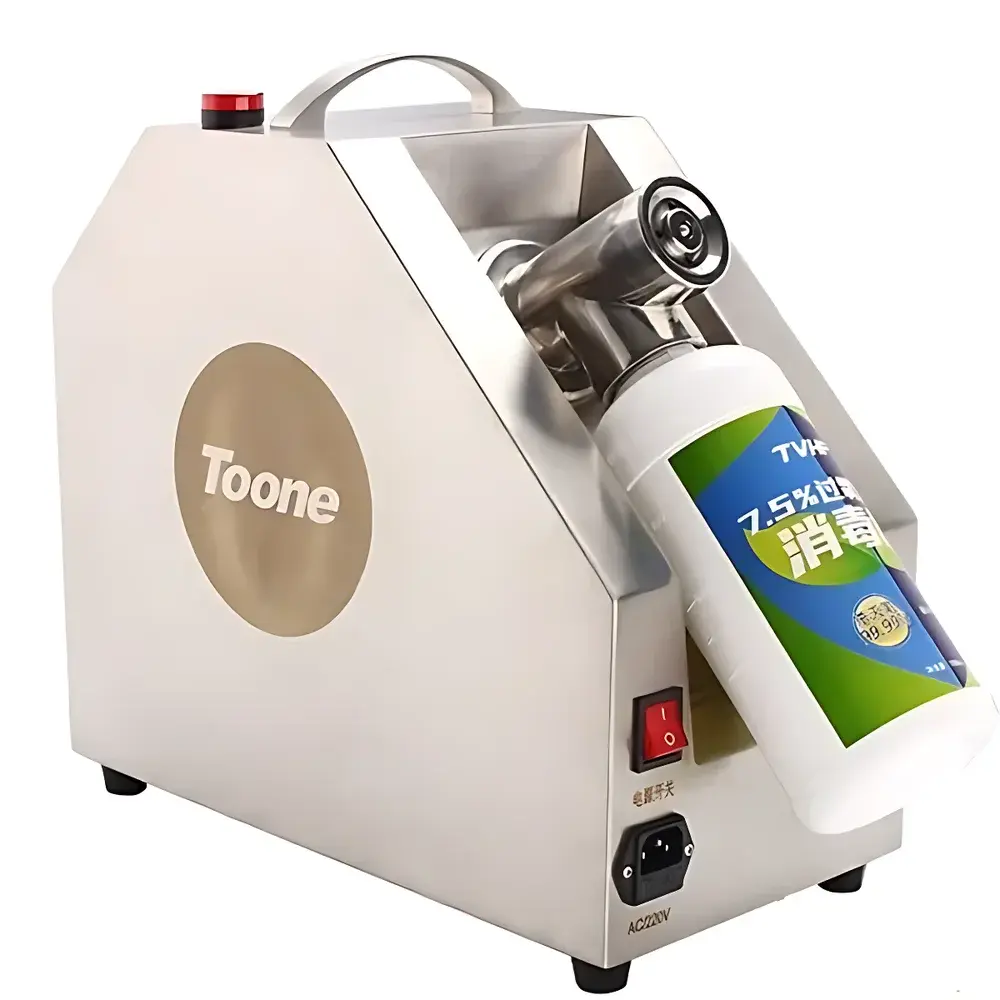
YUYANBIO TVHP100 Hydrogen Peroxide Dry Fog Sterilizer
| Brand | YUYANBIO |
|---|---|
| Origin | Shanghai, China |
| Manufacturer Type | OEM/ODM Manufacturer |
| Country of Origin | China |
| Model | TVHP100 |
| Price Range | USD 4,200 – 5,600 (FOB Shanghai) |
| Weight | 14.4 kg |
| Power Supply | 200–220 V AC, 50 Hz |
| Rated Power | 550 W |
| Chamber Material | ASTM A240 S30403 (304L stainless steel) |
| Touchscreen | 4.3-inch capacitive LCD with embedded microcontroller and PLC-based control logic |
| Data Integrity | Immutable on-device logging |
| Delayed Start | Programmable 1-minute safety delay |
| Remote Operation | IR remote control support with optional Wi-Fi module (firmware v2.1+) |
| Fog Generation Principle | Non-thermal ultrasonic dry fog aerosolization (particle size distribution Dv50 ≈ 7–10 µm) |
| Compatible Biocides | 7.5% w/w hydrogen peroxide aqueous solution, peracetic acid blends, and sporicidal formulations compliant with EN 14885 and EPA List K |
| Maximum Treated Volume | 10 m³ (cuboid equivalent: 2.5 m × 2.0 m × 2.0 m) |
| Optional Accessories | Portable LiFePO₄ power bank (1.2 kWh), stainless-steel mobile trolley (ISO 7 cleanroom-compatible casters), real-time H₂O₂ vapor concentration sensor (0–2000 ppm, ±5% FS), catalytic H₂O₂ decomposition unit (MnO₂/Pt-coated ceramic honeycomb) |
Overview
The YUYANBIO TVHP100 Hydrogen Peroxide Dry Fog Sterilizer is an engineered, non-thermal biodecontamination system designed for rapid, residue-free sterilization of enclosed laboratory workspaces, biosafety cabinets, isolators, and small-scale cleanrooms up to 10 m³. It operates on the principle of controlled dry fog generation—utilizing ultrasonic nebulization to produce a stable, sub-10 µm aerosol mist of hydrogen peroxide (H₂O₂) without thermal activation or condensation. This ensures uniform spatial distribution while eliminating moisture-related corrosion risks common in vaporized hydrogen peroxide (VHP®) systems. The mechanism of microbial inactivation relies on hydroxyl radical (•OH) generation through Fenton-like decomposition pathways, targeting lipids, proteins, and nucleic acids—particularly effective against bacterial endospores (e.g., Bacillus atrophaeus ATCC 9372), viruses, and vegetative pathogens. Unlike steam or ethylene oxide methods, the TVHP100 leaves no toxic residuals post-cycle; decomposed H₂O₂ breaks down solely into water vapor and ambient oxygen, eliminating post-treatment aeration requirements and enabling immediate re-entry and equipment reuse.
Key Features
- Non-thermal dry fog technology: Prevents condensation, material corrosion, and thermal stress on sensitive instrumentation (e.g., optical sensors, electronic enclosures)
- ASTM A240 S30403 (304L) stainless steel enclosure: Electropolished surface finish (Ra ≤ 0.8 µm) for enhanced cleanability and resistance to repeated H₂O₂ exposure
- Immutable audit trail: All sterilization parameters—including cycle time, start/stop timestamps, ambient temperature/humidity (via integrated sensor), and fog duration—are logged to internal flash memory with write-once-read-many (WORM) architecture
- Compliance-ready controls: 4.3-inch industrial touchscreen with password-protected operator/admin tiers; supports 21 CFR Part 11-compliant electronic signatures when paired with optional external validation software
- Safety interlocks: 60-second programmable pre-cycle delay, IR remote start/stop, and automatic fault shutdown upon door breach or pressure anomaly
- Modular consumables: External reservoir design accommodates standardized ISO-certified bottles (250 mL, 500 mL, or 1000 mL); compatible with GMP-grade 7.5% w/w H₂O₂ solutions meeting USP <797> and Ph. Eur. 2.2.49 specifications
Sample Compatibility & Compliance
The TVHP100 has undergone formal materials compatibility testing per ISO 14937 Annex C and EN 14885:2018 Annex A. Verified non-corrosive performance documented for 304L stainless steel, hot-dip galvanized steel (Z275 coating), anodized aluminum 6061-T6, polycarbonate, and silicone elastomers after ≥50 consecutive cycles. Not recommended for use with copper alloys, uncoated carbon steel, or cellulose-based filters without prior validation. Regulatory alignment includes conformity with IEC 61000-6-3 (EMC), IEC 61010-1 (safety), and CE marking under the EU Medical Device Regulation (MDR) Class I (non-invasive, ancillary device). Full traceability documentation—including Factory Acceptance Test (FAT) reports, material certificates (EN 10204 3.1), and third-party bioburden reduction validation (log₁₀ ≥ 6 for Geobacillus stearothermophilus spores)—is provided with each unit.
Software & Data Management
Embedded firmware (v2.3.1) implements deterministic real-time control via a dual-core ARM Cortex-M7 microcontroller with redundant watchdog timers. Cycle data is stored in encrypted binary format (AES-128) and exportable via USB 2.0 to CSV or PDF. Exported files include digital signatures, UTC timestamps, and checksum verification fields—enabling integration into LIMS or electronic lab notebooks (ELN) such as LabWare or Benchling. Optional cloud synchronization (AWS IoT Core) supports remote monitoring and automated report generation for QA/QC audits. Audit logs retain full history for ≥12 months; deletion or overwriting of internal records is physically disabled at the hardware level.
Applications
Primarily deployed in pharmaceutical R&D labs, clinical diagnostics core facilities, and academic biosafety Level 2 (BSL-2) containment suites. Validated use cases include decontamination of laminar flow hoods prior to cell culture setup, terminal sterilization of glovebox interiors before aseptic processing, and periodic bio-decontamination of PCR preparation areas to prevent amplicon carryover. Also employed in veterinary diagnostic labs for pathogen eradication in necropsy stations and in IVF clinics for embryo workstation sanitization—where absence of residual oxidants is critical for gamete viability.
FAQ
What is the maximum recommended room volume for reliable sterilization?
The TVHP100 is validated for consistent log₆ spore reduction in enclosed spaces ≤10 m³ under ISO 14644-1 Class 7 conditions (≤352,000 particles/m³ ≥0.5 µm). Larger volumes require extended cycle times or supplemental units.
Can the device be integrated into a building management system (BMS)?
Yes—via optional Modbus RTU (RS-485) interface or MQTT protocol over Ethernet/Wi-Fi, enabling status reporting, alarm triggering, and scheduled cycle initiation from centralized SCADA platforms.
Is third-party validation support available?
YUYANBIO provides IQ/OQ documentation templates compliant with ASTM E2994 and offers on-site PQ support through certified partners in EU, US, and APAC regions.
Does the system meet FDA requirements for use in GMP environments?
While the TVHP100 itself is not an FDA-cleared medical device, its design, documentation, and operational protocols align with FDA Guidance for Industry: Process Validation (2011) and EU Annex 1 (2022) for sterilization process qualification in aseptic manufacturing.
How often does the ultrasonic transducer require maintenance or replacement?
Under normal usage (≤3 cycles/day), the transducer exhibits ≥15,000 operating hours MTBF; preventive inspection is recommended every 6 months, with replacement only upon calibrated output deviation >±8% (measured via ISO 20480-1 compliant particle sizer).



