
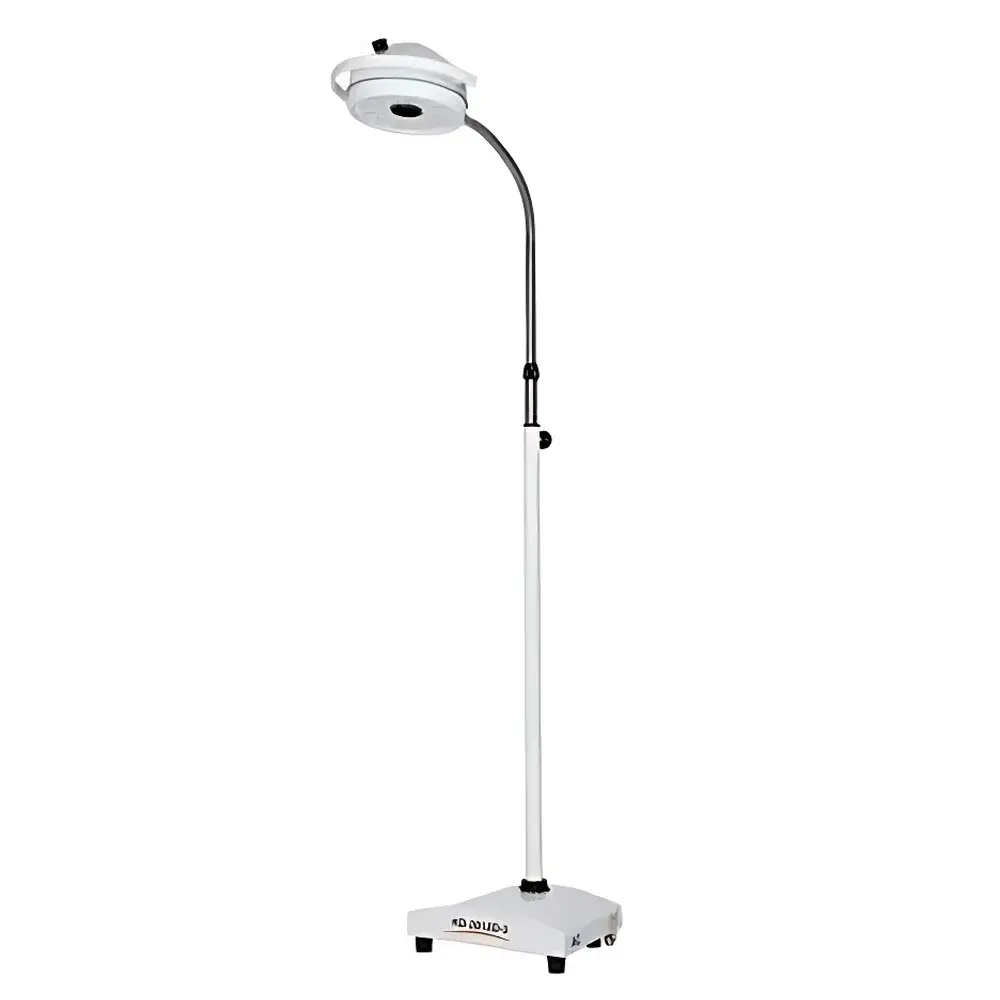
YUYANBIO YS-LED Series Veterinary Surgical Shadowless Lamp
| Brand | YUYANBIO |
|---|---|
| Origin | Shanghai, China |
| Manufacturer Type | Direct Manufacturer |
| Product Category | Domestic |
| Model | YS-LED-4H / YS-LED-5H (4- or 5-Head Configurable LED Veterinary Surgical Lamp) |
| Pricing | Available Upon Request |
| Light Source | High-Efficiency White LED Array |
| Rated Power | 36 W (12-LED Head Configuration) |
| Central Illuminance | 35,000 lx |
| Color Temperature | 5500 ± 500 K |
| Service Life | ≥55,000 h |
| Input Voltage | 220 VAC, 50 Hz |
| Lamp Head Diameter | 200 mm |
| Adjustable Height Range | 1.2–1.8 m |
| Net Weight | 8 kg |
| Light Output Control | Continuous Dimming (10–100%) |
| Beam Focus | Fixed Optic with Uniform Field Distribution |
| Thermal Management | Passive Heat Sink, Zero IR/UV Emission |
| Compliance | Meets IEC 60601-2-41 (Medical Electrical Equipment – Particular Requirements for Surgical Lamps) and GB 9706.1-2020 (Chinese Equivalent) |
Overview
The YUYANBIO YS-LED Series Veterinary Surgical Shadowless Lamp is an engineered illumination system designed specifically for preclinical surgical procedures in laboratory animal research. It operates on the principle of multi-source overlapping illumination geometry—where four or five independently articulated LED lamp heads project light from distinct spatial angles to converge at the surgical field, thereby eliminating shadows cast by the surgeon’s head, hands, or instruments. Unlike conventional halogen or xenon-based surgical lights, this system employs a high-density array of medical-grade white LEDs calibrated to deliver clinically relevant photometric performance: uniform luminance distribution, stable color temperature, minimal thermal load, and zero ultraviolet (UV) or infrared (IR) radiation emission. Its design conforms to the optical and safety requirements defined in IEC 60601-2-41 for surgical lighting equipment used in controlled environments such as AAALAC-accredited vivariums, GLP-compliant pharmacology labs, and academic surgical training facilities.
Key Features
- Multi-head modular architecture (4-head YS-LED-4H or 5-head YS-LED-5H) enables dynamic shadow elimination across variable surgical depths and specimen sizes—from murine craniotomies to porcine thoracotomies.
- Medical-grade LED light engines with >55,000-hour rated lifetime ensure long-term operational continuity and reduce maintenance frequency in high-throughput animal surgery suites.
- Passive thermal management eliminates active cooling fans, minimizing airborne particulate generation and acoustic interference during microsurgical interventions.
- Continuous dimming control (10–100%) via rotary encoder allows real-time adaptation to tissue reflectivity, microscope integration needs, and operator visual acuity preferences.
- Adjustable vertical column (1.2–1.8 m range) and 360° rotational lamp arm joints support ergonomic positioning for standing, seated, or stereotactic setups.
- Fixed-optic collimation delivers consistent beam geometry without focus drift—critical for reproducible photodocumentation and synchronized imaging workflows.
Sample Compatibility & Compliance
The YS-LED Series is validated for use across common laboratory species including Mus musculus (C57BL/6, BALB/c), Rattus norvegicus (Sprague-Dawley, Wistar), Oryctolagus cuniculus (New Zealand White), Canis lupus familiaris (Beagle), and Sus scrofa (Yucatan minipig). Its low-heat output (<35°C surface temperature at 30 cm working distance) prevents thermal stress during prolonged soft-tissue exposure, supporting adherence to ARRIVE 2.0 guidelines and NIH Office of Laboratory Animal Welfare (OLAW) standards. The device complies with IEC 60601-2-41 Clause 201.12.4.101 (Illuminance Uniformity ≥0.7), Clause 201.12.4.102 (Color Rendering Index Ra ≥90), and GB 9706.1-2020 Clause 12 (mechanical stability and tip-over resistance). Electromagnetic compatibility meets IEC 60601-1-2:2014 Class B limits for laboratory environments.
Software & Data Management
While the YS-LED Series operates as a standalone hardware system without embedded firmware or network connectivity, its analog dimming interface is compatible with third-party laboratory automation platforms via 0–10 V DC control input (optional accessory module). All operational parameters—including intensity setting, usage time logs, and lamp head position coordinates—are manually recorded per institutional SOPs. For audit readiness under GLP or AAALAC accreditation, users may integrate lamp usage data into electronic lab notebooks (ELNs) such as LabArchives or Benchling using standardized metadata fields (e.g., “Lighting_Intensity_lx”, “Procedure_Duration_min”, “Species_Model”). Device calibration certificates are issued annually upon request and include traceability to NIM (National Institute of Metrology, China) reference standards.
Applications
- Neurosurgical procedures: stereotaxic electrode implantation, cortical window preparation, spinal cord injury models.
- Cardiovascular interventions: carotid artery ligation, aortic banding, echocardiography-guided catheterization.
- Oncology model establishment: orthotopic tumor implantation, bioluminescent imaging-assisted resection.
- Transgenic model phenotyping: ophthalmic surgery (lens extraction), cochlear implantation, dental pulp exposure.
- Training modules for veterinary students and postdoctoral fellows in aseptic technique, microdissection, and survival surgery ethics.
FAQ
Is the YS-LED lamp compatible with surgical microscopes?
Yes—the lamp’s fixed-optic beam profile and low IR/UV emission prevent thermal lensing or fluorescence quenching, enabling concurrent use with upright or inverted surgical microscopes (e.g., Leica M520, Zeiss OPMI series) without compromising image fidelity.
Can the lamp be mounted on a ceiling or wall bracket?
No—the YS-LED Series is engineered exclusively as a floor-standing unit with counterbalanced base and integrated caster system; ceiling/wall mounting is not supported due to structural and electrical certification constraints.
Does the lamp meet FDA or ISO 13485 requirements?
It is manufactured under a quality management system aligned with ISO 13485:2016 principles and registered with Chinese NMPA (Class II medical device registration number available upon request); however, it is not FDA-listed as it is intended solely for non-clinical, research-use-only (RUO) applications in animal models.
What is the recommended maintenance interval?
Visual inspection and mechanical joint lubrication every 6 months; LED output verification using a calibrated lux meter annually; no routine lamp replacement required within first 5 years of operation.
Is there a version with battery backup or DC input capability?
Not currently—power supply is strictly 220 VAC, 50 Hz; integration with uninterruptible power supplies (UPS) is permissible but must comply with IEC 62040-1 for medical-grade backup systems.
Related Products




