YXLON FF Series Industrial CT System
| Brand | YXLON International GmbH |
|---|---|
| Origin | Germany |
| Model | FF Series |
| Operating Voltage | Up to 600 kV |
| Detector | 3-Line Detector Array (LDA) with 254 µm pixel pitch |
| Dynamic Range | High |
| Signal-to-Noise Ratio | Exceptional |
| Scan Modes | 2D, 3D, Helical (HeliExtend), Field-of-View Extension (Horizontal/Vertical), Virtual Rotation Axis |
| Image Enhancement | ScatterFix 2.0, Beam Hardening Correction (BHC), Metal Artifact Reduction (MAR) |
| Applications | R&D material analysis, dimensional metrology, failure analysis, assembly verification, digital dissection |
| Sample Compatibility | Aluminum, steel, superalloys, AM parts, Li-ion battery cells/modules/systems, CFRP, injection-molded plastics, cultural heritage objects, geological/paleontological/biological specimens, mechatronic assemblies |
Overview
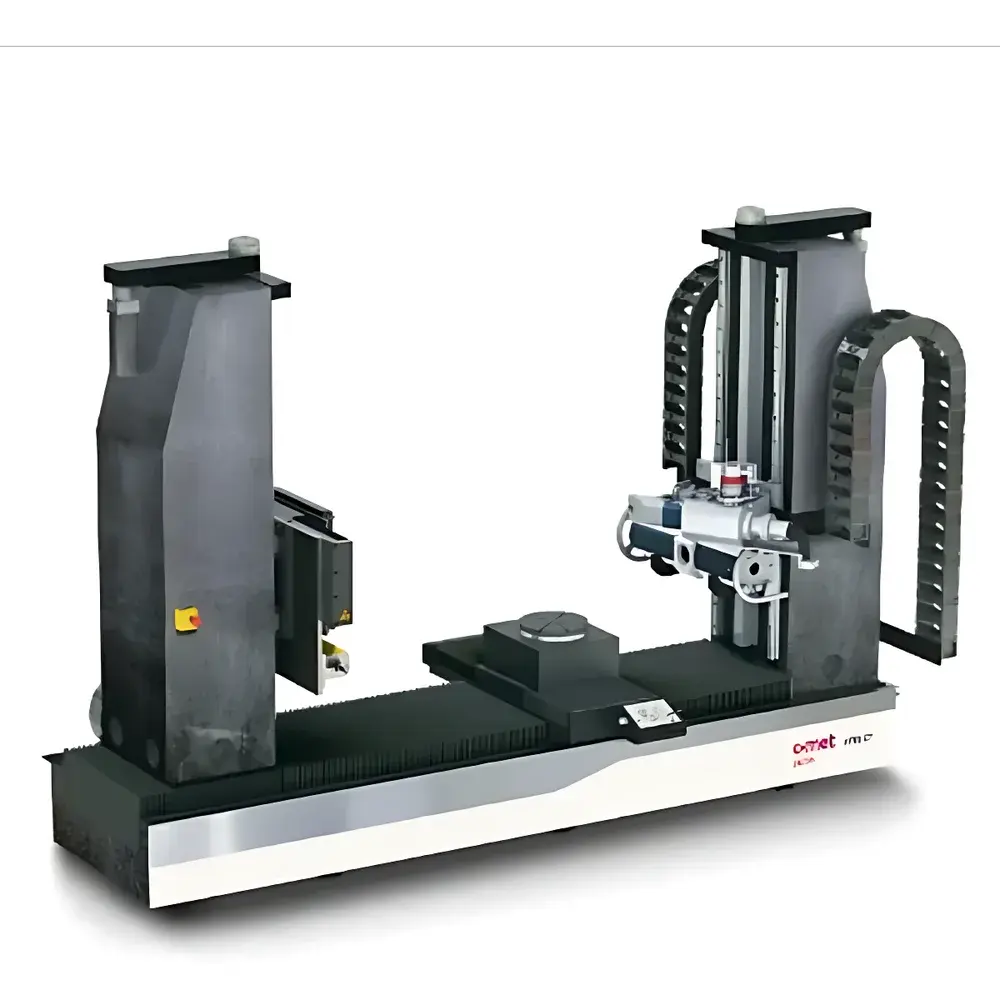
The YXLON FF Series Industrial Computed Tomography (CT) System is a high-performance, metrology-grade X-ray CT platform engineered for non-destructive 3D internal and external inspection of complex industrial components. Based on cone-beam geometry and high-energy microfocus X-ray generation (up to 600 kV), the system employs a proprietary 3-Line Detector Array (LDA) with 254 µm pixel pitch—delivering exceptional spatial resolution, high dynamic range, and superior signal-to-noise ratio. This architecture enables robust volumetric reconstruction of dense, large-scale, or geometrically intricate parts without compromising contrast fidelity or quantitative accuracy. Designed for integration into R&D labs, quality control departments, and advanced manufacturing environments, the FF Series adheres to fundamental principles of radiographic physics and tomographic reconstruction (filtered backprojection and iterative algorithms), ensuring traceable, repeatable, and standards-aligned measurement outcomes.
Key Features
- High-voltage X-ray source (up to 600 kV) optimized for penetrating dense materials including steel, nickel-based superalloys, and thick-walled castings.
- 3-Line Detector Array (LDA) with 254 µm pixel pitch—enabling sub-millimeter defect detectability (<1 mm) and high-fidelity volumetric rendering across small-, medium-, and large-format samples.
- Geminy™ intuitive graphical user interface—designed for operator-agnostic usability, supporting rapid method setup, real-time preview, and automated workflow execution.
- Advanced acquisition modes: standard step-and-shoot, continuous helical scanning (HeliExtend™), horizontal/vertical field-of-view extension, and virtual rotation axis alignment—maximizing flexibility for irregular or oversized parts.
- Integrated image enhancement suite: ScatterFix 2.0 (scattered radiation suppression), Beam Hardening Correction (BHC), and Metal Artifact Reduction (MAR)—ensuring artifact-minimized reconstructions essential for metrological validation and failure root-cause analysis.
- Robust mechanical architecture with high-precision manipulator stages, thermal stabilization, and vibration-damped gantry—critical for sub-pixel registration stability in metrology-grade CT.
Sample Compatibility & Compliance
The FF Series accommodates a broad spectrum of industrial and scientific specimens—from aluminum housings and additively manufactured Ti-6Al-4V turbine blades to lithium-ion battery modules, carbon-fiber reinforced polymer (CFRP) aerospace brackets, and paleontological fossil matrices. Its dual-energy capability and adaptive filtration support multi-material discrimination, while its calibrated geometry enables traceable dimensional metrology compliant with ISO 15530-3 and VDI/VDE 2630 Part 1.3 guidelines. For regulated industries—including automotive (IATF 16949), aerospace (AS9100), and medical device manufacturing—the system supports audit-ready documentation, GLP/GMP-aligned data integrity protocols, and optional 21 CFR Part 11-compliant software modules (e.g., electronic signatures, audit trails, and secure user roles).
Software & Data Management
Acquisition, reconstruction, visualization, and metrology are unified within the YXLON software ecosystem: Geminy™ for acquisition control, datos|x for GPU-accelerated FDK and iterative reconstruction, and Volume Graphics VGStudio MAX for advanced analysis. The platform natively exports industry-standard formats (e.g., DICOM, STL, PLY, ASCII point clouds) and supports direct integration with CAD comparison tools (GD&T evaluation, wall thickness analysis, porosity quantification per ASTM E155/E2667). All raw projections, reconstructed volumes, and measurement reports are stored with immutable metadata—including acquisition parameters, calibration logs, and operator credentials—ensuring full data provenance and long-term archival compliance.
Applications
- R&D material characterization: pore network analysis, grain boundary mapping, phase distribution in composites.
- Precision dimensional metrology: first-article inspection, GD&T verification (position, concentricity, profile), tool wear monitoring.
- Failure analysis: crack propagation path reconstruction, void coalescence in castings, dendritic segregation in AM builds.
- Assembly validation: presence/absence of embedded components, solder joint integrity, wire bond alignment, encapsulation coverage.
- Digital twin generation: high-fidelity 3D models for simulation input, reverse engineering, and generative design iteration.
- Cultural heritage digitization: non-invasive stratigraphic analysis of historical artifacts, corrosion layer mapping, internal structural integrity assessment.
FAQ
What is the maximum part size the FF85 CT can accommodate?
The FF85 supports parts up to Ø 850 mm × H 1000 mm (diameter × height), with optional turntable and manipulator extensions enabling larger envelope configurations.
Does the system support automated defect recognition (ADR)?
Yes—via optional AI-assisted modules integrated into VGStudio MAX, enabling supervised classification of porosity, inclusions, and cracking based on annotated training datasets.
Can measurement results be exported for SPC or MES integration?
Yes—CSV, XML, and database (ODBC/JDBC) export options are available; measurement data can be streamed directly to factory-level quality management systems.
Is the system compliant with radiation safety regulations?
All FF Series systems are CE-marked and designed to meet IEC 61000-6-4 (EMC) and IEC 62463 (radiation protection) requirements; site-specific shielding and interlock validation are performed during commissioning.
How is system calibration maintained over time?
A comprehensive calibration protocol—including geometric, intensity, and metrological checks—is executed at installation and recommended annually; traceable reference phantoms (e.g., PTB-certified spheres, step wedges) are supplied for daily verification.