
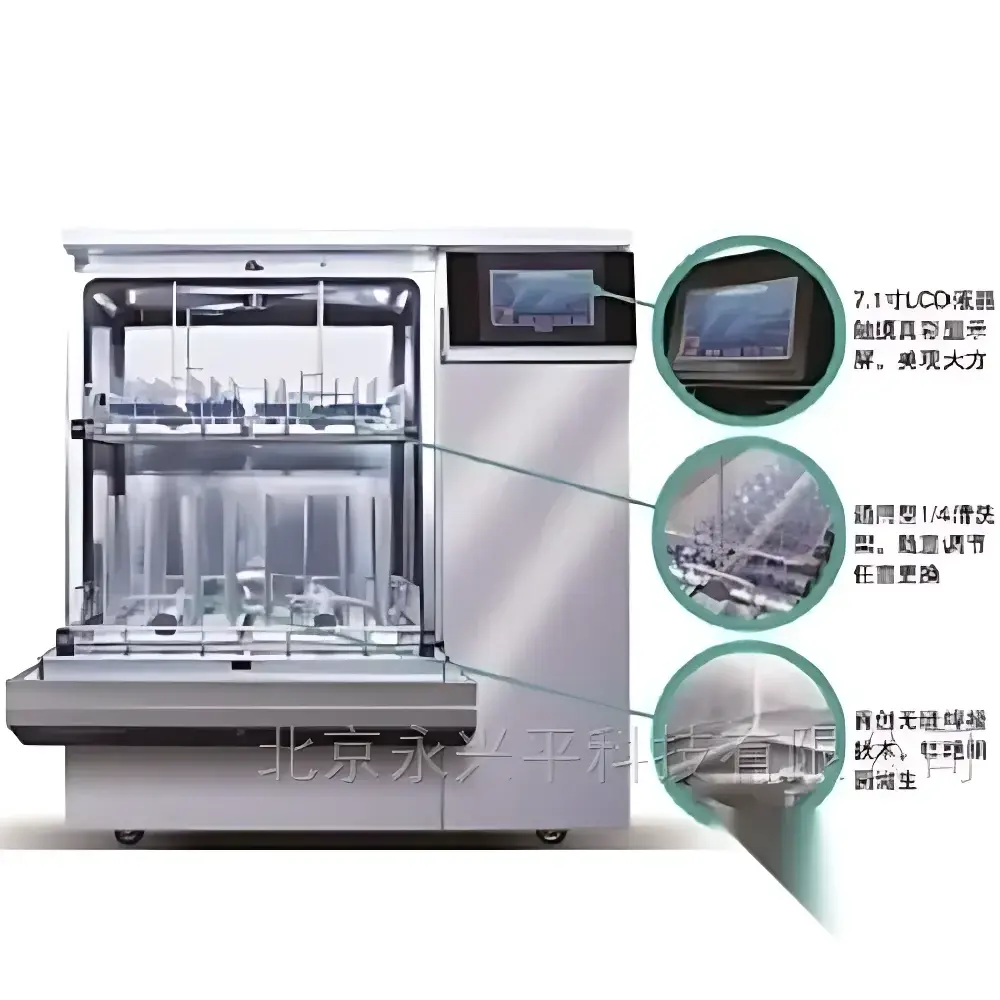
YXP FL200P Fully Automatic Laboratory Glassware Washer
| Brand | YXP |
|---|---|
| Model | FL200P |
| Type | Benchtop Fully Automatic Glassware Washer |
| Construction | 304 Stainless Steel Exterior, 316L Stainless Steel Interior Chamber & Door |
| Chamber Volume | 200 L (nominal) |
| Heating Power | 3.5 kW |
| Max Cleaning Temperature | 93 °C |
| Circulation Pump Flow Rate | ≥ 450 L/min |
| Wash Solution Compatibility | Alkaline, Neutral, and Acidic Detergents (pH 2–12) |
| External Dimensions (L×W×D) | 1200 × 850 × 1850 mm |
| Dry Cycle | Integrated Hot-Air Drying with Dual 316L Steam Condensers |
| Safety | ESL Electronic Safety Lock (Auto-Pause on Door Opening), CE-compliant Electrical Architecture |
| Compliance | Designed to meet ISO 15883-1 (Washer-Disinfectors for Heat-Labile Instruments), GLP/GMP-aligned workflow documentation support |
Overview
The YXP FL200P is a fully automatic, high-reliability laboratory glassware washer engineered for reproducible cleaning and thermal conditioning of reusable labware—including Erlenmeyer flasks, volumetric flasks, beakers, graduated cylinders, and conical bottles—under controlled, auditable conditions. It operates on a closed-loop thermodynamic cleaning principle: heated detergent solution is pressurized, circulated at constant flow, and delivered via dual-axis 360° rotating spray arms combined with tangential nozzle arrays. This architecture ensures complete surface coverage—including hard-to-reach interior geometries—by leveraging hydrodynamic shear forces and sustained thermal dwell time. The system integrates real-time process monitoring, programmable multi-stage cycles (pre-rinse, wash, intermediate rinse, final rinse, thermal disinfection, hot-air drying), and failsafe interlocks compliant with IEC 61000-6-2/6-4 electromagnetic compatibility standards.
Key Features
- HPS (High-Performance Spray) System: Dual rotating spray arms with speed-sensing feedback control deliver uniform 360° coverage; no shadow zones on complex-shaped glassware.
- Tangential Jet Technology: Precision-machined 316L nozzles direct detergent flow at optimal angles along vessel inner walls, enhancing mechanical removal of organic residues and particulate films.
- Dual 316L Steam Condensers: Mounted internally on chamber sidewalls to capture and condense saturated steam generated during heating phases—preventing ambient humidity rise and eliminating vapor discharge into the lab environment.
- Perfecta Hygienic Circulation Pump (Sweden-sourced): Sanitary-grade centrifugal pump rated for continuous operation at ≥ 450 L/min flow, corrosion-resistant wetted parts, and validated pressure stability across all cycle phases.
- ESL Electronic Safety Lock: Motorized door latch with position sensing and immediate program suspension upon door actuation—meeting EN 61000-6-2 safety requirements for operator protection against scalding steam exposure.
- Monolithic 316L Interior: Seamless, welded-free chamber and door fabricated from medical-grade stainless steel (ASTM A240 UNS S31603); electropolished finish and passivated edges minimize biofilm adhesion and simplify validation swabbing.
Sample Compatibility & Compliance
The FL200P accommodates standard and custom labware up to 1 L capacity per item, including borosilicate glass (e.g., Pyrex®, Duran®), polypropylene, and PTFE-coated vessels. Its cycle library supports ASTM E2579-22 (Standard Guide for Validation of Cleaning Processes for Reusable Medical Devices) methodology adaptation, enabling users to define, execute, and document cleaning validation protocols. While not a medical device washer per ISO 15883-1 Annex A, its thermal disinfection stage (≥ 90 °C for ≥ 5 min) achieves log6 reduction of Geobacillus stearothermophilus spores under validated load conditions—making it suitable for QC/QA labs operating under ISO/IEC 17025 or FDA 21 CFR Part 11–aligned data integrity frameworks. All firmware logs include timestamped audit trails with user ID, cycle parameters, temperature/pressure profiles, and door event records.
Software & Data Management
Controlled by a PLC-based embedded system with Windows CE 7.0 HMI interface, the 7.1-inch resistive touchscreen enables intuitive parameter configuration (temperature setpoints, dwell times, pump duty cycles, rinse counts). RS232 serial port permits remote configuration and batch export of cycle logs in CSV format for LIMS integration. Firmware supports configurable password levels (Operator, Technician, Administrator), electronic signature prompts for critical actions (e.g., cycle start/abort), and optional PDF report generation with embedded thermal profile graphs. Data storage retains ≥ 10,000 cycle records onboard with automatic overwrite protection for flagged validation runs.
Applications
- Pharmaceutical R&D and QC labs requiring residue-free preparation of HPLC vials, volumetric flasks, and titration burettes prior to analytical method validation.
- Environmental testing facilities processing soil extract containers and water sampling bottles under EPA Method 500-series compliance workflows.
- Academic core facilities supporting high-throughput teaching labs where consistent cleaning performance across variable user skill levels is essential.
- Biotech process development groups reusing bioreactor sampling tubes and sterile transfer pipettes between fermentation batches.
- Food safety laboratories preparing AOAC-certified glassware for pesticide residue analysis (e.g., GC-MS sample introduction systems).
FAQ
What detergent types are compatible with the FL200P?
Alkaline, neutral, and acidic formulations with pH 2–12 are supported; non-foaming, low-residue detergents meeting ASTM D4159-20 specifications are recommended for trace-level analytical applications.
Can the FL200P be validated for GMP environments?
Yes—its deterministic cycle logic, full parameter logging, and hardware-level safety interlocks enable IQ/OQ/PQ execution per ASTM E2897-23; third-party qualification support documentation is available upon request.
Is external ventilation required for installation?
No—integrated 316L steam condensers eliminate need for ducted exhaust; only standard lab electrical (230 V, 50 Hz, 16 A) and deionized water feed are required.
How is chamber cleanliness verified post-cycle?
Residue verification may be performed via ATP bioluminescence assays (ISO 19458), conductivity testing of final rinse water (< 1 µS/cm), or visual inspection under UV-A light for fluorescent detergent carryover.
What maintenance intervals are recommended?
Daily: Filter basket cleaning; Weekly: Nozzle inspection and condenser drain flush; Annually: Pump seal inspection, temperature sensor calibration, and door gasket integrity check per manufacturer’s service manual.



