
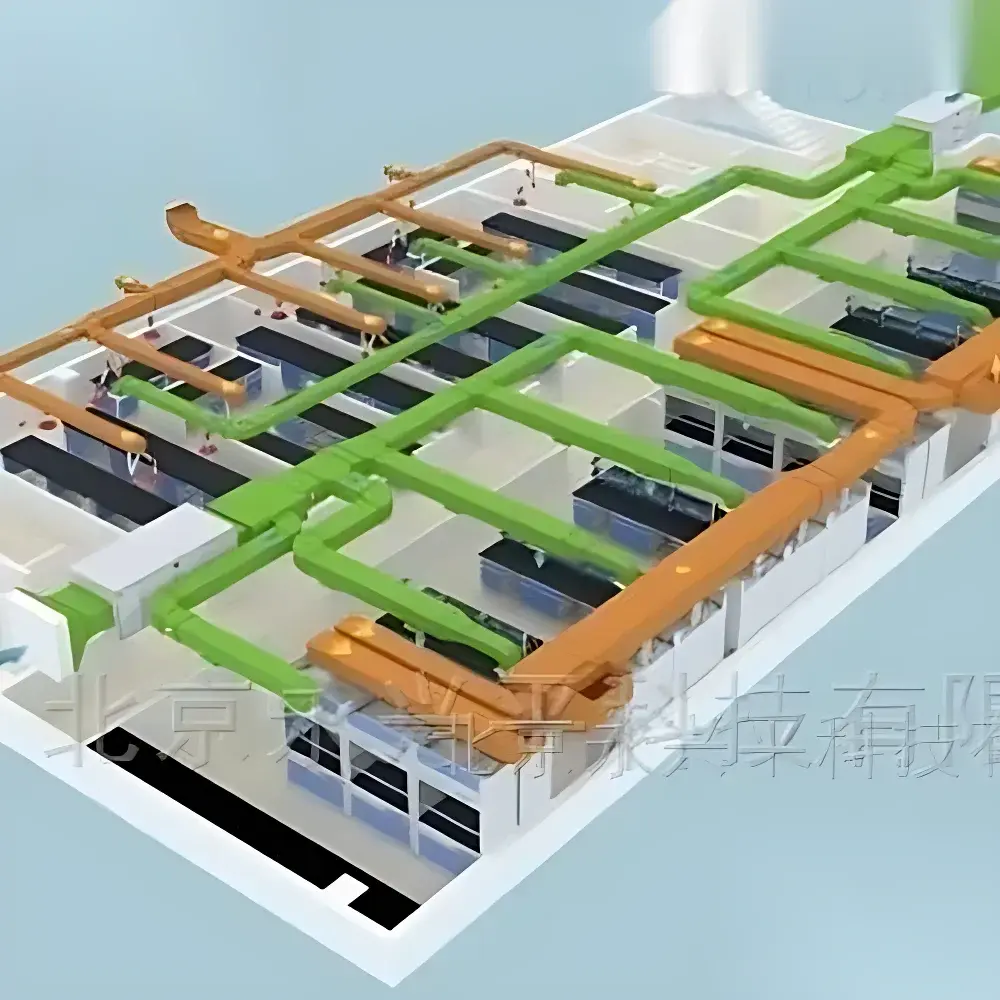
YXP Laboratory Ventilation Engineering System
| Brand | Other Brands |
|---|---|
| Origin | Imported |
| Manufacturer Type | General Distributor |
| Model | YXP |
| Pricing | Upon Request |
Overview
The YXP Laboratory Ventilation Engineering System is a comprehensive, engineered solution for the safe and compliant management of airborne chemical, biological, and particulate hazards in research, analytical, and quality control laboratories. Unlike standalone fume hoods or exhaust fans, the YXP system integrates architectural airflow design, mechanical ventilation components, and intelligent control logic to maintain consistent directional airflow, negative pressure differentials across containment zones, and predictable air exchange rates (typically 6–12 ACH for general labs; higher for high-risk applications). It operates on the fundamental principle of dilution ventilation and local exhaust capture—leveraging laminar and turbulent flow dynamics to prevent recirculation of hazardous vapors, aerosols, and reactive gases generated during sample preparation, synthesis, or instrumentation operation (e.g., ICP-MS, GC-MS, wet chemistry stations). The system is designed to meet baseline performance requirements aligned with ANSI/ASHRAE Standard 110 (fume hood testing), EN 14175 (laboratory fume cupboard performance), and ISO 16000-3 (indoor air quality assessment protocols).
Key Features
- Modular ductwork layout compatible with standard ceiling grid heights and wall-mounted service columns, supporting both ceiling-suspended and floor-standing terminal units.
- Variable Air Volume (VAV) airflow control integrated with occupancy sensors and sash-position feedback to dynamically adjust exhaust and supply rates—reducing energy consumption while maintaining face velocity stability (0.4–0.6 m/s at hood sash openings).
- Corrosion-resistant construction: galvanized steel ducts with epoxy-coated interior surfaces; stainless-steel dampers and fan housings rated for continuous exposure to acidic, alkaline, and organic solvent vapors.
- Redundant safety interlocks including fire-dampers, CO₂/O₂ monitoring integration points, and emergency purge override mode activated via wall-mounted manual stations.
- Acoustic attenuation package meeting NC-35 criteria for laboratory ambient noise levels, minimizing operational distraction without compromising static pressure recovery.
Sample Compatibility & Compliance
The YXP system accommodates diverse laboratory workflows involving volatile organic compounds (VOCs), hydrogen sulfide, chlorine, ammonia, formaldehyde, hydrofluoric acid, and low-boiling-point solvents. Its design supports compatibility with biosafety cabinets (Class II A2/B2), gloveboxes, and inert-atmosphere workstations through dedicated exhaust trunk lines and backpressure-compensated branch connections. Compliance documentation includes CE marking per EU Machinery Directive 2006/42/EC and Pressure Equipment Directive 2014/68/EU where applicable; third-party verification reports for airflow uniformity, leakage rate (<0.5% at 1500 Pa static pressure), and duct velocity profile conformity are available upon project specification. The system architecture permits seamless integration into facilities operating under GLP, ISO/IEC 17025, or FDA 21 CFR Part 11 environments—particularly where audit-trail-capable HVAC loggers and alarm event timestamping are required.
Software & Data Management
The YXP system interfaces with industry-standard Building Management Systems (BMS) via BACnet MS/TP or Modbus RTU protocols. Optional embedded controller firmware provides real-time logging of total airflow (m³/h), static pressure differentials (Pa), fan RPM, filter differential pressure, and fault codes—with data export in CSV or OPC UA format. Historical records are retained for ≥18 months onboard and support automated generation of ASHRAE-compliant ventilation validation reports. All configuration changes, alarm acknowledgments, and manual overrides are time-stamped and user-ID logged to satisfy traceability requirements under ISO 9001 Clause 8.5.2 and Annex A.5 of ISO/IEC 17025:2017.
Applications
- Chemistry and pharmaceutical R&D labs handling synthesis, crystallization, and stability testing under controlled atmospheric conditions.
- Environmental testing facilities performing EPA Method 8270/8260 analyses requiring VOC containment and odor suppression.
- Materials science laboratories conducting plasma etching, thin-film deposition, or battery electrolyte handling.
- Clinical diagnostics and pathology labs managing formalin-fixed tissue processing and immunohistochemistry reagents.
- University teaching labs where variable occupancy patterns and multi-user scheduling necessitate adaptive airflow governance.
FAQ
Does the YXP system include fume hoods or is it limited to ductwork and controls?
The YXP designation refers to the full ventilation engineering package—including duct routing, fan arrays, VAV boxes, and central control logic. Fume hoods are specified separately as end-point devices and selected based on application risk class (e.g., ducted vs. recirculating, perchloric acid-rated, radioisotope-certified).
Can the system be retrofitted into an existing laboratory building?
Yes—modular duct segments, flexible connectors, and compact inline fans allow phased installation with minimal structural modification. Structural load analysis and ceiling cavity clearance verification are conducted during pre-installation site survey.
What certifications are provided upon commissioning?
Final deliverables include ASHRAE 110 tracer gas test reports, duct leakage certification per SMACNA HVAC Air Duct Leakage Test Manual, and functional performance verification sign-off by a licensed mechanical engineer.
Is remote monitoring supported?
Standard Ethernet/IP connectivity enables secure remote access via TLS-encrypted web interface or API endpoints for integration into enterprise lab infrastructure dashboards.



