
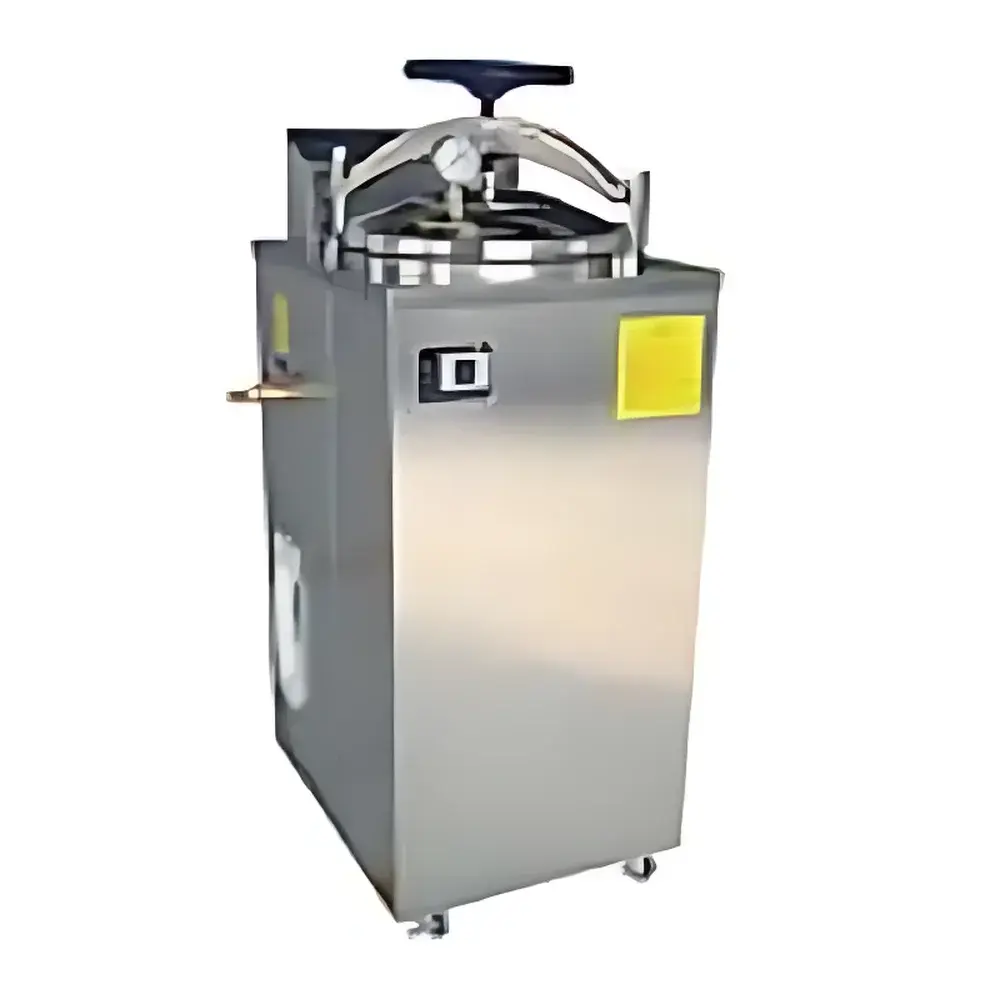
YXQ-LS-50G Vertical Steam Sterilizer
| Origin | Shanghai, China |
|---|---|
| Manufacturer Type | Authorized Distributor |
| Country of Origin | China |
| Model | YXQ-LS-50G |
| Chamber Volume | 50 L |
| Max Operating Temperature | 135 °C |
| Max Working Pressure | 0.22 MPa |
| Sterilization Power | 3.1 kW |
| Drying Power | 0.8 kW |
| Voltage/Frequency | 220 V ±10% / 50 Hz ±2% |
| External Dimensions (W×D×H) | 600 × 500 × 1080 mm |
| Internal Chamber Diameter × Height | Ø350 × 525 mm |
| Basket Dimensions | Ø330 × 250 mm (2 pcs) |
| Sterilization Time Range | 4–120 min |
| Drying Time Range | 30–240 min |
| Temperature Range | 109–135 °C |
| Safety Compliance | Meets PRC Pressure Vessel Safety Technical Supervision Regulations (Article 49) |
Overview
The YXQ-LS-50G Vertical Steam Sterilizer is a fully automated, microprocessor-controlled laboratory-grade autoclave engineered for reliable terminal sterilization of heat-stable instruments, glassware, culture media, and porous loads in pathology, histology, microbiology, and biomedical research laboratories. It operates on the fundamental principle of saturated steam under pressure—leveraging the well-established thermal lethality kinetics of moist heat to achieve sterility assurance levels (SAL) of 10−6 per item, in accordance with ISO 17665-1:2017 (Sterilization of health care products — Moist heat — Part 1: Requirements for the development, validation and routine control of a sterilization process for medical devices). Designed for vertical orientation to conserve bench or floor space, the unit integrates sterilization and post-cycle drying in a single chamber, eliminating the need for separate drying ovens and reducing workflow interruption. Its robust construction and safety-critical architecture align with national pressure equipment regulatory frameworks applicable to Class I fixed pressure vessels in China, while its operational logic supports compliance with GLP and basic GMP documentation requirements through repeatable, parameter-locked cycles.
Key Features
- Microcomputer-based intelligent control system with digital PID temperature regulation and real-time cycle monitoring
- Handwheel-type quick-opening door equipped with dual mechanical and interlock safety mechanisms—fully compliant with Article 49 of the PRC Pressure Vessel Safety Technical Supervision Regulations
- Chamber and outer casing fabricated from high-grade SUS304 stainless steel for long-term resistance to acidic, alkaline, and saline corrosion encountered in routine lab cleaning and sterilization environments
- Self-sealing silicone gasket with automatic expansion under pressure, ensuring leak-tight integrity during pressurization and eliminating manual torque adjustment
- Integrated cold air purge via internal circulating exhaust mode with 3-L condensate collection bottle, enabling efficient air removal prior to sterilization phase
- Comprehensive safety suite: overpressure self-relief valve, low-water-level alarm with automatic power cutoff, dry-run prevention, overtemperature protection, and auto-shutdown upon cycle completion
- Three-stage programmable operation modes: sterilization-only; sterilization + exhaust + drainage; sterilization + exhaust + drainage + drying
- Acoustic end-of-cycle alert and automatic de-energization for operator safety and energy efficiency
Sample Compatibility & Compliance
The YXQ-LS-50G accommodates standard histology instrument sets, stainless-steel forceps, scalpel handles, reusable glass petri dishes, agar-filled culture tubes, and wrapped surgical packs—provided load configuration permits uniform steam penetration. Its 50-L chamber (Ø350 × 525 mm) and dual Ø330 × 250 mm stainless-steel baskets support batch processing without compromising load homogeneity. While not certified to EN 13060 or FDA 510(k) standards out-of-the-box, the device’s operational parameters (109–135 °C, 0.22 MPa max) fall within validated ranges used in ISO/IEC 17025-accredited labs for non-critical and semi-critical item sterilization. Users are advised to perform installation qualification (IQ), operational qualification (OQ), and performance qualification (PQ) per local SOPs and institutional biosafety policies prior to routine use.
Software & Data Management
The embedded controller provides non-volatile cycle storage for up to 10 user-defined programs, each configurable with independent setpoints for sterilization temperature, hold time, and post-sterilization drying duration. Real-time display shows current chamber temperature, pressure, elapsed time, and phase status (heating, sterilizing, exhausting, drying). Though the unit does not feature Ethernet/Wi-Fi connectivity or electronic audit trail functionality, all cycle parameters are logged internally with timestamped start/end records accessible via front-panel navigation—supporting manual traceability for GLP-aligned documentation. For facilities requiring 21 CFR Part 11 compliance, integration with external data loggers or LIMS systems is recommended via RS232 or analog output interfaces (optional accessories).
Applications
- Routine sterilization of histopathology tools, embedding cassettes, and paraffin-processing accessories in pathology core labs
- Preparation of sterile nutrient agar, broth media, and buffer solutions in academic and clinical microbiology settings
- Decontamination of biohazardous waste containers and reusable PPE components in BSL-2 containment areas
- Terminal sterilization of stainless-steel instruments used in animal surgery and tissue harvesting protocols
- Validation support for sterilization process development in preclinical research facilities operating under institutional biosafety committee (IBC) oversight
FAQ
What is the maximum load capacity for this sterilizer?
The chamber accepts two standard baskets (Ø330 × 250 mm each), accommodating up to 50 L of loosely packed, steam-permeable items. Optimal loading should maintain ≥25% free volume for effective air removal and steam circulation.
Does the unit comply with international sterilization standards such as ISO 17665?
The YXQ-LS-50G implements core physical principles defined in ISO 17665-1 (moist heat sterilization), but formal conformity assessment and third-party certification are not included. Validation must be conducted by the end-user per ISO 17665-2 guidelines.
Can it sterilize liquids in sealed containers?
No. This model is not designed for liquid cycle sterilization. Sealed vials or flasks may rupture due to thermal expansion; only open or vented containers should be processed.
Is routine maintenance required beyond daily draining and gasket inspection?
Yes. Weekly chamber interior cleaning with mild detergent, quarterly safety valve testing, and annual calibration of temperature/pressure sensors are strongly recommended to sustain performance and regulatory readiness.
What electrical infrastructure is needed for safe operation?
A dedicated 220 V ±10%, 50 Hz ±2% circuit with minimum 20 A breaker rating and proper grounding is mandatory. Voltage fluctuations exceeding specification may impair microcontroller stability and heating element longevity.





