
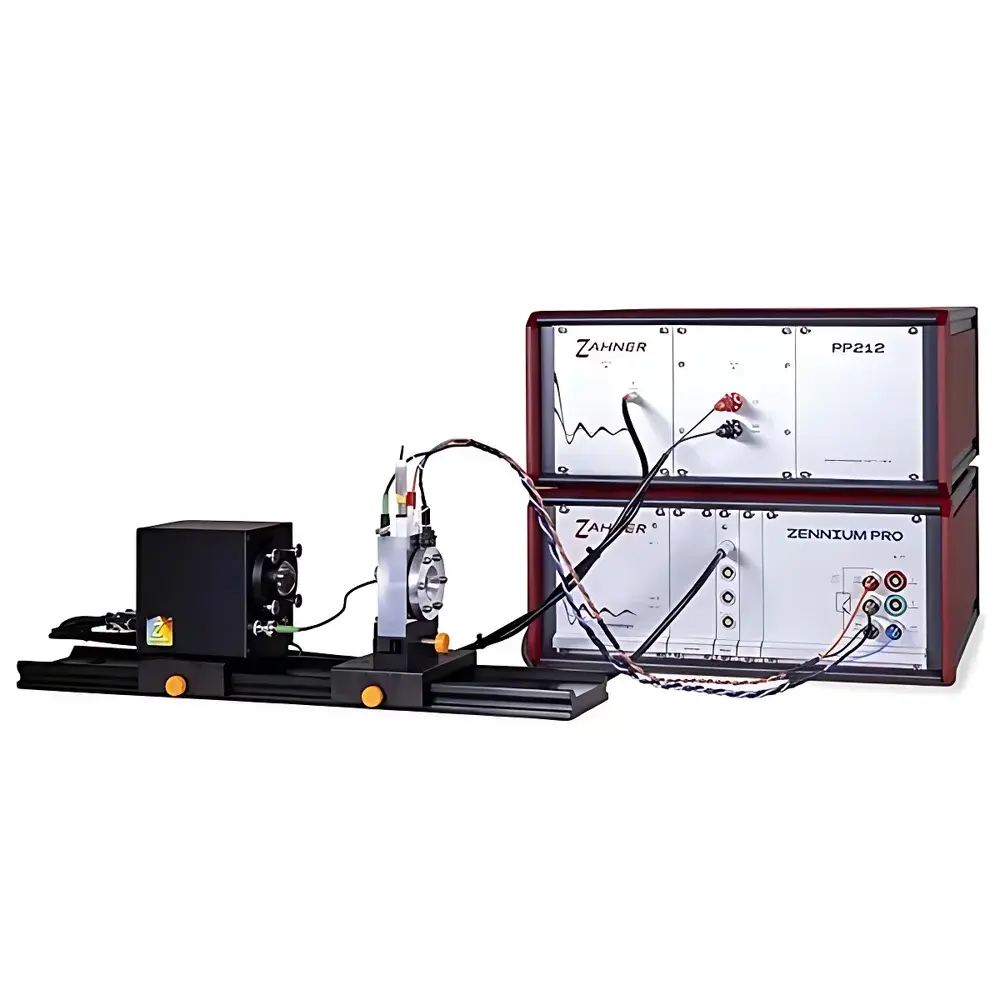
Zahner CIMPS Pro Zennium Electrochemical Workstation with Controlled Intensity Modulated Photoelectrochemical Spectroscopy Capability
| Brand | Zahner |
|---|---|
| Origin | Germany |
| Model | CIMPS-Pro Zennium |
| Instrument Type | Electrochemical Workstation |
| Channel Count | Single-Channel |
| Current Range | ±3 A, ±10 A |
| Current Accuracy | 0.02% of reading |
| Potential Accuracy | ±50 µV |
| Potentiostatic Range | ±15 V, ±20 V |
| AC Impedance Frequency Range | 10 µHz – 8 MHz |
Overview
The Zahner CIMPS Pro Zennium Electrochemical Workstation is a high-precision, research-grade platform engineered for controlled intensity modulated photoelectrochemical spectroscopy (CIMPS), integrating synchronized electrochemical and optoelectronic measurement capabilities within a single, unified architecture. Unlike conventional potentiostats, the CIMPS system implements real-time closed-loop optical intensity regulation—enabling quantitative, traceable, and reproducible photoresponse characterization under dynamically modulated illumination. Its core operational principle relies on simultaneous acquisition of photocurrent (IMPS) and photovoltage (IMVS) transients in response to precisely calibrated sinusoidal or stepwise light intensity perturbations, while maintaining strict galvanostatic or potentiostatic control. This dual-domain (electrochemical + photonic) measurement fidelity makes it indispensable for evaluating charge carrier generation, recombination kinetics, interfacial charge transfer resistance, and transport time constants in photoactive materials—including perovskite solar cells, dye-sensitized solar cells (DSSCs), photoelectrodes for water splitting, organic photovoltaics (OPVs), and quantum dot heterostructures.
Key Features
- Real-time closed-loop optical intensity control via integrated NIST-traceable photodiode sensor embedded within each smart LED light source unit
- Automatic recognition of interchangeable light sources (365–1550 nm) via onboard identification chips storing full calibration metadata
- Dual-mode operation: simultaneous IMPS (intensity-modulated photocurrent spectroscopy) and IMVS (intensity-modulated photovoltage spectroscopy)
- High-resolution current and potential control: ±10 A current range with 0.02% accuracy; ±20 V compliance voltage; 50 µV potential resolution
- Broad-frequency electrochemical impedance spectroscopy (EIS) from 10 µHz to 8 MHz, fully compatible with photocurrent-coupled frequency domain analysis
- Integrated EPC42 optical modulation controller, PP212 external bipotentiostat/galvanostat, and motorized optical bench with precision alignment stages
- Overload protection circuitry for all optical modules and electrochemical channels, ensuring long-term hardware stability during extended transient measurements
Sample Compatibility & Compliance
The CIMPS Pro Zennium supports standard three-electrode electrochemical cells as well as custom-designed photoelectrochemical cells (e.g., quartz-window sealed cells, gas-tight H-cell configurations, and microfluidic integration). It accommodates solid-state, liquid-junction, and hybrid electrolyte systems—including aqueous, non-aqueous, and ionic liquid media. All hardware and firmware comply with IEC 61010-1 safety standards for laboratory electrical equipment. Software execution adheres to GLP and GMP principles where applicable: Thales software supports user-defined audit trails, electronic signatures, and 21 CFR Part 11-compliant data integrity protocols—including immutable raw data storage, version-controlled method files, and timestamped operator logs. Calibration certificates for light sources are issued per ISO/IEC 17025-accredited procedures by Zahner’s metrology laboratory.
Software & Data Management
Thales software serves as the unified interface for instrument control, experiment sequencing, and real-time visualization. It includes preconfigured templates for IMPS, IMVS, transient photocurrent/voltage, charge extraction (CE), chopped-light voltammetry (CLV), and classical EIS/CV. Raw data are stored in open-format HDF5 containers with embedded metadata (wavelength, irradiance, electrode geometry, electrolyte composition). The SIM modeling module enables advanced equivalent circuit fitting—including distributed element models (e.g., transmission line, constant phase elements) and analytical photocarrier transport functions (e.g., diffusion-limited, recombination-limited, surface-state-mediated responses). Export options include CSV, MATLAB (.mat), and Origin-compatible formats. Batch processing, script-based automation (via Python API), and cloud-synced project repositories are supported for multi-user lab environments.
Applications
- Quantitative determination of electron/hole transport times and recombination lifetimes in thin-film photoelectrodes
- Frequency-resolved efficiency mapping of photovoltaic devices under variable bias and illumination conditions
- In situ monitoring of interfacial degradation mechanisms during operational stability testing (e.g., J–V hysteresis, Voc decay kinetics)
- Characterization of charge separation efficiency at semiconductor/electrolyte interfaces in photoelectrocatalytic systems
- Correlation of IPCE/QE spectra with EIS-derived surface state density and flat-band potential shifts
- Development and validation of physics-based device models for perovskite and tandem solar cells
FAQ
What distinguishes CIMPS from conventional potentiostats equipped with external light sources?
CIMPS integrates optical feedback control directly into the measurement loop—eliminating drift-induced artifacts common in open-loop setups. Each light source is factory-calibrated against NIST standards and auto-identified by the system, ensuring irradiance accuracy better than ±2% across its spectral range.
Can CIMPS perform both IMPS and IMVS in a single experiment?
Yes—the Zennium hardware architecture allows synchronous acquisition of both photocurrent and photovoltage transients under identical illumination modulation profiles, enabling direct calculation of photoconductance and photovoltage gain spectra.
Is the system compatible with third-party photoelectrochemical cells?
All standard cell geometries with BNC or triaxial connections are supported. Custom cell integration requires verification of optical path alignment and electrical shielding compatibility—documentation and mechanical drawings are provided upon request.
How is light intensity calibrated in CIMPS?
Users may input absolute irradiance values in W/cm²; the system automatically adjusts LED drive current using real-time photodiode feedback. Calibration curves for each wavelength channel are stored in the source’s identification chip and applied dynamically during measurement.
Does Thales software support automated sequence programming for accelerated screening?
Yes—users can define multi-step protocols combining illumination ramping, potential stepping, and impedance acquisition, with conditional branching based on real-time parameter thresholds (e.g., current saturation, Voc stabilization).





