
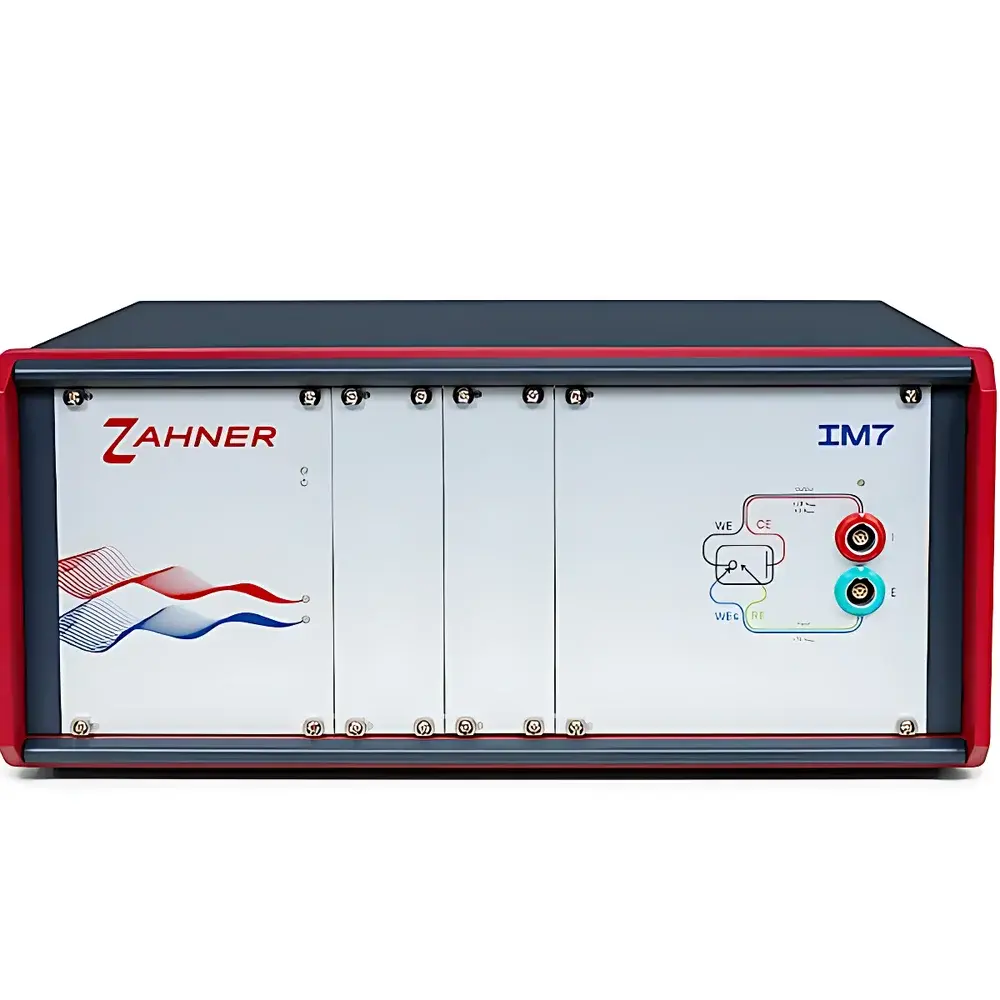
Zahner IM7 Electrochemical Workstation
| Brand | Zahner |
|---|---|
| Origin | Germany |
| Model | IM7 |
| Instrument Type | Electrochemical Workstation |
| Channel Count | Single-Channel |
| Current Range | ±3 A |
| Current Accuracy | < 0.0025% |
| Potential Range | ±15 V |
| EIS Frequency Range | 10 µHz – 8 MHz |
| Input Impedance | >10 TΩ |
| ADC Resolution | 32-bit |
| Voltage Resolution | 2.5 nV / 7.5 nV |
| Current Resolution | ±2 aA (2 × 10⁻¹⁸ A) |
| Small-Signal Rise Time | 150 ns – 200 µs (5 auto-ranging steps) |
| IR Compensation | Real-time, adaptive |
| Grounding Mode | Switchable floating/grounded |
| Communication Interface | Gigabit Ethernet |
| Internal Storage | 40 GB SSD |
Overview
The Zahner IM7 Electrochemical Workstation is a high-performance, modular electrochemical measurement platform engineered for precision, stability, and scalability in advanced research and industrial development environments. Built upon Zahner’s decades of expertise in electrochemical instrumentation, the IM7 integrates potentiostat, galvanostat, and frequency response analyzer (FRA) functionalities into a single, unified architecture. Its core measurement principle relies on digital-controlled analog feedback loops with ultra-low-noise signal conditioning, enabling true DC–10 MHz bandwidth operation and sub-attoampere current resolution. Designed for demanding applications—including fuel cell stack characterization, battery electrode kinetics, corrosion science under high-impedance conditions, and photoelectrochemical studies—the IM7 delivers laboratory-grade reproducibility and traceable metrology compliant with ISO/IEC 17025-aligned calibration practices.
Key Features
- Ultra-high-resolution 32-bit ADC/DAC architecture supporting ±2 aA current resolution and 2.5 nV voltage resolution—enabling detection of interfacial charge transfer processes at near-theoretical limits.
- Wide dynamic range: ±3 A maximum current output and ±15 V applied potential window, with ±28 V compliance voltage for high-resistance systems such as coated metals, geological electrolytes, or pressurized autoclave cells.
- Comprehensive EIS capability spanning 10 µHz to 8 MHz with <0.0025% frequency accuracy and 10,000 steps per decade resolution—ideal for multi-scale impedance modeling from double-layer relaxation to bulk transport phenomena.
- Switchable grounded/floating reference configuration, allowing safe and accurate measurements in non-earth-referenced setups (e.g., pipeline corrosion monitoring, high-voltage battery modules, or electrochemical reactors).
- Modular expansion support via standardized interfaces: external potentiostats, electronic loads, CIMPS photoelectrochemical modules, and multi-channel impedance multiplexers for simultaneous EIS on up to five individual cells within a stack.
- Gigabit Ethernet interface with embedded 40 GB SSD for local data buffering, time-stamped acquisition, and deterministic network timing—critical for GLP/GMP-compliant audit trails and synchronized multi-instrument experiments.
Sample Compatibility & Compliance
The IM7 accommodates a broad spectrum of electrochemical sample configurations—from microelectrodes and rotating disk electrodes (RDE/RRDE) to full-scale fuel cell MEAs and lithium-ion pouch cells. Its >10 TΩ input impedance ensures minimal loading error during high-impedance measurements (e.g., polymer electrolyte membranes or passive oxide layers), while its real-time adaptive IR compensation algorithm supports accurate kinetic analysis even in poorly conductive media. The system complies with key international standards including ASTM G102 (calculation of corrosion rates), ISO 16773 (EIS for coatings), USP (analytical instrument qualification), and FDA 21 CFR Part 11 requirements when used with Zahner Lab’s audit-trail-enabled workflows and electronic signature support.
Software & Data Management
Zahner Lab is the native control and analysis software suite for the IM7, developed for cross-platform compatibility (Windows 11, macOS, Linux) and engineered to meet rigorous scientific workflow standards. Its drag-and-drop experiment builder—based on Google Blockly’s visual programming framework—enables rapid construction of complex, repeatable sequences (e.g., GITT/PITT protocols interleaved with time-resolved EIS). Each measurement includes embedded metadata (timestamp, hardware ID, calibration state, environmental logs), ensuring full traceability. Remote access via secure Ethernet enables collaborative lab management, multi-user observation (with single active control), and integration into automated test benches via Python/C++ APIs. Offline analysis is supported by Zahner Analysis, featuring Z-HIT validation, Kramers–Kronig consistency checks, equivalent circuit fitting with statistical uncertainty estimation, and Mott–Schottky/DC polarization curve deconvolution.
Applications
- Electrocatalysis and reaction mechanism studies (OER, HER, CO₂RR) using transient techniques and multi-frequency EIS.
- Fuel cell and electrolyzer R&D: single-cell and stack-level diagnostics, degradation mapping, and impedance tomography.
- Lithium-ion and solid-state battery development: SEI formation kinetics, Li-plating detection, and aging trajectory modeling.
- Corrosion science: localized corrosion monitoring, coating delamination assessment, and cathodic protection optimization in buried infrastructure.
- Photoelectrochemistry: CIMPS-integrated quantum efficiency mapping and charge separation lifetime analysis.
- Sensor development: low-concentration analyte detection, redox mediator kinetics, and biofilm-electrode interface characterization.
- Materials science: conductivity profiling of conductive polymers, ionic liquids, and hybrid perovskites under controlled bias and illumination.
FAQ
What distinguishes the IM7 from previous Zahner workstations?
The IM7 introduces a fully re-engineered signal chain with 32-bit ADC resolution, gigabit Ethernet deterministic control, and native support for floating-ground topologies—enabling direct integration into high-voltage and isolated experimental systems without external isolation amplifiers.
Can the IM7 perform simultaneous EIS on multiple electrodes?
Yes—using optional multi-channel impedance multiplexer hardware, the IM7 can acquire parallel EIS spectra from up to five independent working electrodes within a single test sequence, with synchronized timing and shared reference/counter connections.
Is Zahner Lab compatible with third-party automation frameworks?
Yes—Zahner provides documented Python and C++ APIs for programmatic control, data streaming, and experiment orchestration, supporting integration with LabVIEW, MATLAB, or custom CI/CD pipelines for high-throughput screening.
How is calibration traceability maintained?
Each IM7 ships with factory calibration certificates traceable to national metrology institutes (PTB, NIST); users may perform in-house verification using Zahner’s certified reference cells and impedance standards, with full logging in Zahner Lab’s audit trail module.
Does the system support long-term unattended operation?
Yes—the embedded SSD, watchdog timers, network health monitoring, and automatic recovery protocols enable continuous operation over weeks, with configurable email/SNMP alerts for anomalies or completion events.
Related Products





