
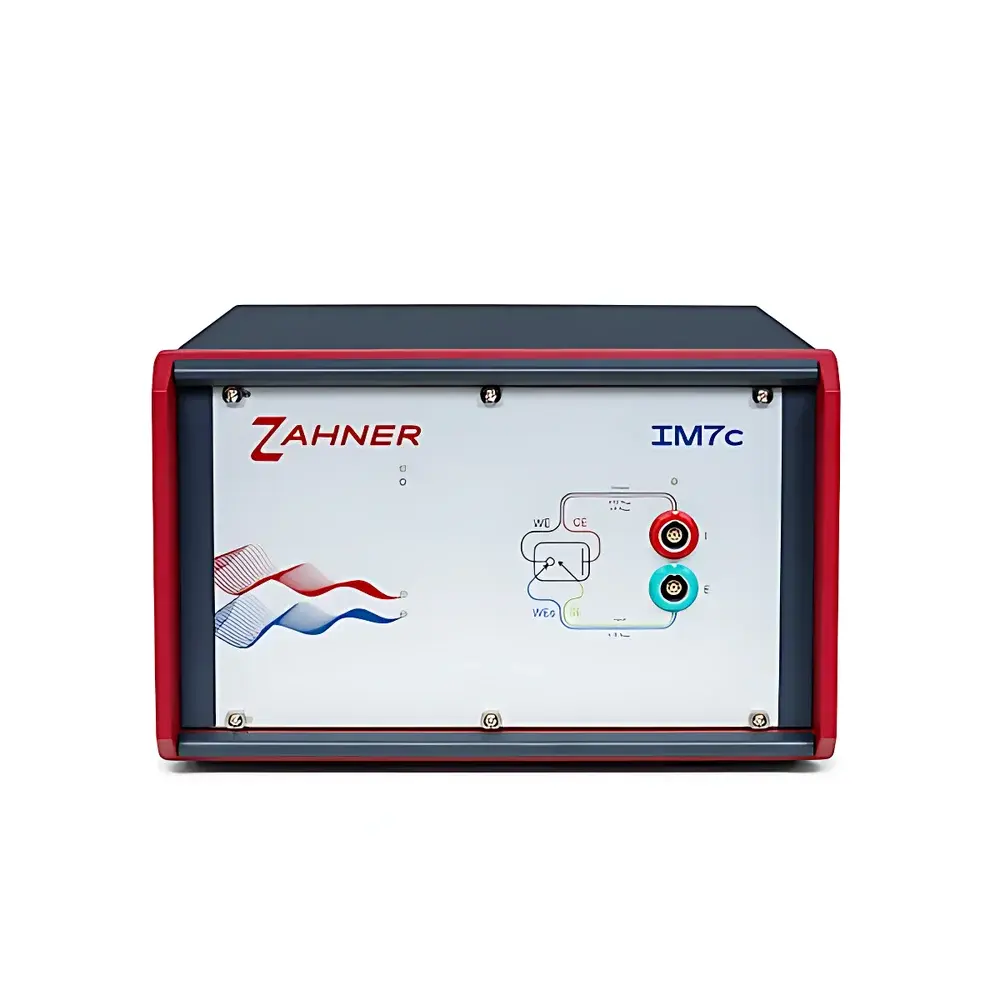
Zahner IM7c Electrochemical Workstation
| Brand | Zahner |
|---|---|
| Origin | Germany |
| Model | IM7c |
| Instrument Type | Electrochemical Workstation |
| Channel Count | Single-Channel |
| Current Range | ±2 A |
| EIS Frequency Range | 10 µHz – 5 MHz |
| ADC Resolution | 32-bit |
| Voltage Scan Range | ±14 V |
| Potentiostatic Range | ±5 V / ±14 V |
| Voltage Resolution | 2.5 nV / 7.5 nV |
| Current Resolution | 2 × 10⁻¹⁸ A |
| Input Impedance | >10 TΩ (HIZ option: 1000 TΩ) |
| AC Voltage Perturbation | 0–6 V (24-bit resolution) |
| AC Current Perturbation | 0–2 A (24-bit, 12 ranges) |
| Grounding Modes | Grounded & Floating |
| IR Compensation Range | 0–10 MΩ |
| Bandwidth | DC–6 MHz |
| Communication Interface | Gigabit Ethernet |
| Internal Storage | 40 GB SSD |
| CV Scan Rate | up to 10,000 V/s (with ADF high-speed option) |
Overview
The Zahner IM7c Electrochemical Workstation is a precision-engineered, single-channel potentiostat/galvanostat platform designed for advanced electrochemical characterization in research and industrial development environments. Built upon Zahner’s legacy of high-fidelity instrumentation, the IM7c implements true analog front-end architecture with 32-bit analog-to-digital conversion, enabling sub-attometer current resolution (2 × 10⁻¹⁸ A) and nanovolt-level voltage control. Its core measurement principle relies on four-quadrant bipotentiostatic operation with real-time digital signal processing, supporting both linear and non-linear electrochemical techniques—including potentiodynamic, galvanodynamic, and hybrid time/frequency-domain protocols. The system’s extended EIS frequency range (10 µHz to 5 MHz) and DC–6 MHz analog bandwidth ensure accurate impedance acquisition across ultra-low-frequency corrosion kinetics and high-frequency interfacial dynamics. Designed for demanding applications such as battery aging studies, fuel cell membrane evaluation, and in-situ electrolyzer diagnostics, the IM7c integrates hardware-level HDP (High Dynamic Precision) technology to maintain signal integrity across six decades of current magnitude without range switching artifacts.
Key Features
- 32-bit ADC/DAC architecture with 2.5 nV voltage resolution and 2 × 10⁻¹⁸ A current resolution for ultra-low-noise measurements
- True floating-ground capability—enabling safe, artifact-free measurements in grounded systems such as autoclaves, pipeline corrosion cells, or pressurized electrochemical reactors
- Programmable IR compensation with real-time, adaptive correction across 0–10 MΩ resistance range—critical for low-conductivity media and thick electrode architectures
- Optional ADF (Advanced Dynamic Fast) module enabling cyclic voltammetry scan rates up to 10,000 V/s with <100 ns step response
- Gigabit Ethernet interface supporting deterministic latency (<1 ms), remote synchronization, and secure multi-user access under lab network policies
- Integrated 40 GB SSD for onboard experiment logging, metadata tagging, and fail-safe data buffering during network interruptions
- HIZ (High-Impedance) input option extending input impedance to 1000 TΩ—essential for insulating film characterization and low-current biosensor applications
Sample Compatibility & Compliance
The IM7c accommodates a broad spectrum of electrochemical configurations: three-electrode cells, rotating disk electrodes (RDE), rotating ring-disk electrodes (RRDE), microelectrodes, solid-state batteries (via spring-loaded or vacuum-sealed fixtures), and aqueous/non-aqueous electrolyte systems. Its floating-ground design permits direct integration with external power supplies, electronic loads, and environmental chambers—enabling combined EIS-GITT, EIS-PITT, and operando impedance profiling of large-format energy storage devices. From a regulatory standpoint, the IM7c supports GLP/GMP-aligned workflows through audit-trail-enabled software logging, timestamped parameter versioning, and user-access-controlled experiment templates. While not certified as medical device hardware, its firmware and Zahner Lab software architecture comply with key principles of FDA 21 CFR Part 11 (electronic records/signatures) when deployed with institutional IT governance controls—including role-based permissions, encrypted data export, and immutable raw-data archiving.
Software & Data Management
Zahner Lab—the native control and analysis suite for the IM7 series—is a cross-platform application (Windows 11, Linux, macOS) built on a modular, extensible framework. Its drag-and-drop experiment builder allows users to compose complex, multi-step protocols—such as sequential EIS + CV + GITT cycles—with conditional branching and real-time parameter feedback. Each measurement is stored with full metadata (hardware configuration, calibration history, environmental tags), ensuring traceability and reproducibility. Remote operation is supported via standard TCP/IP; multiple Zahner Lab clients may simultaneously monitor one IM7 unit, though active control is restricted to a single session to prevent command collisions. For integration into automated test benches, native Python and C++ APIs provide low-level access to all instrument functions—including waveform generation, data streaming, and real-time FFT processing. Offline analysis is performed using Zahner Analysis, which includes Z-HIT validation, Kramers-Kronig consistency checking, equivalent circuit fitting (with custom topology definition), and Mott-Schottky/semiconductor parameter extraction.
Applications
The IM7c serves as a foundational tool across academic and industrial electrochemistry domains. In battery R&D, it enables precise quantification of SEI growth kinetics via low-frequency EIS, lithium plating detection through differential capacity analysis, and impedance evolution tracking during long-term cycling. For hydrogen technologies, it supports PEM electrolyzer membrane resistance mapping, catalyst stability assessment under dynamic polarization, and degradation mode identification in alkaline and AEM systems. Corrosion scientists utilize its ultra-low-frequency capability (10 µHz) for monitoring slow dissolution processes and coating delamination onset. Additional use cases include photoelectrochemical cell characterization (with synchronized light-source triggering), supercapacitor aging studies (via accelerated constant-current cycling with embedded EIS), and electrochemical biosensor development requiring femtoampere-level current detection and noise-immune phase-sensitive demodulation.
FAQ
What distinguishes the IM7c from earlier IM series models?
The IM7c introduces enhanced floating-ground isolation, gigabit Ethernet connectivity, integrated SSD storage, and native support for Zahner Lab’s modular experiment builder—replacing legacy script-based automation with visual workflow composition.
Can the IM7c perform simultaneous multi-frequency EIS?
Yes—it supports multi-sine EIS with up to 1024 frequency points per sweep, fully configurable in logarithmic or linear spacing, and compatible with time-resolved transient EIS acquisition.
Is third-party hardware integration supported?
Yes—via TTL triggers, analog I/O ports, and API-driven control, the IM7c synchronizes with commercial battery cyclers, climate chambers, optical spectrometers, and mass spectrometers.
Does the system support ASTM or ISO-standardized test methods?
Zahner Lab includes preconfigured templates for ASTM G102 (corrosion rate calculation), ASTM E1492 (EIS data validation), and ISO 12944-6 (coating impedance testing), with customizable reporting formats.
How is data security handled during remote operation?
All Ethernet communication uses TLS 1.2 encryption; user authentication is enforced via Windows Active Directory or local credential stores, and raw data files are SHA-256 hashed upon export to verify integrity.
Related Products




