
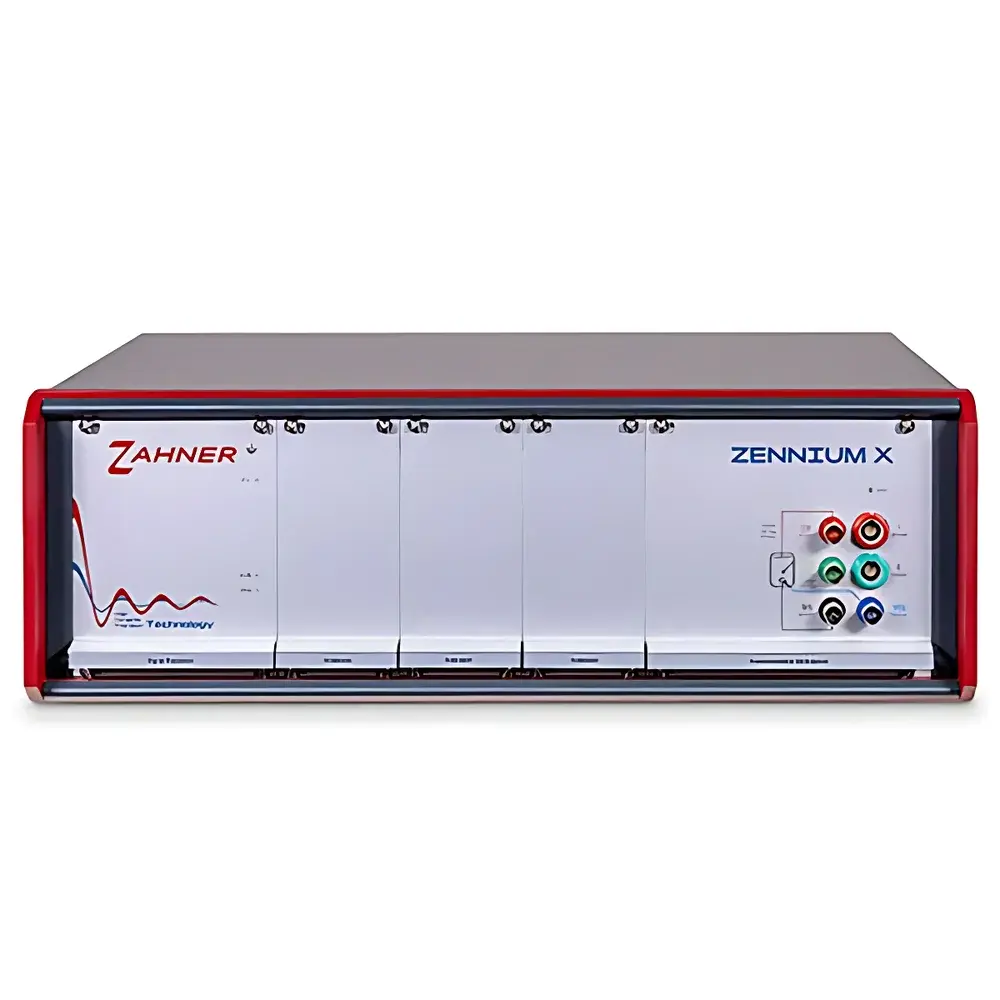
Zahner Zennium X Electrochemical Workstation
| Brand | Zahner |
|---|---|
| Origin | Germany |
| Model | Zennium X |
| Instrument Type | Electrochemical Workstation |
| Channel Count | Single-Channel |
| Current Range | ±4 A |
| Current Accuracy | ±0.02% of reading + ±0.01% of full scale (1 µA–100 mA), ±0.2% of reading + ±0.1% of full scale (100 mA–3 A), ±0.2% of reading + ±0.1% of full scale (10 nA–1 µA) |
| Potential Accuracy | ±50 µV |
| Potentiostatic Range | ±15 V |
| Compliance Voltage | ±32 V |
| EIS Frequency Range | 10 µHz–12 MHz |
| Frequency Accuracy | 0.0025% |
| Frequency Resolution | 10,000 steps/decade |
| Input Impedance | >10 TΩ |
| Voltage Resolution | 3 nV |
| Current Resolution | ±5 aA (32-bit DAC/ADC) |
| Bandwidth | 15 MHz |
| IR Compensation | Real-time, automatic EIS-based compensation |
| Grounding Mode | Switchable floating/grounded configuration |
| ADC/DAC Resolution | 32-bit HDP (High Dynamic Precision) architecture |
Overview
The Zahner Zennium X Electrochemical Workstation is a high-performance, research-grade potentiostat/galvanostat engineered for precision electrochemical characterization across academic, industrial, and regulatory environments. Built upon Zahner’s proprietary 32-bit High Dynamic Precision (HDP) analog/digital signal conversion architecture, the Zennium X delivers exceptional resolution, stability, and bandwidth—enabling rigorous quantitative analysis of interfacial charge transfer, mass transport, and surface reaction kinetics. Its core measurement principles include controlled-potential/current excitation, time-domain transient analysis (e.g., chronoamperometry, chronopotentiometry), and frequency-domain impedance spectroscopy (EIS) based on linear perturbation theory under small-signal conditions. With a DC current range of ±4 A and a compliance voltage up to ±32 V, the system supports demanding applications such as high-power battery cycling, fuel cell stack evaluation, and corrosion testing under realistic load conditions. The 15 MHz analog bandwidth ensures faithful reproduction of fast transient responses, while its >10 TΩ input impedance minimizes loading effects during ultra-high-impedance measurements—critical for dielectric coatings, solid electrolytes, and bioelectrochemical interfaces.
Key Features
- 32-bit HDP signal processing architecture for sub-aA current resolution (±5 aA) and 3 nV potential resolution
- Ultra-wide EIS frequency coverage from 10 µHz to 12 MHz with 0.0025% frequency accuracy and 10,000 steps per decade
- Real-time, model-free IR compensation integrated directly into EIS acquisition routines
- Switchable floating/grounded configuration for compatibility with grounded reference electrodes, three-electrode cells, and multi-cell stacks
- Modular expansion capability: supports optional high-current boosters (up to ±20 A), high-voltage modules (±100 V), electrochemical noise (ECN) probes, photoelectrochemical interfaces, and multi-channel impedance add-ons
- Auto-ranging current amplifiers with five dynamic response steps (150 ns – 200 µs rise time), enabling accurate capture of both fast kinetics and slow diffusion-limited processes
- Compliance voltage of ±32 V accommodates high-resistance systems including ceramic separators, polymer membranes, and thick protective coatings
Sample Compatibility & Compliance
The Zennium X is designed for universal compatibility with standard and custom electrochemical cells—including rotating disk electrodes (RDE), rotating ring-disk electrodes (RRDE), microelectrodes, gas diffusion electrodes (GDE), and in situ/operando flow cells. It meets essential requirements for GLP and GMP-aligned laboratories through audit-trail-capable software logging, user-access control, electronic signatures, and data integrity features compliant with FDA 21 CFR Part 11. All EIS and DC methods adhere to ASTM G106 (Standard Practice for Verification of Algorithmic Implementation of Electrochemical Impedance Spectroscopy), ISO 17025 traceability frameworks, and IEC 61000-4-30 for electromagnetic compatibility. Input protection circuits and galvanic isolation ensure safe operation with high-impedance samples such as lithium-ion battery separators (<1 mS/cm conductivity) and anti-corrosion polymer films.
Software & Data Management
Thales XT—the native software platform for Zennium instruments—provides an integrated environment for experiment design, real-time visualization, post-acquisition modeling, and reporting. It supports over 60 standardized electrochemical techniques categorized by application domain: CV/LSV, DPV, SWV, EIS, Mott-Schottky, NFRA, GITT/PITT, battery cycling (with coulombic efficiency tracking), and corrosion protocols (Tafel, LPR, EIS-based coating degradation). All experiments generate timestamped, metadata-rich datasets stored in HDF5 format for long-term archival and interoperability with Python/MATLAB. Thales XT includes built-in equivalent circuit fitting (Z-HIT validation, Kramers-Kronig consistency checks), automated baseline correction, multi-curve overlay with customizable legends/colors, and export to CSV, PNG, SVG, and PDF. Software updates are delivered via secure, version-controlled repositories with release notes documenting traceable changes per ISO/IEC 17025 clause 5.9.
Applications
The Zennium X serves as a foundational instrument in energy storage R&D (Li-ion, Na-ion, solid-state batteries), renewable energy conversion (PEMFC, SOFC, photoelectrochemical water splitting), corrosion science (coating lifetime prediction, inhibitor screening), sensor development (amperometric biosensors, gas sensors), and fundamental physical electrochemistry (double-layer structure, electron transfer kinetics at single-crystal electrodes). Its low-noise performance enables reliable detection of faradaic signals from monolayer catalysts, while its wide EIS bandwidth resolves both bulk electrolyte resistance (MHz range) and interfacial capacitance (µHz–mHz range) within a single scan—eliminating the need for instrument reconfiguration between high- and low-frequency regimes.
FAQ
What grounding configurations does the Zennium X support?
The instrument features a hardware-switchable ground/floating mode, allowing direct connection to grounded reference electrodes or isolated electrochemical cells without signal distortion.
Is Thales XT software compliant with 21 CFR Part 11?
Yes—Thales XT implements electronic signatures, role-based access control, immutable audit trails, and data encryption aligned with FDA requirements for regulated environments.
Can the Zennium X perform simultaneous multi-frequency EIS?
No—it acquires EIS spectra sequentially; however, its 12 MHz upper limit and 10 µHz lower limit enable comprehensive coverage of relaxation processes spanning 12 decades in a single sweep.
Does the system support real-time IR compensation during potentiodynamic scans?
Yes—IR compensation is applied dynamically during all EIS and DC techniques using adaptive algorithms that adjust based on instantaneous impedance magnitude and phase.
What is the maximum sampling rate for time-domain measurements?
The system achieves up to 5 MS/s (5 million samples per second) in high-speed transient modes, constrained only by selected current/potential ranges and filter settings.




