
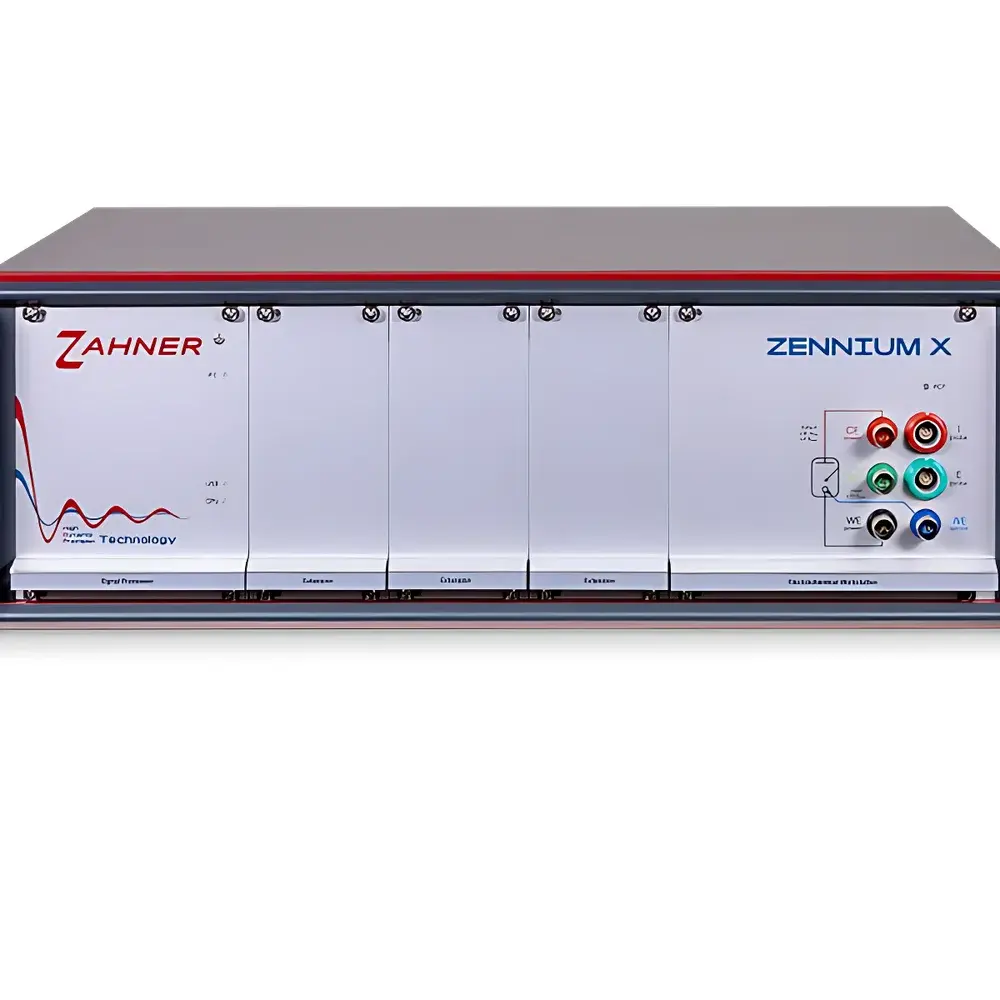
Zahner Zennium X Electrochemical Workstation
| Brand | Zahner |
|---|---|
| Origin | Germany |
| Model | Zennium X |
| Instrument Type | Electrochemical Workstation |
| Current Range | ±4 A |
| Current Accuracy | ±0.02% of reading + ±0.01% of full scale (1 µA–100 mA) / ±0.2% of reading + ±0.1% of full scale (100 mA–3 A) / ±0.2% of reading + ±0.1% of full scale (10 nA–1 µA) |
| Potential Accuracy | ±50 µV |
| Potentiostatic Range | ±15 V |
| EIS Frequency Range | 10 µHz–12 MHz |
| Input Impedance | >10 TΩ |
| Voltage Resolution | 3 nV |
| Current Resolution | ±2 aA (±2×10⁻¹⁸ A) |
| ADC Resolution | 32 bit |
| Bandwidth | 15 MHz |
| IR Compensation | Real-time, automatic |
| Grounding Mode | Switchable floating/grounded |
Overview
The Zahner Zennium X Electrochemical Workstation is a high-performance, modular potentiostat/galvanostat engineered for precision electrochemical characterization across research and industrial laboratories. Built on Zahner’s proprietary High Dynamic Performance (HDP) architecture, it integrates a 32-bit analog-to-digital converter (ADC), 15 MHz system bandwidth, and ultra-low-noise signal conditioning to deliver exceptional resolution and reproducibility in both DC and AC measurements. Its core measurement principle relies on four-quadrant current control and real-time digital feedback loops, enabling stable operation under highly capacitive or resistive loads—critical for thin-film electrodes, solid-state electrolytes, and low-conductivity media. The workstation supports full compliance with electrochemical standards including ASTM G102 (impedance calculation), ISO 16773 (corrosion monitoring), and IEC 62660-2 (battery cell testing), making it suitable for GLP/GMP-aligned environments where traceability and audit readiness are required.
Key Features
- Ultra-wide electrochemical impedance spectroscopy (EIS) range: 10 µHz to 12 MHz with frequency accuracy of ±0.0025% and 10,000 steps per decade
- High-resolution current sensing: ±2 aA (2×10⁻¹⁸ A) minimum detectable current via 32-bit ADC, supporting sub-picoampere kinetics studies
- Potentiostatic control with ±15 V compliance voltage and ±32 V slot voltage; voltage resolution down to 3 nV
- True four-quadrant operation with ±4 A maximum current output and selectable current ranges (10 nA–3 A)
- Real-time, automatic positive-feedback IR compensation integrated into all EIS and transient protocols
- Switchable grounding configuration (floating or grounded) for compatibility with grounded cells, battery packs, and multi-electrode arrays
- Modular expansion interface supporting external potentiostats, electronic loads, photoelectrochemical modules, and auxiliary analog/digital I/O
- Low-noise design with >10 TΩ input impedance and <5 pF parallel capacitance—optimized for high-impedance coatings, insulating films, and reference electrode stability
Sample Compatibility & Compliance
The Zennium X accommodates diverse electrochemical configurations—including three-electrode cells, rotating disk electrodes (RDE), scanning electrochemical microscopy (SECM) probes, fuel cell single cells, pouch and cylindrical battery test fixtures, and coated metal substrates. Its wide dynamic range and adaptive rise time (150 ns to 200 µs in five programmable steps) ensure accurate transient response for fast electron-transfer reactions and double-layer charging processes. For regulatory compliance, the system supports 21 CFR Part 11–ready software workflows (with electronic signatures, audit trails, and user role management), and its hardware meets EN 61326-1 (EMC) and EN 61010-1 (safety) requirements. It is routinely deployed in laboratories conducting ASTM D1148 (rubber aging), ISO 9223 (corrosivity classification), and USP (analytical instrument qualification) protocols.
Software & Data Management
Zennium X operates exclusively with Zahner’s Thales XT software—a Windows-based platform designed for method-driven experimentation and data integrity. Thales XT provides intuitive protocol building for cyclic voltammetry, chronoamperometry, pulse techniques, multi-sine EIS, and custom waveform generation. All raw data are stored in HDF5 format with embedded metadata (timestamp, instrument ID, calibration history, user annotations), ensuring FAIR (Findable, Accessible, Interoperable, Reusable) principles. The software includes built-in EIS fitting tools compliant with Kramers-Kronig validation, equivalent circuit modeling (ZView-compatible export), and automated report generation with PDF/XLSX export. Audit trail logs record every parameter change, file access, and user login event—fully traceable for FDA inspections or internal QA audits.
Applications
- Advanced battery R&D: SEI formation analysis, Li-ion diffusion coefficient mapping, impedance evolution during cycling, and thermal runaway onset detection
- Fuel cell catalyst evaluation: ORR activity quantification, membrane hydration monitoring, and degradation mechanism identification via low-frequency EIS
- Corrosion science: Electrochemical noise analysis (ENA), localized corrosion mapping, and inhibitor efficiency assessment under simulated service conditions
- Photoelectrochemistry: Incident photon-to-current efficiency (IPCE) measurements, transient photocurrent decay, and band-edge determination
- Materials development: Conductivity profiling of conductive polymers, redox-active MOFs, and 2D nanomaterial dispersions
- Sensor validation: Amperometric biosensor calibration, interference rejection testing, and long-term drift characterization
- Coating & surface engineering: Porosity estimation of anodized layers, barrier property quantification of organic coatings, and self-healing mechanism verification
FAQ
What is the minimum measurable current resolution of the Zennium X?
The system achieves ±2 aA (2×10⁻¹⁸ A) current resolution using its 32-bit ADC and ultra-low-noise front-end design—enabling reliable detection of single-molecule electron transfer events under optimized shielding conditions.
Can the Zennium X perform simultaneous multi-channel EIS measurements?
No—the Zennium X is a single-channel potentiostat. However, its modular architecture supports integration with up to three external Zahner potentiostat modules (e.g., Zennium EPC) via the optional Multi-Channel Expansion Unit, enabling synchronized multi-electrode EIS acquisition.
Is the IR compensation fully automated during EIS acquisition?
Yes—real-time positive-feedback IR compensation is applied continuously during frequency sweeps without interrupting data collection, preserving phase coherence and minimizing distortion at high frequencies.
Does the Zennium X support battery cycling protocols with variable load profiles?
Yes—Thales XT includes dedicated battery test modules compliant with IEC 61960 and GB/T 31486 standards, supporting CC/CV charge/discharge, pulse testing, HPPC, and dynamic stress profiling with configurable voltage/current limits and safety cutoffs.
How is calibration traceability maintained?
Zahner provides NIST-traceable calibration certificates for voltage, current, and impedance at time of delivery. Field recalibration is supported using the integrated self-test routine and optional external reference standards (e.g., Zahner CalKit-100k). Calibration history is embedded in all HDF5 data files and accessible via Thales XT audit log.




