
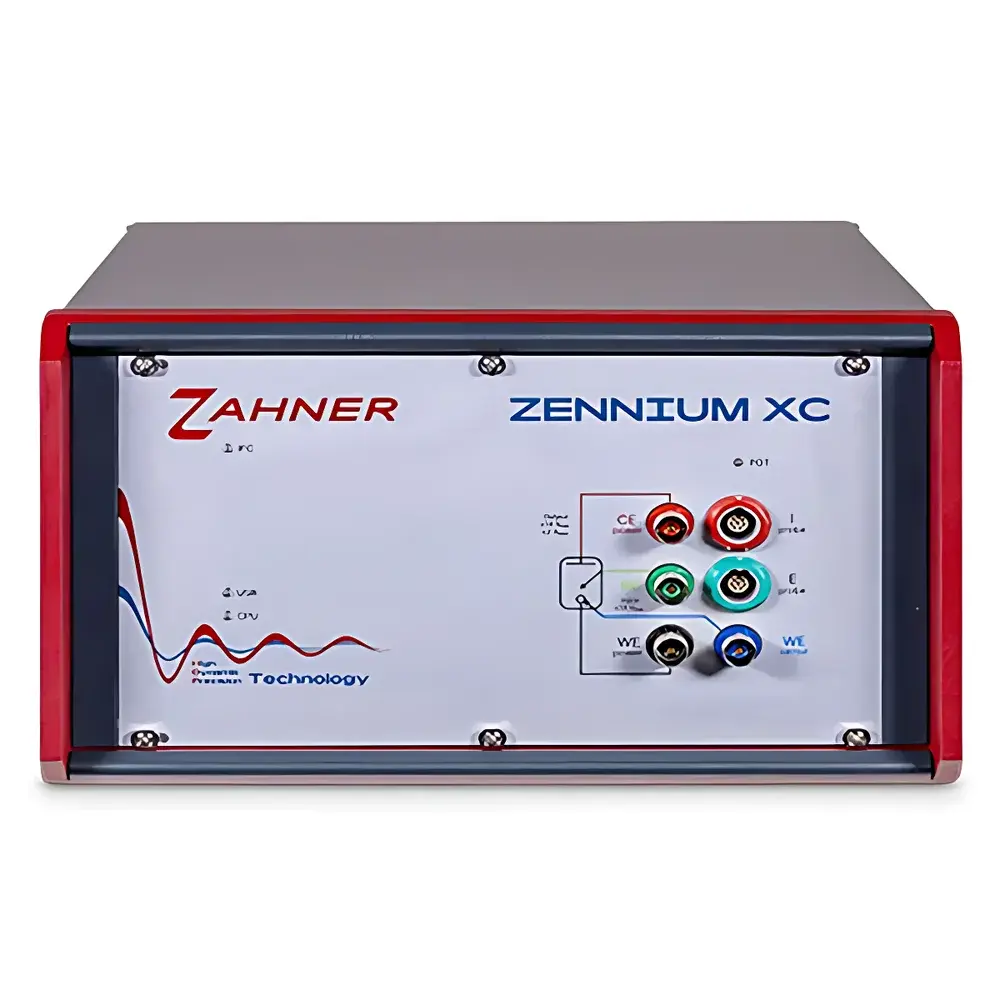
Zahner Zennium XC Electrochemical Workstation
| Brand | Zahner |
|---|---|
| Origin | Germany |
| Model | Zennium XC |
| Instrument Type | Electrochemical Workstation |
| Channel Count | Single-Channel |
| Current Range | ±2 A |
| Current Accuracy | 0.04% |
| Potential Accuracy | 100 µV |
| Potentiostatic Range | ±14 V |
| EIS Frequency Range | 10 µHz – 5 MHz |
| ADC Resolution | 32-bit |
| Voltage Resolution | 2.5 nV / 7.5 nV |
| Input Impedance | 10 TΩ (optional Hi-Z: 1000 TΩ) |
| EIS Accuracy | ±0.2% (100 mΩ–10 MΩ), ±2% (1 mΩ–100 mΩ or 10 MΩ–10 GΩ) |
| AC Perturbation Amplitude | 0–6 V (18-bit resolution) |
| Grounding Modes | Grounded & Switchable Floating Ground |
| IR Compensation | Real-time, automatic, 0–10 MΩ range |
| Bandwidth | 6 MHz |
| CV Scan Rate | up to 10,000 V/s (with ADF high-speed option) |
Overview
The Zahner Zennium XC Electrochemical Workstation is a precision-engineered, single-channel potentiostat/galvanostat designed for demanding electrochemical research and industrial development. Built upon Zahner’s proprietary HDP (High Dynamic Performance) architecture, it integrates a 32-bit analog-to-digital converter with ultra-low noise design and real-time digital signal processing to deliver exceptional resolution, stability, and fidelity across the full electrochemical measurement spectrum. Its core measurement principle relies on four-quadrant current control, galvanostatic/potentiostatic feedback loops with sub-microsecond response, and true dual-channel simultaneous acquisition (potential + current) for accurate kinetic and impedance characterization. The workstation supports both grounded and switchable floating ground configurations—enabling safe, artifact-free measurements in electrically isolated systems such as autoclaves, buried pipelines, fuel cell stacks, and high-voltage battery test cells. With a DC potential range of ±14 V and current capability up to ±2 A, the Zennium XC bridges the gap between benchtop versatility and system-level robustness required for applied electrochemistry under realistic operating conditions.
Key Features
- 32-bit high-resolution ADC with 5 aA current detection limit and 2.5 nV voltage resolution in low-noise mode
- Ultra-broad EIS frequency coverage from 10 µHz to 5 MHz—enabling both slow diffusion-controlled processes and fast interfacial kinetics analysis
- HDP technology ensures >140 dB dynamic range and <0.0025% frequency accuracy (10000 steps/decade)
- Real-time, fully automated IR compensation (0–10 MΩ range) with adaptive algorithm for stable EIS under varying solution resistance
- 6 MHz control bandwidth and optional ADF high-speed module supporting CV scan rates up to 10,000 V/s
- Configurable grounding: selectable grounded or floating operation—critical for corrosion studies in conductive media and high-pressure electrochemical reactors
- 18-bit programmable AC perturbation amplitude (0–6 V) with precise harmonic distortion control for nonlinear EIS (NFRA)
- Input impedance ≥10 TΩ (upgradable to 1000 TΩ with Hi-Z option), minimizing loading effects on high-impedance samples (e.g., coatings, membranes, insulating electrolytes)
Sample Compatibility & Compliance
The Zennium XC is compatible with a wide range of electrochemical interfaces—including aqueous and non-aqueous electrolytes, solid-state ion conductors, polymer electrolytes, gas diffusion electrodes, rotating disk/ring-disk electrodes (RDE/RRDE), microelectrodes, and coated metallic substrates. Its floating ground capability allows direct integration into grounded industrial setups without ground-loop interference. From a regulatory standpoint, the instrument supports GLP-compliant workflows through Thales-XT software’s audit-trail-enabled experiment logging, user-access controls, and timestamped raw data archiving. While not inherently FDA 21 CFR Part 11 certified, its data integrity framework—including immutable metadata tagging, checksummed binary storage (.zennium format), and export to CSV/TXT—aligns with ISO/IEC 17025 and ASTM G102 (standard practice for calculating corrosion rates) requirements. All firmware and hardware designs comply with CE, EMC Directive 2014/30/EU, and RoHS 2011/65/EU standards.
Software & Data Management
Thales-XT is the native, modular software platform for the Zennium XC—engineered for both real-time experimental control and rigorous offline analysis. It provides intuitive drag-and-drop sequence programming, multi-window live plotting with synchronized time-base scaling, and real-time parameter monitoring (e.g., phase angle, modulus, current transient). All experiments—including EIS, CV, LSV, CA/CP, Mott-Schottky, Z-HIT validation, NFRA, GITT/PITT, and battery cycling—are preconfigured with scientifically validated parameter presets. Offline analysis via Zahner Analysis includes advanced equivalent circuit fitting (EIS), Kramers-Kronig validation, distribution of relaxation times (DRT), and differential capacitance mapping. Data exports support industry-standard formats: vector graphics (SVG, PNG), tabular ASCII (TXT, CSV), and structured binary archives. All files retain embedded metadata (instrument ID, calibration timestamps, environmental logs), ensuring traceability for peer-reviewed publication and internal QA/QC documentation.
Applications
The Zennium XC serves as a foundational tool across academic and industrial electrochemistry domains. In energy storage research, it enables high-fidelity EIS tracking during Li-ion battery formation cycles, SEI evolution studies under variable SoC, and impedance spectroscopy of solid-state electrolytes at elevated temperatures. For fuel cell development, its floating ground and ±14 V compliance facilitate membrane electrode assembly (MEA) testing in humidified H₂/air environments and catalyst layer impedance mapping. Corrosion scientists use its linear polarization resistance (LPR), Tafel analysis, and electrochemical noise modules to quantify inhibitor efficiency and localized pitting behavior in chloride-rich media. Additional applications include photovoltaic interface characterization (perovskite solar cells), supercapacitor charge-discharge asymmetry analysis, sensor response kinetics (e.g., enzymatic biosensors), and fundamental studies of double-layer structure via impedance-derived capacitance dispersion.
FAQ
Does the Zennium XC support true floating ground operation for high-voltage electrochemical cells?
Yes—the instrument features a hardware-switchable floating ground mode, allowing isolation from earth reference. This is essential for measurements in pressurized autoclaves, bipolar battery stacks, or grounded pipeline corrosion monitoring.
What EIS accuracy specifications apply across different impedance magnitudes?
EIS magnitude accuracy is ±0.2% for impedances between 100 mΩ and 10 MΩ; ±2% for ranges below 100 mΩ or above 10 MΩ—validated per IEC 62304 and ASTM E2581 guidelines.
Can Thales-XT perform automated equivalent circuit fitting with statistical error estimation?
Yes—Zahner Analysis includes nonlinear least-squares fitting with Levenberg-Marquardt optimization, confidence interval calculation, and residual error mapping for all standard R-C, transmission line, and distributed element models.
Is the 10,000 V/s CV scan rate achievable without hardware modification?
No—the ADF (Advanced Digital Fast) high-speed option is required for scan rates beyond 1000 V/s; it upgrades the DAC update rate, current filter bandwidth, and synchronization logic.
How does the Zennium XC handle IR drop correction during dynamic techniques like GITT or PITT?
IR compensation is applied in real time using either current-interrupt or current-reversal methods, with user-defined delay times and averaging windows—fully integrated into GITT/PITT protocol templates in Thales-XT.







