
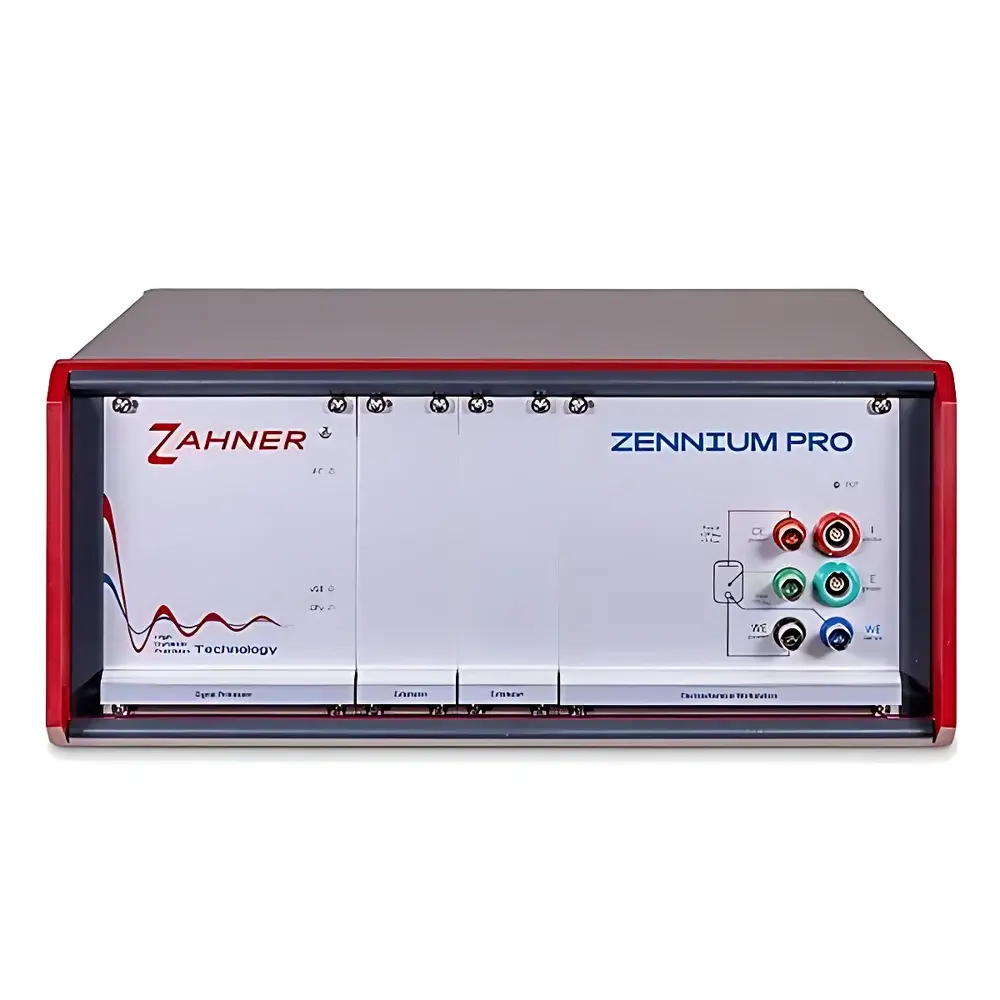
Zahner ZenniumPro Electrochemical Workstation
| Brand | Zahner |
|---|---|
| Origin | Germany |
| Model | ZenniumPro |
| Instrument Type | Electrochemical Workstation |
| Channel Count | Single-Channel |
| Current Range | ±3 A |
| Current Resolution | ±5 aA |
| Potential Accuracy | ±50 µV |
| Potentiostatic Range | ±15 V |
| EIS Frequency Range | 10 µHz – 8 MHz |
| Input Impedance | >10 TΩ |
| ADC Resolution | 32-bit |
| Bandwidth | 10 MHz |
| Voltage Resolution | 3 nV |
| IR Compensation | Real-time, automatic |
| Grounding Modes | Switchable floating/grounded |
| Small-Signal Rise Time | 150 ns – 200 µs (5 steps) |
| Impedance Accuracy | 1 mΩ–10 GΩ (±2%), 100 mΩ–10 MΩ (±0.2%) in POT mode |
| Software | Thales XT + Zahner Analysis (EIS fitting, CIMPS, Z-HIT, NFRA) |
Overview
The Zahner ZenniumPro Electrochemical Workstation is a high-performance, modular potentiostat/galvanostat and frequency response analyzer engineered for precision electrochemical research and industrial R&D. Built upon Zahner’s legacy of German-engineered instrumentation, the ZenniumPro implements advanced 32-bit High Dynamic Performance (HDP) analog-to-digital conversion and real-time digital signal processing to deliver exceptional resolution, stability, and fidelity across DC and AC domains. Its core architecture supports true potentiostatic, galvanostatic, and electrochemical impedance spectroscopy (EIS) measurements under rigorously controlled conditions—enabling quantitative analysis of charge transfer kinetics, interfacial capacitance, diffusion-limited processes, and electrode/electrolyte stability. The workstation operates with a ±15 V compliance voltage and ±3 A current output, while maintaining >10 TΩ input impedance and sub-50 µV potential accuracy—critical for low-noise measurements on high-impedance systems such as coated metals, solid-state electrolytes, and biological interfaces. Its switchable grounded/floating configuration ensures safe and accurate operation in demanding environments including autoclaves, buried pipeline monitoring setups, and high-voltage electrochemical cells.
Key Features
- Ultra-high-resolution current measurement: ±5 aA (attoampere) resolution with 32-bit ADC and adaptive range switching
- Wide EIS frequency coverage: 10 µHz to 8 MHz with 0.0025% frequency accuracy and 10,000 points/decade resolution
- Real-time, model-free IR compensation integrated into all EIS and transient techniques
- 10 MHz system bandwidth enabling fast transient capture (rise time: 150 ns – 200 µs across five selectable ranges)
- Modular expandability: Supports optional high-current modules (up to ±20 A), high-voltage extensions (±60 V), electrochemical noise probes, pulse generators, multi-channel EIS, and CIMPS (current-modulated photoelectrochemical spectroscopy) accessories
- Dual grounding architecture: Configurable floating or earth-referenced operation for compatibility with grounded reactors, pressure vessels, and field-deployed corrosion sensors
- Low-capacitance probe support and ultra-low-noise front-end design optimized for microelectrode and thin-film measurements
Sample Compatibility & Compliance
The ZenniumPro is validated for use across a broad spectrum of electrochemical sample types—including aqueous and non-aqueous electrolytes, polymer electrolytes, molten salts, solid-state batteries, fuel cell membranes, conductive polymers, corrosion-resistant coatings, and photoelectrodes. Its high input impedance (>10 TΩ) and low leakage current ensure minimal loading effects on capacitive interfaces (e.g., oxide layers, SAMs, biomembranes). The system complies with ISO 17025 calibration traceability requirements when operated with certified reference electrodes and calibrated shunts. All hardware and firmware are designed to meet IEC 61000-4 electromagnetic compatibility standards. Data acquisition and storage workflows align with GLP and GMP principles; Thales XT software supports audit trails, user access control, electronic signatures, and 21 CFR Part 11-compliant data integrity protocols when configured with appropriate IT infrastructure.
Software & Data Management
Thales XT is the native, Windows-based control and analysis platform for the ZenniumPro. It provides fully synchronized online visualization across up to eight independent parameter windows, with real-time plotting of current, potential, phase, modulus, and derived quantities during acquisition. All raw data—including time-domain transients, complex impedance spectra, and derivative waveforms—are stored in open-format binary files (.zennium) with embedded metadata (timestamp, technique parameters, instrument configuration, calibration history). Offline analysis includes advanced EIS modeling via Zahner Analysis (supporting equivalent circuit fitting, Z-HIT validation, Kramers-Kronig consistency checks, and NFRA nonlinear frequency response analysis), CIMPS spectral deconvolution, Tafel extrapolation, differential pulse analysis, and GITT/PITT diffusion coefficient calculation. Graphical tools support drag-and-drop zooming, multi-curve overlay with customizable legends/colors, batch export to CSV/PNG/SVG, and automated report generation with configurable templates.
Applications
- Energy storage: Li-ion/sodium-ion battery electrode kinetics, SEI formation, aging mechanisms, and impedance evolution under cycling (BattCycling module)
- Fuel cells & electrolyzers: PEM and SOEC catalyst activity mapping, membrane resistance profiling, and degradation diagnostics via long-term EIS monitoring
- Corrosion science: DC polarization, LPR, EIS-based coating defect quantification, and localized corrosion detection using electrochemical noise (EN) and zero-resistance ammeter (ZRA) modes
- Photoelectrochemistry: CIMPS-enabled quantum efficiency mapping, surface state density estimation, and charge separation lifetime analysis
- Sensors & biosensors: Amperometric detection limits, redox mediator kinetics, and interfacial electron transfer rate determination
- Materials development: Conductivity of conductive polymers, charge transport in perovskites, double-layer capacitance of supercapacitors, and passivation behavior of stainless steels and aluminum alloys
FAQ
What grounding configurations does the ZenniumPro support?
The ZenniumPro offers user-selectable floating or grounded operation, allowing direct integration into pressurized autoclaves, grounded pipeline test rigs, and multi-cell battery testers without ground loops or safety hazards.
Can the ZenniumPro perform simultaneous multi-frequency EIS?
No—it performs single-sine EIS with high spectral purity; however, its 8 MHz upper limit and 10 µHz lower limit enable comprehensive characterization from bulk solution resistance to slow interfacial relaxation processes.
Is Thales XT compatible with third-party data analysis tools?
Yes—raw data exports as ASCII-compatible CSV or structured binary files, enabling import into MATLAB, Python (with zenniumio libraries), Origin, or Igor Pro for custom modeling and statistical analysis.
Does the system support automated sequence execution for unattended testing?
Yes—Thales XT includes scripting via Python API and built-in sequence editors for chained experiments (e.g., CV → EIS → chronoamperometry), with conditional branching based on real-time parameter thresholds.
How is calibration traceability maintained?
Zahner provides factory calibration certificates traceable to PTB (Physikalisch-Technische Bundesanstalt); users may perform periodic verification using NIST-traceable reference resistors and potentiostatic standards, with full documentation supported in Thales XT’s calibration log module.





