
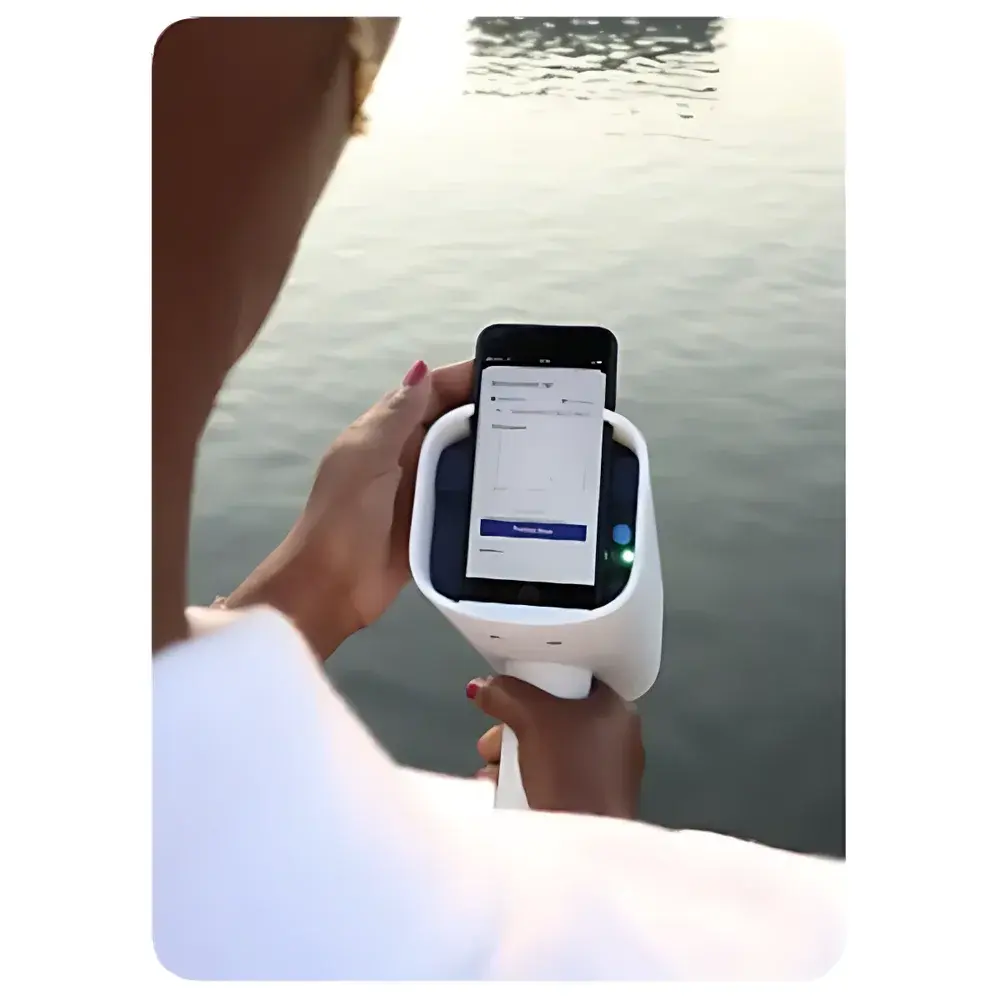
Zealquest WISP Orca Handheld Full-Spectrum Water Quality Spectrometer
| Brand | Zealquest |
|---|---|
| Origin | Netherlands |
| Manufacturer Type | Authorized Distributor |
| Origin Category | Imported |
| Model | WISP Orca |
| Measurement Principle | Simultaneous acquisition of upwelling radiance (Lu), downwelling radiance (Ld), and downwelling irradiance (Ed) via dual-radiance and single-irradiance optical sensors for in-situ water optical property derivation |
| Spectral Range | 220–1100 nm (calibration-dependent) |
| Measurable Parameters | Chlorophyll-a, Phycocyanin (cyanobacterial pigment), Colored Dissolved Organic Matter (CDOM), Secchi depth / transparency, Total Suspended Solids (TSS) |
| Spectral Resolution | 0.43 nm |
| Optical Bandwidth (FWHM) | 4.65 nm |
| Signal-to-Noise Ratio | ≥330:1 |
| Integration Time | 30 µs – 40 s |
| Operating Temperature | 0–55 °C |
| Dimensions | 262 × 201 mm |
| Weight | 1.3 kg |
Overview
The Zealquest WISP Orca is a field-deployable, handheld full-spectrum spectroradiometer engineered for quantitative optical water quality assessment in both freshwater and marine environments. It operates on the foundational principles of in-water remote sensing optics, leveraging simultaneous, co-located measurements of three critical radiometric quantities: upwelling spectral radiance (Lu), downwelling spectral radiance (Ld), and downwelling spectral irradiance (Ed). These measurements are acquired using a rigorously aligned optical architecture—two calibrated radiance sensors oriented at ±42° from the vertical axis (for Lu and Ld, respectively) and one nadir-facing irradiance sensor. This tri-sensor configuration enables direct computation of inherent optical properties (IOPs) and apparent optical properties (AOPs), including remote-sensing reflectance (Rrs), without requiring post-hoc atmospheric correction or empirical scaling. The instrument’s core analytical output—chlorophyll-a concentration, phycocyanin (as a proxy for cyanobacterial biomass), CDOM absorption coefficient, water transparency (Secchi depth equivalent), and suspended particulate matter—is derived via physics-informed inversion algorithms embedded in its onboard firmware. Designed for operational hydro-optical monitoring, the WISP Orca bridges the gap between laboratory-grade spectrophotometry and satellite ocean color validation requirements.
Key Features
- Tri-sensor optical head with factory-calibrated radiance (±42°) and irradiance (0°) channels, minimizing inter-sensor alignment drift and enabling robust Rrs calculation
- High-fidelity spectral acquisition across 220–1100 nm with 0.43 nm pixel resolution and 4.65 nm optical bandwidth (FWHM), supporting UV-enhanced CDOM detection and NIR-based turbidity estimation
- Integrated WIboard controller featuring embedded GPS, 3-axis tilt compensation, and real-time georeferenced metadata tagging for GLP-compliant field logging
- On-device computation: all primary water quality parameters generated in ≤60 seconds post-trigger, with no external PC dependency
- Secure cloud-native data pipeline supporting ISO/IEC 27001-aligned encryption, audit-trail-enabled QC flagging, multi-algorithm reprocessing, and RESTful API access for integration into SCADA or digital twin platforms
- Ruggedized industrial housing rated IP67, operational across 0–55 °C, with 1.3 kg mass optimized for single-hand deployment from vessels, piers, or unmanned surface vehicles (USVs)
Sample Compatibility & Compliance
The WISP Orca is validated for direct immersion or surface-skimming operation in natural waters—including oligotrophic lakes, eutrophic reservoirs, estuarine gradients, and coastal shelf systems. Its optical design conforms to the geometric and radiometric standards outlined in ASTM E275-22 (Standard Practices for Describing and Measuring Performance of Spectrophotometers) and ISO 17289:2015 (Water quality — Optical sensors for measuring chromophoric dissolved organic matter). While not a regulatory compliance device per se, its traceable calibration chain (NIST-traceable irradiance standards, CRF-corrected radiance transfer functions) supports data use in US EPA Method 445.0 (Chlorophyll a by In Vitro Fluorometry) and EU WFD Annex V monitoring programs. All firmware and cloud software modules comply with FDA 21 CFR Part 11 requirements for electronic records and signatures when configured for GxP-aligned deployments.
Software & Data Management
Data acquisition, processing, and archival are unified under the Zealquest Cloud Platform—a secure, role-based SaaS environment accessible via web browser or native iOS application (preloaded on included iPhone 5E controller). Raw spectral files (.ASD format) and processed parameter tables (.CSV/.GeoJSON) are automatically timestamped, geotagged, and version-controlled. Built-in QC tools allow users to apply manual flags (e.g., “sun glint”, “wave-induced noise”) that persist through reprocessing. Algorithmic flexibility includes selectable models: NASA OCx for chlorophyll-a, QAA-v6 for CDOM absorption, and custom user-defined regressions uploaded via encrypted ZIP. Audit logs record every data modification event—including who changed what, when, and why—ensuring full traceability for GLP/GMP audits. Export options include direct integration with Python (via PyWISP SDK), MATLAB, or enterprise GIS systems via OGC-compliant WFS/WMS endpoints.
Applications
- Algal bloom early warning: Real-time phycocyanin quantification enables rapid identification of cyanobacterial dominance prior to toxin accumulation
- Satellite validation: High-temporal-resolution Rrs spectra serve as ground-truth inputs for Sentinel-3 OLCI and Landsat-9 OLI-2 atmospheric correction verification
- Aquaculture site management: Daily transparency and TSS trends inform feeding schedules and harvest timing to minimize stress and waste
- Dredging and sediment plume tracking: Sub-minute turbidity mapping supports environmental impact assessments during coastal infrastructure projects
- Drinking water source protection: CDOM/chlorophyll co-monitoring detects terrestrial runoff events and phytoplankton shifts indicative of watershed disturbance
- Academic teaching labs: Modular hardware and open spectral data format facilitate hands-on instruction in aquatic optics, remote sensing, and environmental data science
FAQ
Is the WISP Orca suitable for deep-water profiling?
No—it is designed for surface or near-surface (≤0.5 m depth) optical measurements. For vertical profiling, Zealquest recommends coupling it with the WISP DeepLine winch system and pressure-rated sensor housings.
How often does the instrument require recalibration?
Factory calibration is valid for 12 months under normal field use. Annual recalibration against NIST-traceable standards is recommended; Zealquest offers certified lab services with full uncertainty budget reporting.
Can raw spectra be exported for third-party analysis?
Yes—unprocessed .ASD files (including dark current, integration time, and temperature metadata) are fully exportable in standard format compatible with ENVI, SeaDAS, and custom Python workflows.
Does the system support offline operation?
Yes—onboard storage retains ≥10,000 spectral scans. All computations and basic visualization occur locally; cloud sync resumes automatically upon network reconnection.
What regulatory frameworks does the cloud platform meet?
The Zealquest Cloud Platform is ISO 27001 certified, GDPR-compliant, and implements 21 CFR Part 11 controls including electronic signature validation, audit trail integrity checks, and role-based access governance.
Related Products







