
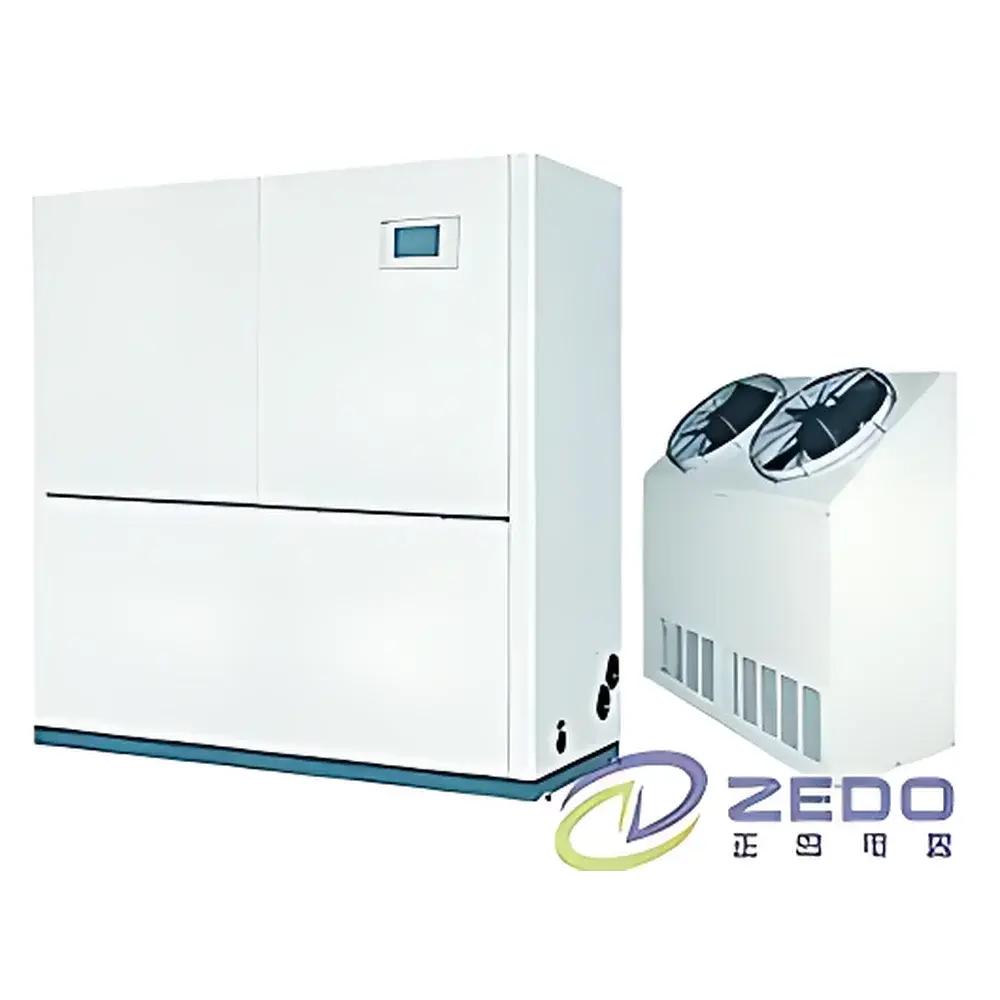
ZEDO HF20Q-I Air-Cooled Precision Constant Temperature and Humidity Control Unit
| Brand | ZEDO |
|---|---|
| Origin | Zhejiang, China |
| Manufacturer Type | Direct Manufacturer |
| Country of Origin | China |
| Model | HF20Q-I |
| Cooling Type | Air-Cooled |
| Refrigerant | R22 (also configurable with R407c/R134a) |
| Temperature Control Range | 18–27°C ±0.5°C |
| Humidity Control Range | 45–75% RH ±5% RH |
| Cooling Capacity | 20.1 kW |
| Heating Capacity | 9.0 kW |
| Airflow Rate | 4500 m³/h |
| External Static Pressure | ≥300 Pa |
| Compressor | Imported High-Efficiency Scroll Compressor |
| Humidification | Electrode Steam Humidifier |
| Dehumidification | Continuous Condensation-Based System |
| Fan Type | Low-Noise Centrifugal Fan |
| Power Supply | 3N~50 Hz / 380 V |
| Noise Level | 64 dB(A) |
| Dimensions (L×W×H) | 1300 × 740 × 1730 mm |
| Unit Weight | 233 kg |
| Control System | CAREL PCC32 Intelligent Programmable Microcontroller |
| Compliance | Designed for GLP-compliant laboratory environments |
Overview
The ZEDO HF20Q-I Air-Cooled Precision Constant Temperature and Humidity Control Unit is an engineered environmental conditioning system designed to maintain stable, repeatable air temperature and relative humidity (RH) in controlled laboratory, archival, and industrial process spaces. It operates on the principle of integrated vapor-compression refrigeration, electric resistance heating, electrode-based steam humidification, and condensate-driven dehumidification—enabling simultaneous, independent control of both thermal and moisture parameters within a single air-handling loop. Unlike generic HVAC units, the HF20Q-I is purpose-built for applications demanding metrological stability: its microprocessor-controlled dynamic regulation minimizes thermal overshoot (<0.2°C deviation during setpoint transitions) and maintains RH within ±5% RH under steady-state conditions—critical for calibration labs, pharmaceutical stability chambers, optical coating facilities, and long-term archival storage of hygroscopic media (e.g., film, parchment, lithium battery precursors). The unit’s air-cooled architecture eliminates dependency on chilled water infrastructure, making it deployable in retrofit or standalone installations where utility flexibility is constrained.
Key Features
- Integrated dual-loop climate control: simultaneous, decoupled regulation of temperature (18–27°C ±0.5°C) and relative humidity (45–75% RH ±5% RH) via closed-loop PID algorithms
- High-efficiency imported scroll compressor with R22 refrigerant (R407c/R134a optional), delivering 20.1 kW cooling capacity and 9.0 kW heating capacity at rated conditions
- Electrode steam humidifier with automatic scale-inhibiting drain cycle—enabling reliable operation in hard-water regions without manual descaling intervals
- CAREL PCC32 programmable controller with serial communication interface (RS485), supporting remote monitoring, data logging, and integration into building management systems (BMS)
- Low-noise centrifugal fan (64 dB(A)) providing 4500 m³/h airflow at ≥300 Pa external static pressure—compatible with ducted distribution networks up to 30 m in length
- Modular construction with stainless-steel internal components, corrosion-resistant coil coatings, and IP54-rated electrical enclosures for extended service life in non-cleanroom industrial settings
- Configurable fresh-air intake (10–30% of total airflow), pre-conditioned via the unit’s evaporator coil to prevent uncontrolled thermal/humidity loading
Sample Compatibility & Compliance
The HF20Q-I is not a test chamber but a precision environmental conditioning unit intended for integration into larger conditioned spaces—such as ISO Class 7 cleanrooms, metrology labs, or archival vaults—where ambient air quality must conform to stringent stability criteria. It complies with foundational requirements of ISO 14644-1 (airborne particle control), ASTM E145-22 (specifications for gravity-convection and forced-ventilation ovens and environmental chambers), and IEC 61000-6-3 (EMC emission standards). While not certified to FDA 21 CFR Part 11 out-of-the-box, its CAREL controller supports optional audit-trail modules and electronic signature protocols required for GxP-regulated environments. Units are routinely deployed in facilities operating under ISO/IEC 17025 accreditation, where documented environmental stability is mandatory for measurement uncertainty budgets. The system accommodates spatially distributed sensing—up to four external temperature/RH probes can be connected to the controller for zone-weighted averaging and differential control logic.
Software & Data Management
The embedded CAREL PCC32 controller provides native support for real-time parameter visualization, alarm history (with time-stamped event logs), and scheduled operational profiles (e.g., night-time energy-saving modes). Data export is supported via USB flash drive (CSV format) or RS232/RS485 serial output to SCADA or LIMS platforms. Optional Ethernet gateway modules enable Modbus TCP or BACnet/IP protocol translation for enterprise-level integration. All configuration changes—including setpoints, PID tuning constants, and alarm thresholds—are logged with user ID, timestamp, and prior/post values, satisfying basic traceability requirements for GLP and ISO 9001 quality systems. Firmware updates are performed offline via SD card to prevent network exposure, and controller memory retains all operational parameters during power interruption.
Applications
- Pharmaceutical stability testing suites requiring ICH Q1A(R3)-compliant temperature/humidity constancy over 6–24 month studies
- Optical thin-film deposition rooms where dew-point drift must remain below 0.3°C to prevent condensation on vacuum chamber viewports
- Archival repositories housing cellulose acetate film, magnetic tape, or vellum manuscripts—environments where RH excursions beyond ±5% accelerate hydrolytic degradation
- Calibration laboratories maintaining reference standards (e.g., platinum resistance thermometers, hygrometers) per ISO/IEC 17025 clause 5.10.4
- Advanced battery material synthesis labs storing moisture-sensitive cathode precursors (e.g., Ni-rich NMC, Li-metal anodes) under inert gas-blanketed, low-RH conditions
- Microelectronics packaging areas where electrostatic discharge (ESD) risk is mitigated by stabilizing RH between 45–55% RH
FAQ
What is the minimum recommended room insulation level for stable operation?
For ±0.5°C temperature stability, walls/ceilings should achieve U-values ≤0.35 W/m²·K (R-value ≥2.8 m²·K/W) with continuous vapor barriers to limit infiltration load.
Can the unit operate continuously at 18°C and 45% RH in a 30°C ambient environment?
Yes—the system’s 20.1 kW cooling capacity and condensate-based dehumidification allow sustained operation at the lower boundary of its control range, provided ventilation loads are accounted for in system sizing.
Is the electrode humidifier compatible with reverse-osmosis (RO) water?
No—electrode humidifiers require conductive water (typically 50–150 µS/cm). RO water must be mineralized or blended with tap water to ensure proper current flow and steam generation.
Does the controller support validation documentation packages (IQ/OQ)?
Yes—ZEDO provides factory-generated test reports, sensor calibration certificates (NIST-traceable), and configurable OQ protocols aligned with ASTM E2500-23 for equipment qualification in regulated industries.
What maintenance intervals are recommended for uninterrupted 24/7 operation?
Compressor oil analysis every 8,000 hours; humidifier electrode replacement every 12 months; coil cleaning every 6 months; full controller firmware verification annually.



