
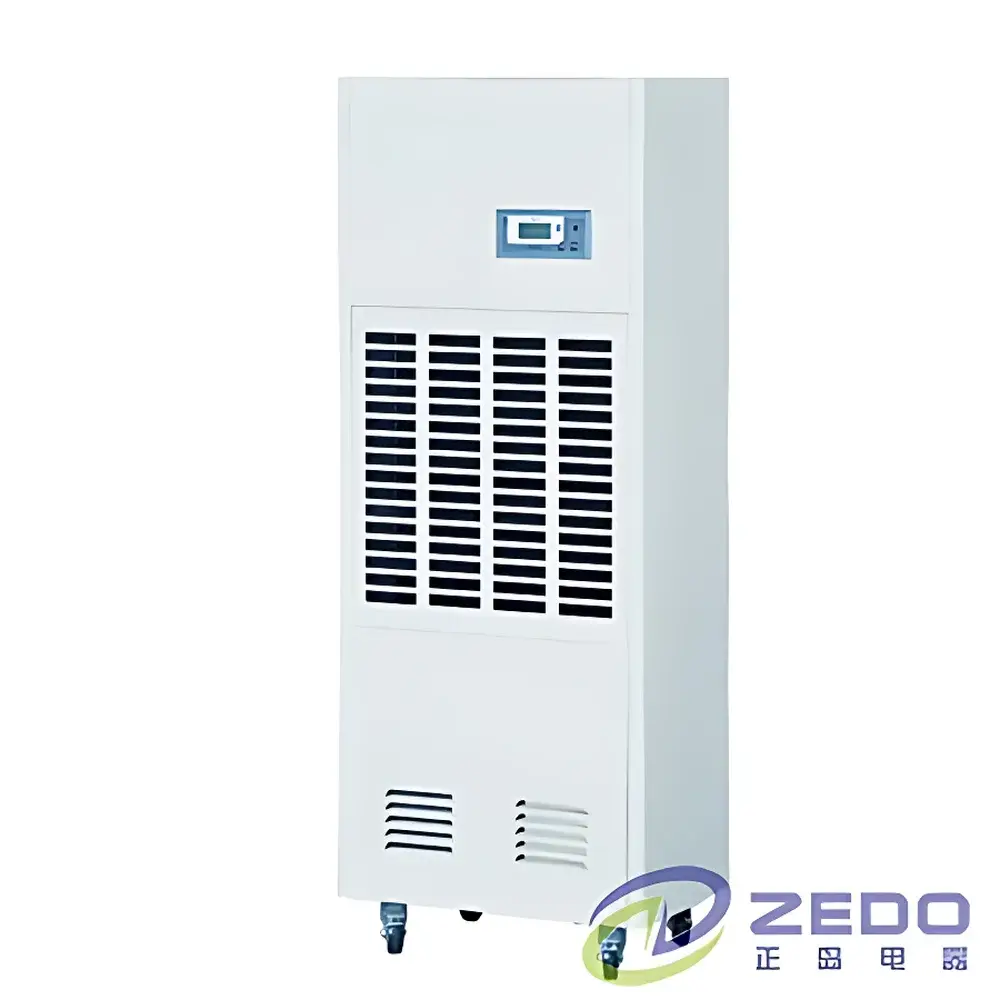
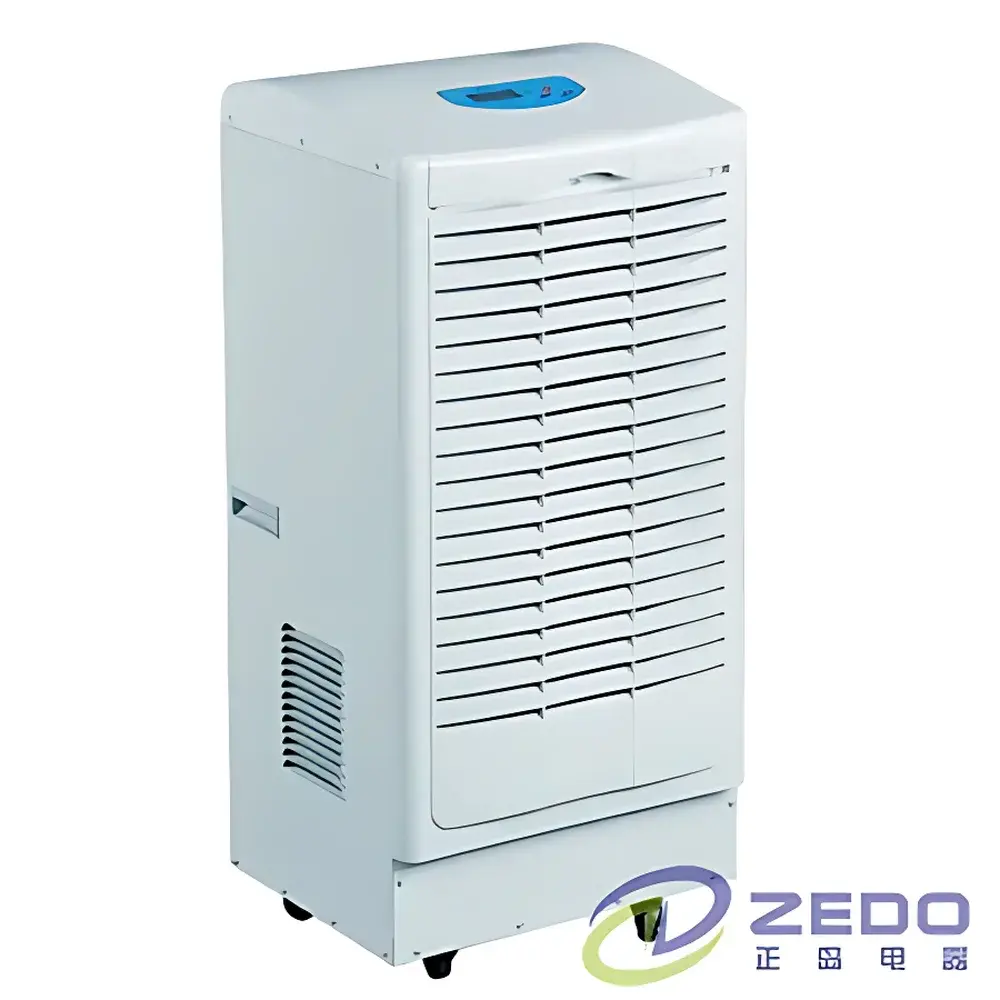
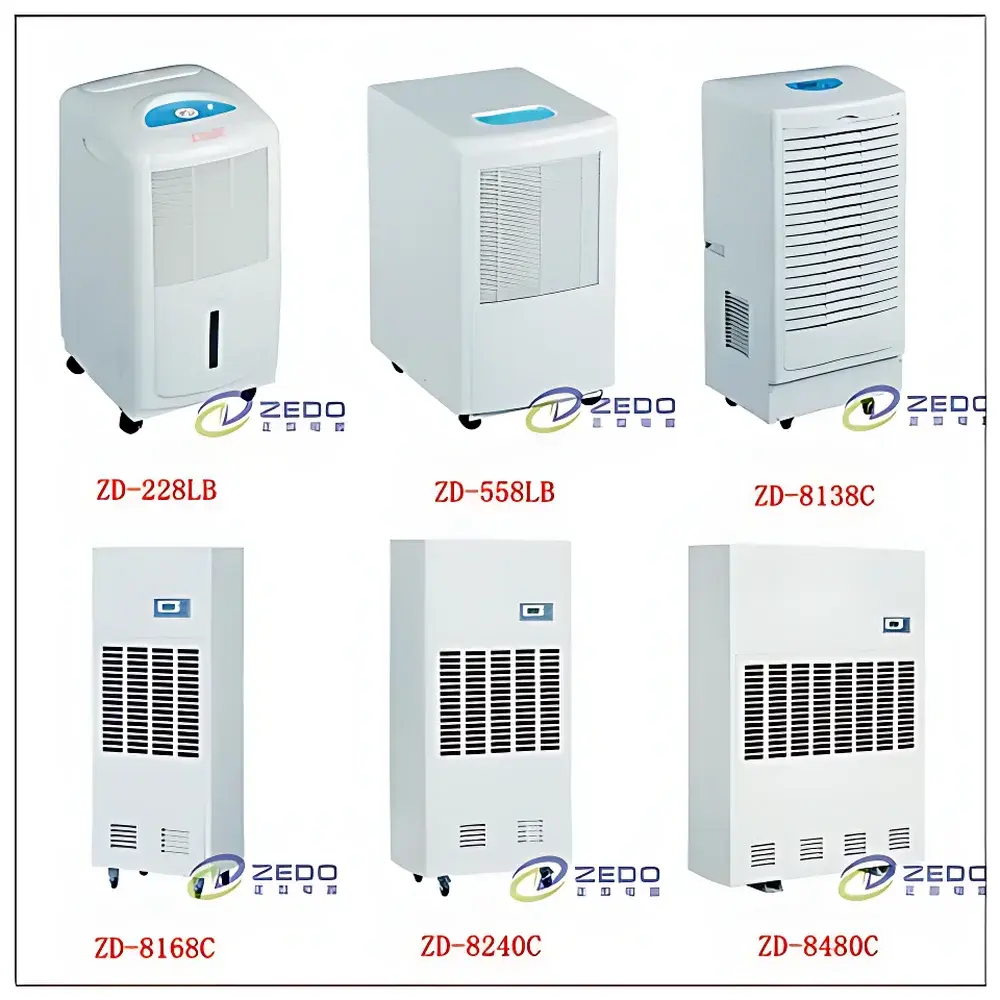
ZEDO ZD-8168C Tea Leaf Dehumidifier
| Brand | ZEDO |
|---|---|
| Origin | Zhejiang, China |
| Manufacturer Type | Direct Manufacturer |
| Country of Origin | China |
| Model | ZD-8168C |
| Dehumidification Capacity | 168 L/day (7 L/h) |
| Control Method | Intelligent Humidity Setpoint Control |
| Drainage | Continuous via PVC Drain Hose |
| Power Supply | 380 V ~ 50 Hz |
| Input Power | 2800 W |
| Operating Temperature Range | 5–38 °C |
| Noise Level | 52 dB(A) |
| Dimensions (W×D×H) | 605 × 410 × 1650 mm |
| Net Weight | 126 kg |
| Compressor | High-Efficiency Scroll Type |
| Heat Exchanger | Hydrophilic Aluminum Fin-Tube with Internal Grooved Copper Tubes |
| Fan System | Industrial External Rotor Centrifugal Blower (Dual Impeller) |
| Filtration | Standard Activated Carbon Filter |
| Safety Protections | Three-Minute Compressor Delay, High/Low Pressure Protection, Overload & Undervoltage Protection, Fault Self-Diagnosis |
| Microcontroller | Embedded Microcomputer Controller with Japanese Shinko High-Precision Humidity/Temperature Sensor |
Overview
The ZEDO ZD-8168C Tea Leaf Dehumidifier is an industrial-grade, precision-controlled dehumidification system engineered specifically for post-harvest handling of fresh tea leaves (Camellia sinensis) in controlled-environment processing facilities. Unlike general-purpose dehumidifiers, the ZD-8168C integrates thermodynamic design principles optimized for low-temperature, high-humidity biological materials—where moisture removal must occur without inducing thermal degradation, enzymatic oxidation (e.g., polyphenol oxidase activity), or structural damage to delicate leaf tissues. It operates on the principle of refrigerant-based condensation dehumidification: ambient air is drawn across a sub-zero evaporator coil, where water vapor condenses and is drained continuously; the dried air is then reheated via the condenser coil to maintain near-ambient discharge temperature—minimizing thermal shock to stored or staged leaf batches. This process enables precise control of relative humidity (RH) within sealed drying rooms (130–180 m²), supporting critical pre-processing steps such as withering, fixation preparation, and moisture stabilization prior to rolling or pan-firing.
Key Features
- Industrial scroll compressor with R410A refrigerant—designed for continuous operation under fluctuating load conditions typical of tea processing cycles.
- Hydrophilic aluminum finned-tube heat exchanger with internally grooved copper tubing—maximizes latent heat transfer efficiency while resisting corrosion from organic volatiles emitted by fresh leaves.
- Dual centrifugal impeller external rotor blower—delivers uniform airflow distribution across large-volume chambers, ensuring consistent RH profiles and eliminating localized microclimates that may trigger premature browning or fermentation.
- Embedded microcomputer controller with Shinko high-accuracy capacitive humidity sensor (±2% RH, 0–99% RH range)—enables programmable setpoint control, hysteresis adjustment, and real-time logging of environmental parameters.
- Integrated activated carbon pre-filter—removes airborne terpenes, aldehydes, and particulate matter generated during early-stage leaf metabolism, preventing coil fouling and maintaining long-term hygienic performance.
- Comprehensive electrical protection suite—including three-minute compressor restart delay, high/low pressure cut-off, phase loss detection, and thermal overload relays—ensures compliance with IEC 60335-1 safety standards for industrial equipment.
Sample Compatibility & Compliance
The ZD-8168C is validated for use with unprocessed green tea leaves (including tender buds and one-bud-two-leaves grades), oolong precursors, and white tea silver needles—materials highly sensitive to RH excursions above 70% and temperature gradients exceeding ±2°C. Its operational envelope (5–38°C ambient) aligns with ISO 20933:2020 guidelines for post-harvest handling of aromatic agricultural commodities. The unit meets CE marking requirements for electromagnetic compatibility (EN 61000-6-3/6-4) and low-voltage directive (2014/35/EU). While not certified to FDA 21 CFR Part 11, its data logging capability supports GLP-compliant record retention when paired with external audit-trail software. All structural components comply with RoHS Directive 2011/65/EU for restricted hazardous substances.
Software & Data Management
The onboard controller stores up to 30 days of time-stamped humidity/temperature readings at 15-minute intervals. Data export is supported via USB interface (CSV format) for integration into laboratory information management systems (LIMS) or enterprise resource planning (ERP) platforms. Optional RS-485 Modbus RTU communication enables remote monitoring and centralized control in multi-unit installations—facilitating synchronized dehumidification across parallel withering rooms. No cloud connectivity or proprietary SaaS platform is embedded; all firmware updates are performed locally via secure USB firmware loader, preserving data sovereignty and minimizing cybersecurity exposure.
Applications
- Controlled withering of fresh tea leaves—achieving targeted 10–15% weight loss while suppressing enzymatic browning and preserving volatile aroma compounds (e.g., linalool, geraniol).
- Pre-fixation moisture equalization—ensuring uniform leaf water activity (aw) prior to steaming or pan-firing, reducing batch variability in color, infusion clarity, and catechin retention.
- Storage conditioning of semi-processed leaves (e.g., rolled but unfired oolong)—maintaining RH below 60% to inhibit mold growth (Aspergillus spp., Penicillium spp.) per ISO 21527-1 microbiological testing protocols.
- Environmental stabilization in QC laboratories—supporting ASTM D4456-22 standard test methods for tea leaf physical property evaluation under reproducible humidity conditions.
- Supplemental dehumidification in underground tea storage vaults—mitigating condensation risks in high-humidity subterranean environments per EN 1504-9 structural protection standards.
FAQ
What is the minimum recommended room volume for optimal performance?
For stable RH control, the unit is calibrated for enclosed spaces ≥130 m² with ceiling height ≤3.5 m and air exchange rate <0.5 ACH. Smaller volumes require manual fan speed reduction to prevent over-drying.
Can the ZD-8168C operate continuously for 72+ hours during peak harvest season?
Yes—its IP54-rated enclosure, industrial-grade bearings, and redundant thermal protection enable uninterrupted operation under rated load, provided ambient intake air is free of excessive dust or leaf particulates.
Does the unit support integration with building management systems (BMS)?
Via optional RS-485 Modbus RTU interface (sold separately), enabling read-only parameter access and alarm status reporting compatible with BACnet/IP gateways.
Is calibration traceable to national metrology institutes?
The Shinko humidity sensor is factory-calibrated against NIST-traceable reference hygrometers; full recalibration service is available through ZEDO’s authorized service centers every 12 months.
How does the activated carbon filter impact maintenance intervals?
Under typical tea processing conditions (8–12 hrs/day, ambient VOC load), the filter requires replacement every 6 months; extended runtime or high-dust environments reduce service life to 3–4 months.



