
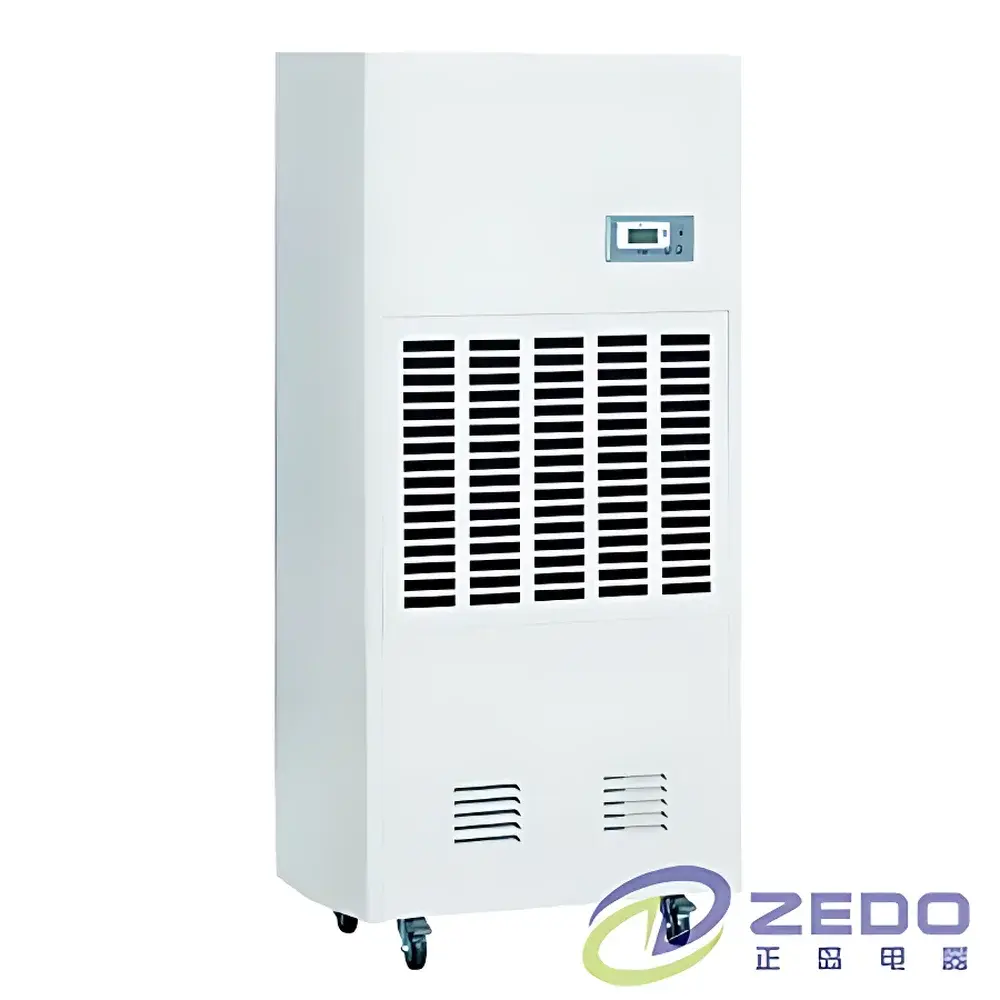
ZEDO ZD-8240C Fully Automatic Desiccant-Integrated Compressor Dehumidifier
| Brand | ZEDO |
|---|---|
| Origin | Zhejiang, China |
| Manufacturer Type | OEM Manufacturer |
| Product Category | Domestic Industrial-Grade Dehumidifier |
| Model | ZD-8240C |
| Dehumidification Capacity | 240 L/day (240 kg/day) |
| Control Method | Intelligent Humidity Setpoint Regulation |
| Drainage | Continuous via PVC Drain Hose |
| Power Supply | 380 V AC, 50 Hz |
| Input Power | 4900 W |
| Operating Temperature Range | 5–38 °C |
| Noise Level | 52 dB(A) |
| Dimensions (W×D×H) | 770 × 470 × 1650 mm |
| Net Weight | 160 kg |
| Safety Protections | 3-min Compressor Delay, High/Low Pressure Protection, Overload & Undervoltage Protection, Fault Self-Diagnosis Display |
| Air Filtration | Standard Activated Carbon Filter |
| Fan System | Dual-Centrifugal Industrial External-Rotor Blower |
| Heat Exchanger | High-Efficiency Finned-Tube Copper Coil with Hydrophilic Aluminum Fins |
| Compressor Type | International Brand Scroll Compressor |
| Refrigerant | Eco-Friendly R-410A or Equivalent |
| Compliance | CE-marked Electrical Architecture (IEC 60335-1), IP20 Indoor Use Rating |
| Software Interface | Microprocessor-Based Controller with Japanese SHINYO High-Accuracy RH/T Sensor (±2% RH, ±0.5 °C) |
Overview
The ZEDO ZD-8240C is a heavy-duty, fully automatic compressor-based dehumidifier engineered for continuous environmental humidity control in mission-critical indoor spaces where moisture-induced degradation poses measurable risk to materials integrity, dimensional stability, and long-term functionality. Unlike portable or residential-grade units, the ZD-8240C operates on the principle of refrigerant-driven condensation—drawing ambient air across a cooled evaporator coil where water vapor condenses at dew point temperatures, then re-heating the dried air via a condenser coil to maintain near-constant sensible temperature while reducing relative humidity (RH). This thermodynamic cycle ensures stable dew point depression without significant thermal load fluctuation, making it suitable for environments requiring tight RH control between 30–60% at ambient temperatures from 5 °C to 38 °C. Its design targets applications where hygroscopic damage—such as metal oxidation, optical lens fogging, paper delamination, electronic PCB dendritic growth, or archival media hydrolysis—must be mitigated through deterministic, repeatable, and auditable humidity management.
Key Features
- Industrial-grade scroll compressor with high COP efficiency and low mechanical wear, paired with eco-friendly R-410A refrigerant compliant with current EU F-Gas Regulation Annex I thresholds.
- Dual-centrifugal external-rotor blower system delivering uniform airflow distribution across a compact, high-surface-area finned-tube heat exchanger—optimized for maximum latent heat extraction per unit volume.
- Microprocessor-based controller integrated with SHINYO high-stability capacitive humidity sensor (±2% RH accuracy, 0.5% RH resolution) and NTC temperature probe (±0.5 °C), enabling precise setpoint regulation and real-time deviation logging.
- Full diagnostic interface with LED status indicators for compressor cycling, filter saturation, drain blockage, refrigerant pressure anomalies, and electrical fault codes—supporting predictive maintenance planning.
- Structural architecture separates refrigeration and airflow subsystems, minimizing cross-contamination risk and simplifying field service access to compressors, fans, and condensate pans per ISO 5141-2 maintenance guidelines.
- Triple-layer safety architecture including compressor anti-short-cycle delay (3-minute reset), dual-pressure switch monitoring, thermal overload relays, and undervoltage lockout—all certified to IEC 60335-1 Class II insulation standards.
Sample Compatibility & Compliance
The ZD-8240C is validated for use in controlled environments housing hygroscopically sensitive assets—including but not limited to archival documents (ISO 11799:2015), museum-grade artifacts (BS 4971:2017), precision metrology equipment (ISO 14644-1 Class 8 cleanroom-adjacent zones), pharmaceutical reference standards (USP ), and lithium-ion battery storage (IEC 62619 Annex A). It meets electromagnetic compatibility requirements per EN 61000-6-3 (Emission) and EN 61000-6-2 (Immunity), and its electrical enclosure conforms to IP20 ingress protection for dry indoor industrial locations. While not intrinsically rated for hazardous areas, its non-sparking motor design and grounded chassis support deployment in general laboratory, warehouse, and quality control facility settings under GLP-aligned environmental monitoring programs.
Software & Data Management
The embedded controller supports time-stamped event logging of RH setpoint deviations, compressor runtime cycles, fault triggers, and manual override actions—exportable via USB port in CSV format for integration into LIMS or environmental monitoring systems (EMS). Audit trail functionality complies with FDA 21 CFR Part 11 requirements when deployed with external validation protocols, including electronic signature capture and user-level access control (admin/operator tiers). Optional RS-485 Modbus RTU interface enables centralized fleet monitoring across multi-unit installations, facilitating automated alarm escalation via SCADA or building management systems (BMS).
Applications
This unit is routinely specified in environments where uncontrolled humidity compromises functional reliability or regulatory compliance: archival repositories maintaining ISO 11799-compliant microclimate conditions; hospital sterile processing departments managing instrument drying cabinets; semiconductor fabrication support labs controlling solder paste storage RH; food-grade cold storage buffer zones preventing condensation on packaging lines; and calibration laboratories housing CMMs, interferometers, and mass standards per ISO/IEC 17025 Clause 6.3. Its 240 L/day capacity sustains ≤50% RH in sealed 200 m² spaces with typical infiltration rates (<0.5 ACH), verified through ASHRAE Guideline 24-2022 psychrometric modeling.
FAQ
What is the minimum recommended ambient temperature for continuous operation?
The unit is rated for stable performance between 5 °C and 38 °C. Below 5 °C, frost accumulation on the evaporator may impair condensate removal efficiency; optional hot-gas defrost kits are available for sub-5 °C deployments.
Does the ZD-8240C support remote monitoring or BMS integration?
Yes—via optional RS-485 Modbus RTU module, enabling real-time RH, temperature, and operational status telemetry to third-party building automation platforms.
Is the activated carbon filter replaceable, and what is its service interval?
The standard filter is user-replaceable every 6–12 months depending on airborne particulate load; MERV-8 equivalent filtration efficiency is maintained throughout nominal service life.
Can this unit be used in cleanroom-adjacent areas without compromising ISO class integrity?
When installed with ducted inlet/outlet configurations and HEPA post-filtration (optional), it supports ISO 14644-1 Class 8 environments; particle generation from internal components is below 10⁴ particles/m³ ≥0.5 µm per ISO 21501-4.
What documentation is provided for IQ/OQ validation support?
Factory test reports (including refrigerant charge verification, airflow calibration, and RH control repeatability data), electrical schematics, and FAT checklists are supplied standard; URS-aligned protocol templates available upon request.



