
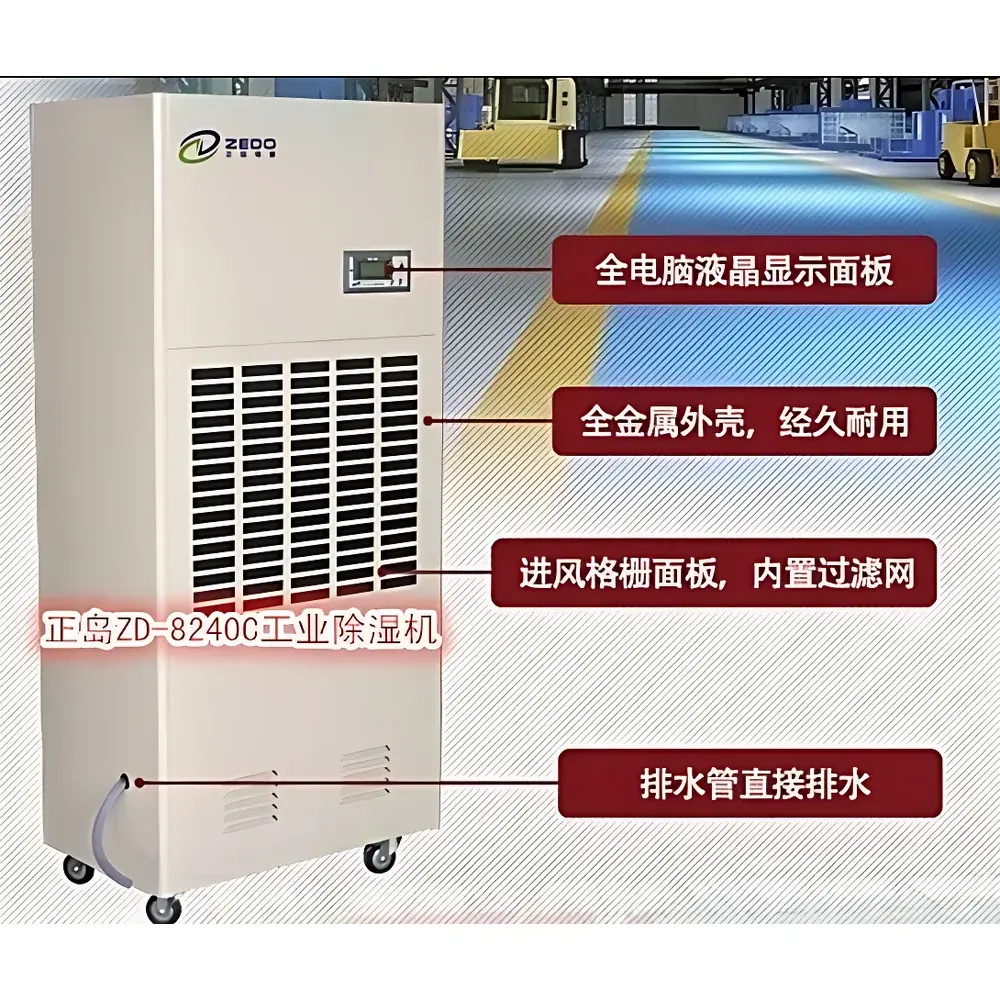
ZEDO ZD-8240C Industrial Dehumidifier for Production Workshops
| Brand | ZEDO |
|---|---|
| Origin | Zhejiang, China |
| Manufacturer Type | Direct Manufacturer |
| Country of Origin | China |
| Model | ZD-8240C |
| Instrument Type | Compressor-Based Dehumidifier |
| Dehumidification Capacity | 240 L/day |
| Control Method | Intelligent Humidity Setpoint Control |
| Drainage | Continuous via PVC Hose |
| Power Supply | 380 V AC, 50 Hz |
| Input Power | 4900 W |
| Operating Temperature Range | 5–38 °C |
| Noise Level | 52 dB(A) |
| Dimensions (W×D×H) | 770 × 470 × 1650 mm |
| Net Weight | 160 kg |
| Applicable Area | 180–240 m² |
| Safety Protections | 3-min Compressor Delay Start, High/Low Pressure Protection, Overload & Undervoltage Protection, Fault Self-Diagnosis |
| Air Filtration | Standard Activated Carbon Filter |
| Fan System | Dual-Centrifugal External Rotor Fan with High Airflow & Low Noise |
| Heat Exchanger | Enhanced Finned-Tube Design with Internal Grooved Copper Tubes & Hydrophilic Aluminum Fins |
| Compressor | International Brand Scroll Compressor |
| Refrigerant | Environmentally Friendly R-type Refrigerant |
| Control System | Microcomputer Controller with Japanese SHINYO High-Precision Temperature & RH Sensor |
| Display Interface | Human-Machine Touch Panel with Real-Time Status Feedback |
Overview
The ZEDO ZD-8240C Industrial Dehumidifier is an engineered solution designed specifically for controlled humidity management in production workshops, cleanrooms, and mission-critical storage environments. It operates on the principle of refrigerant-based condensation dehumidification: ambient air is drawn across a cooled evaporator coil, where moisture condenses and is collected or drained continuously; the dried air is then reheated slightly by the condenser before being discharged back into the space. This thermodynamic cycle ensures stable, repeatable dew point suppression and precise relative humidity (RH) regulation—critical for preventing corrosion, mold growth, dimensional instability in hygroscopic materials, and electrostatic discharge (ESD) risks in electronics manufacturing. With a rated capacity of 240 liters per day at 30 °C / 80 % RH (standard AHAM test conditions), the unit maintains consistent performance across its operational range of 5–38 °C ambient temperature—making it suitable for year-round deployment in temperate and subtropical industrial zones.
Key Features
- Robust structural architecture featuring independent airflow and refrigeration circuits—enabling modular service access and minimizing downtime during routine maintenance.
- High-efficiency scroll compressor from a globally recognized OEM supplier, paired with an environmentally compliant refrigerant formulation meeting current regional phase-down schedules (e.g., aligned with EU F-Gas Regulation Annex I thresholds).
- Optimized heat exchanger assembly incorporating internally grooved copper tubing and hydrophilic aluminum fins—delivering enhanced thermal transfer coefficients and reduced frost accumulation under high-load conditions.
- Dual-centrifugal external rotor fan system delivering >3200 m³/h airflow at low acoustic signature (≤52 dB[A] at 1 m), engineered to sustain uniform air distribution across large-volume spaces up to 240 m².
- Microprocessor-based control platform integrated with a calibrated SHINYO capacitive humidity sensor (±2 % RH accuracy, 0.1 % RH resolution) and real-time fault diagnostics—including compressor cycling status, refrigerant pressure anomalies, filter clogging alerts, and drainage blockage detection.
- Comprehensive electrical safety suite compliant with IEC 60335-1:2012 requirements: three-phase motor protection via class 10 thermal overload relays, undervoltage/phase-loss monitoring, high/low pressure cutouts, and automatic 3-minute compressor restart delay to prevent liquid slugging.
Sample Compatibility & Compliance
The ZD-8240C is intended for use in non-explosive, non-corrosive indoor atmospheres typical of ISO Class 7–8 cleanrooms, pharmaceutical packaging areas, archival storage vaults, and precision instrument calibration labs. Its construction meets IP20 ingress protection standards for indoor electrical equipment. While not intrinsically safe for hazardous locations (ATEX/IECEx), the unit complies with CE marking directives (EMC Directive 2014/30/EU and Low Voltage Directive 2014/35/EU). For GMP-regulated facilities, the device supports audit-ready operation through timestamped event logging (power-on/off, setpoint changes, alarm triggers) and optional RS485 Modbus RTU interface for integration into building management systems (BMS) or SCADA platforms. It does not include FDA 21 CFR Part 11-compliant electronic signature functionality out-of-the-box but may be validated for use within documented quality systems when deployed with supplementary procedural controls.
Software & Data Management
The onboard controller provides local human-machine interaction via a tactile LCD touchscreen interface supporting multilingual menu navigation (English, Chinese, Spanish). All operational parameters—including target RH setpoint (30–80 % RH adjustable in 1 % increments), current ambient RH/temperature, runtime hours, and active fault codes—are displayed in real time. Event history is retained for the most recent 100 system events, each logged with date/time stamp and severity classification (warning vs. critical). Data export is limited to manual screen capture; no built-in USB or Ethernet connectivity is provided. For centralized monitoring, optional third-party BMS integration is supported via standard Modbus RTU protocol over RS485—allowing remote readout of humidity, temperature, compressor status, and alarm states without proprietary middleware.
Applications
- Electronics assembly lines requiring RH control between 45–60 % to mitigate solder paste slump, component warpage, and ESD-induced latent failures.
- Pharmaceutical secondary packaging zones where hygroscopic excipients (e.g., lactose, microcrystalline cellulose) must remain below critical moisture content thresholds to ensure tablet hardness and dissolution profile consistency.
- Archival repositories housing magnetic media, microfilm, or parchment documents—where prolonged exposure above 65 % RH accelerates hydrolytic degradation and fungal colonization.
- Precision metrology labs housing coordinate measuring machines (CMMs), laser interferometers, or optical encoders—where thermal expansion due to moisture-induced refractive index shifts compromises sub-micron measurement repeatability.
- Food processing dry storage areas maintaining ambient RH ≤ 55 % to inhibit Aspergillus flavus proliferation and aflatoxin generation in nuts, spices, and dried fruits.
FAQ
What is the recommended maintenance interval for the ZD-8240C?
Filter cleaning is advised every 14 days under continuous operation; full preventive maintenance—including refrigerant charge verification, coil inspection, and electrical terminal torque validation—should occur semiannually per ISO 55001-aligned asset management protocols.
Can this unit operate unattended for extended periods?
Yes—the integrated fault detection system automatically shuts down the compressor upon detecting abnormal pressure differentials, refrigerant leaks, or condensate overflow, and retains error logs for technician review.
Is the ZD-8240C suitable for low-temperature environments such as cold rooms?
No—it is rated for minimum ambient operation at 5 °C; use below this threshold requires supplemental hot-gas bypass or desiccant-assisted hybrid configurations not included in this model.
Does the unit support external humidistat integration?
Yes—dry-contact alarm outputs and 0–10 V analog inputs are available for external setpoint override or cascade control with room-level humidity sensors.
How is condensate disposal handled?
Continuous gravity-fed drainage is enabled via standard 16 mm ID PVC hose; pump-assisted lift kits (up to 5 m head) are available as accessories for installations lacking floor-level drain access.
Related Products



