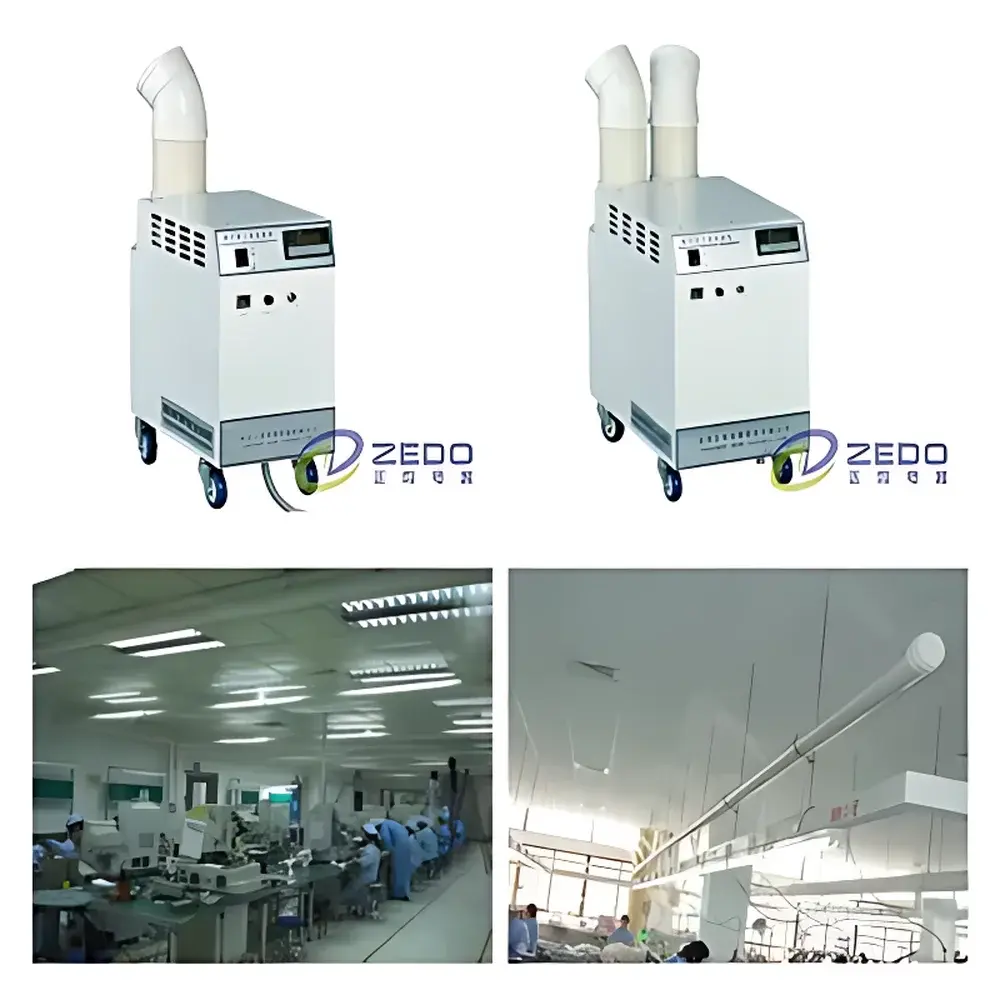
ZEDO ZS-30Z Semiconductor Cleanroom Ultrasonic Humidifier
| Brand | ZEDO |
|---|---|
| Model | ZS-30Z |
| Type | Industrial Ultrasonic Humidifier |
| Application | ESD-Sensitive Semiconductor Manufacturing Environments |
| Humidification Capacity | 3 kg/h |
| Power Consumption | 900 W |
| Construction | Full Stainless Steel Enclosure (AISI 304) |
| Water System | Auto-fill with Overflow Protection |
| 雾化方� | �: Single-Tube Ultrasonic Atomization |
| Control Mode | Humidity Feedback Control (RH Sensor-Based) |
| IP Rating | IP68 Waterproof Power Supply & Fan |
| 雾化片 | Alumina Ceramic Transducer (3000–5000 h Lifetime) |
| Sensor | Japanese Shinyo High-Accuracy Capacitive RH Sensor (±2% RH, 10–95% RH Range) |
| Compliance | Designed for ISO Class 5–7 Cleanrooms per ISO 14644-1 |
| Certification | CE, RoHS, GB/T 19001-2016 (ISO 9001) |
Overview
The ZEDO ZS-30Z Semiconductor Cleanroom Ultrasonic Humidifier is an engineered environmental control solution specifically designed for electrostatic discharge (ESD)-sensitive semiconductor fabrication environments. It operates on the principle of high-frequency ultrasonic transduction—where piezoelectric ceramic elements vibrate at >1.7 MHz to atomize deionized or softened water into sub-5 µm droplets. These micro-droplets remain airborne long enough to achieve uniform spatial dispersion and rapid vapor-phase equilibration, enabling precise relative humidity (RH) stabilization in critical zones such as photolithography bays, wafer probe stations, and automated material handling corridors. Unlike steam or evaporative systems, ultrasonic humidification introduces no thermal load, avoids mineral carryover (when paired with DI water), and delivers immediate response to RH setpoint deviations—essential for maintaining process stability in ISO Class 5–7 cleanrooms where static charge accumulation above ±100 V can compromise device yield.
Key Features
- Full AISI 304 stainless steel enclosure with electropolished interior and powder-coated exterior—resistant to corrosion, cleaning agents, and cleanroom-compatible solvents.
- Integrated ultrasonic atomizer module with alumina ceramic transducers rated for 3,000–5,000 operating hours; compatible with hard water and alkaline/acidic feed conditions when pretreated.
- IP68-rated sealed variable-frequency power supply and 36V brushless waterproof fan—certified for submersion up to 1 meter, eliminating condensation-induced failure modes in high-humidity perimeter zones.
- Auto-fill system with float valve and redundant overflow cutoff—ensures uninterrupted operation while preventing spillage during unattended shifts.
- Microprocessor-based controller with capacitive RH sensor from Shinyo (Japan), offering ±2% RH accuracy across 10–95% RH range and real-time PID-driven feedback modulation.
- Modular single-tube mist delivery architecture—optimized for targeted humidification in localized workstations or integration into ducted HVAC distribution networks via optional mounting brackets.
Sample Compatibility & Compliance
The ZS-30Z is validated for use with deionized (DI) water (conductivity ≤ 1 µS/cm) and softened municipal feed water (hardness < 100 ppm CaCO₃). It complies with cleanroom material compatibility requirements per ISO 14644-8 (airborne molecular contamination) when operated with appropriate water pretreatment. The unit’s non-shedding stainless steel wetted surfaces and absence of lubricants or organic gaskets prevent particle generation and VOC off-gassing. Its control firmware supports audit-ready event logging—including RH setpoint changes, fault codes, and runtime hours—facilitating GLP/GMP documentation workflows. While not FDA 21 CFR Part 11–certified out-of-the-box, the controller’s data export capability (via RS-485 Modbus RTU) enables integration with validated SCADA or MES platforms requiring electronic record integrity.
Software & Data Management
The ZS-30Z employs embedded firmware with a local LCD interface supporting touch-responsive parameter configuration, real-time RH trend display, and alarm history review. All operational events—including low-water alerts, over-humidity lockouts, and transducer impedance drift warnings—are timestamped and stored in non-volatile memory for ≥30 days. Data export is supported via standard Modbus RTU protocol over RS-485, allowing seamless integration with building management systems (BMS), environmental monitoring platforms (e.g., Sensiplus, Vaisala viewLinc), or custom LabVIEW/Python-based dashboards. Firmware updates are performed via USB port using signed binary packages, ensuring traceability and version control in regulated environments.
Applications
- Static mitigation in front-end semiconductor manufacturing: photomask storage, lithography tool ambient zones, and wafer handling gloveboxes.
- Humidity stabilization in back-end test and assembly areas—preventing solder paste moisture absorption and die-attach delamination.
- Localized compensation in high-air-change-rate cleanrooms where central HVAC cannot maintain tight RH bands (e.g., 40–45% RH ±2%).
- Supporting IPC-A-610 and J-STD-001 compliance by minimizing ESD-related latent defects during PCB and IC packaging.
- Integration into Class 100–10,000 cleanrooms compliant with SEMI S2/S8 safety guidelines and ISO 14644-1 air cleanliness classifications.
FAQ
What water quality is required for optimal operation?
Deionized water (≤1 µS/cm conductivity) is recommended for maximum transducer lifespan and zero white dust residue. Softened water (<100 ppm hardness) may be used with periodic descaling using citric acid solution.
Can the ZS-30Z be integrated into a central BMS?
Yes—it supports Modbus RTU over RS-485 for bidirectional communication, including RH readback, setpoint adjustment, and status reporting.
Is the unit suitable for continuous 24/7 operation in Class 100 cleanrooms?
Yes—the IP68-rated electronics, stainless steel construction, and sealed transducer housing meet continuous-duty requirements for ISO Class 5–7 environments.
How is calibration traceability maintained for the RH sensor?
The Shinyo sensor is factory-calibrated against NIST-traceable reference hygrometers; field recalibration is possible using saturated salt solutions per ISO 4677.
Does the humidifier generate ozone or NOx byproducts?
No—ultrasonic atomization is a purely mechanical process with no electrical discharge or UV exposure; independent testing confirms undetectable ozone (<0.5 ppb) output.