
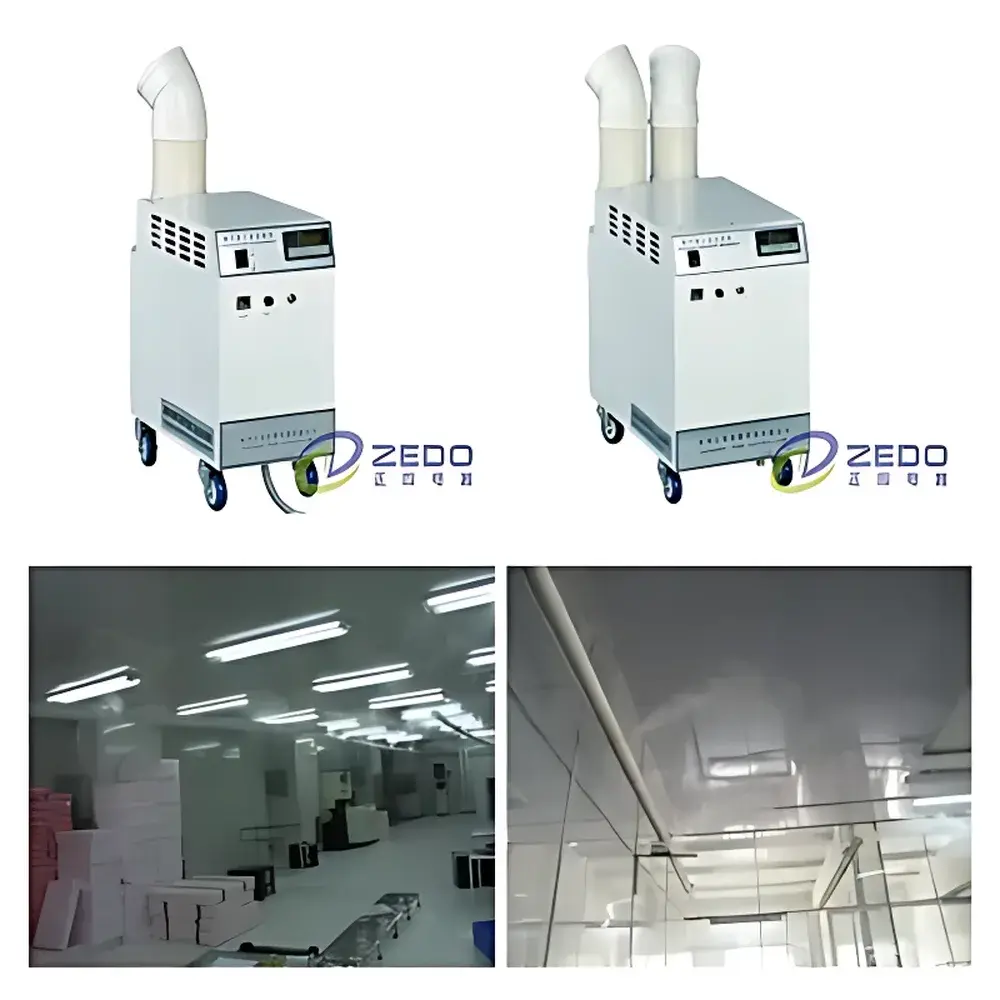
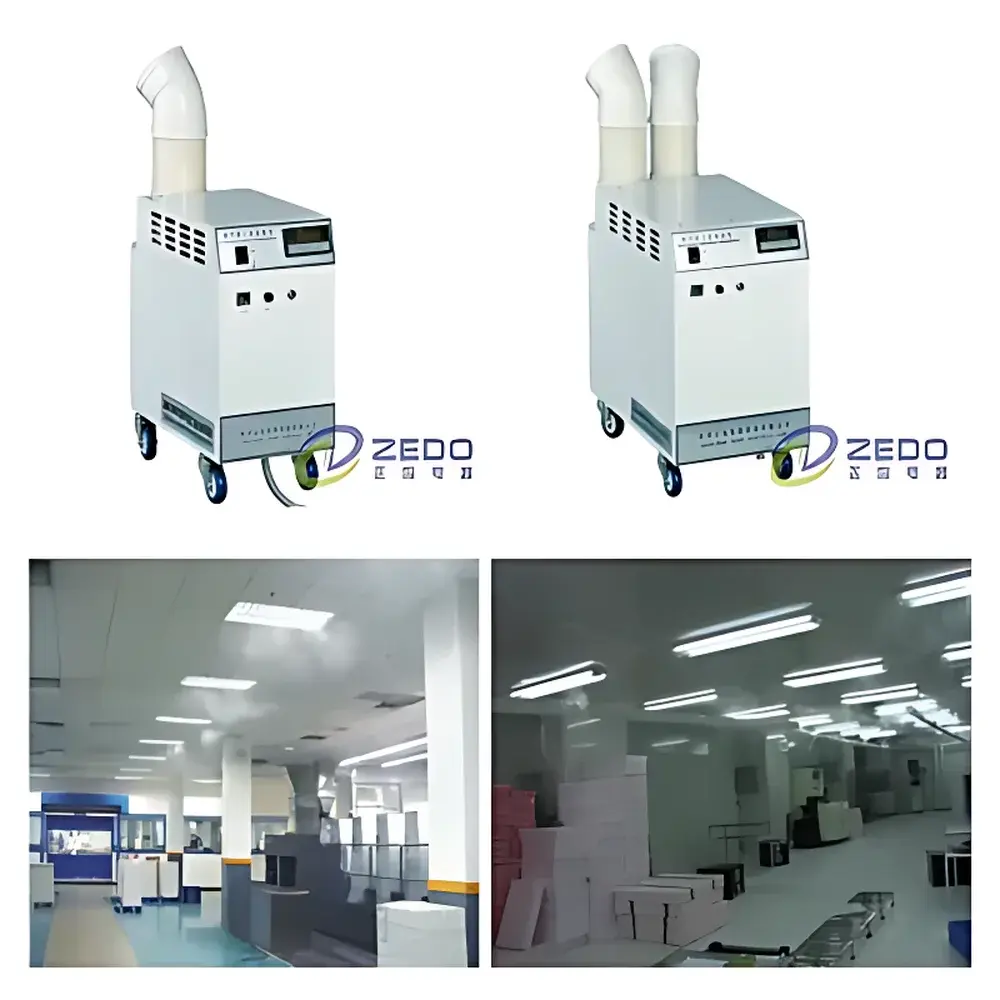
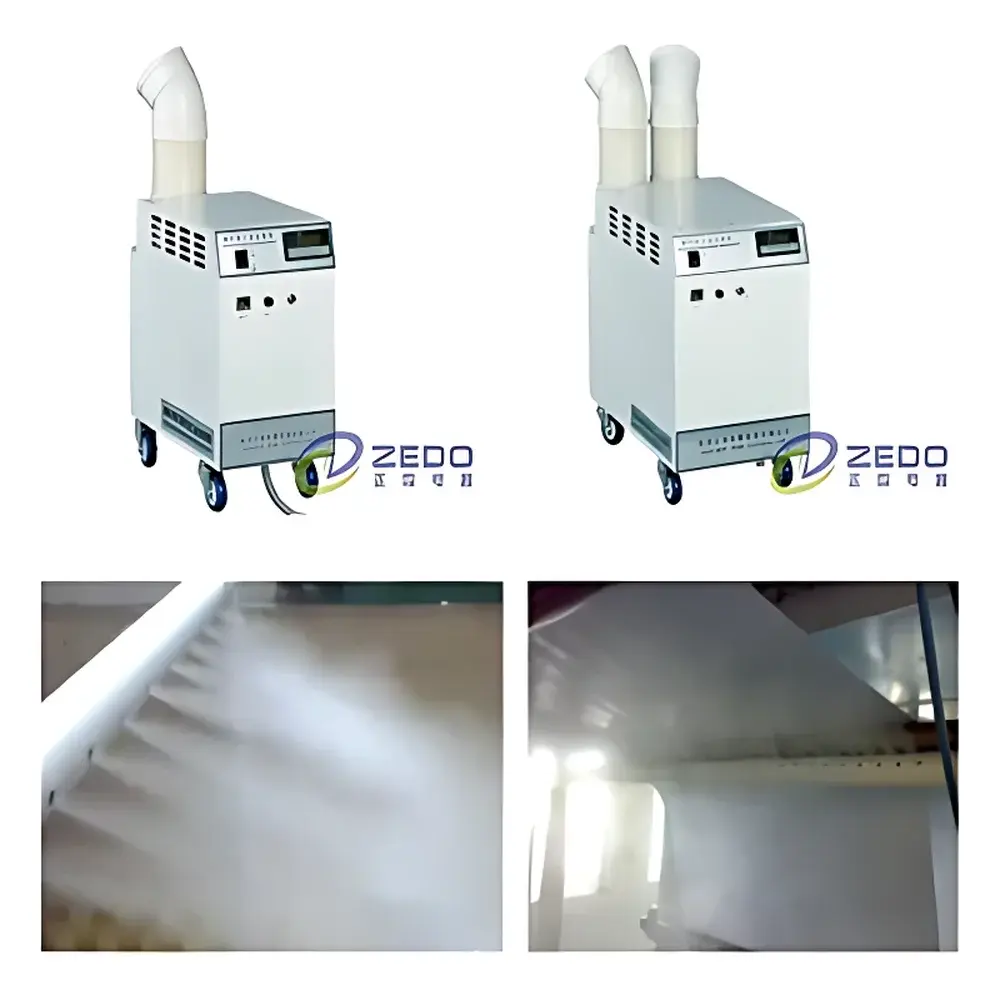
ZEDO ZS-40Z Industrial Ultrasonic Humidifier for Printing Facilities
| Brand | ZEDO |
|---|---|
| Origin | Zhejiang, China |
| Manufacturer Type | OEM Manufacturer |
| Product Category | Domestic (China-made) |
| Model | ZS-40Z |
| Power Consumption | 1200 W |
| Humidification Capacity | 12 kg/h |
| Control Mode | Humidity-sensing Automatic Control (with Japanese Shinyo High-Accuracy RH Sensor) |
| 雾化方� | �: Ultrasonic Oscillation (2.4 MHz) |
| Enclosure Material | Full Stainless Steel (304) with Powder Coating |
| IP Rating | IP68 (Waterproof Power Supply & Fan) |
| 雾化片 | Alumina Ceramic Transducer (Alkaline/Acid-Resistant, 3000–5000 h Lifetime) |
| Mobility | Equipped with Locking Casters |
| Compliance | Designed for ISO 14644 Cleanroom-adjacent environments and GLP-aligned humidity stability requirements |
Overview
The ZEDO ZS-40Z Industrial Ultrasonic Humidifier is an engineered solution for precision humidity control in printing production environments where electrostatic discharge (ESD), dimensional instability of paper substrates, and ink transfer inconsistencies directly compromise print fidelity and operational continuity. Unlike evaporative or steam-based systems, the ZS-40Z employs high-frequency ultrasonic transduction (2.4 MHz) to atomize deionized or softened water into sub-10 µm droplets—enabling rapid, uniform dispersion without thermal load or mineral residue accumulation. Its design targets the critical ambient envelope defined by industry best practices: 22 ± 4 °C temperature and 60 ± 10 %RH relative humidity—parameters empirically validated to minimize surface resistivity of paper stocks (typically 10⁹–10¹¹ Ω/sq), suppress airborne particulate adhesion, and stabilize ink rheology during high-speed web offset or flexographic processes.
Key Features
- Full 304 stainless steel enclosure with electrophoretic powder coating—resistant to corrosion, chemical exposure, and mechanical abrasion in industrial settings.
- Integrated ultrasonic transducer module with ceramic (alumina) diaphragms—rated for alkaline/acidic water conditions and engineered for 3,000–5,000 hours of continuous operation.
- IP68-rated sealed variable-frequency power supply and 36 V DC waterproof fan—capable of submerged operation (1 m depth), eliminating moisture ingress failure modes common in conventional humidifiers.
- Microprocessor-based controller with Shinyo (Japan) capacitive humidity sensor—providing ±3 %RH accuracy across 20–95 %RH range and supporting setpoint-driven ON/OFF, timed, or closed-loop humidity regulation.
- Automatic water level management system with float-switch overflow protection and solenoid-controlled inlet—ensuring uninterrupted operation under varying municipal water pressure conditions.
- Modular mobility via four locking swivel casters—enabling repositioning between press rooms, paper storage zones, and pre-conditioning areas without permanent installation.
Sample Compatibility & Compliance
The ZS-40Z is compatible with standard industrial water supplies (conductivity ≤ 250 µS/cm recommended); for hard water regions, integration with inline softening or reverse osmosis pretreatment is advised to prevent transducer scaling. While not a medical or pharmaceutical-grade device, its construction materials and control architecture align with baseline requirements for Good Laboratory Practice (GLP) and Good Manufacturing Practice (GMP) support environments—particularly where humidity stability is documented per ISO 14644-1 Annex B or ASTM D6751 (for paper conditioning). The unit meets CE electromagnetic compatibility directives (2014/30/EU) and conforms to IEC 60335-1 safety standards for household and similar electrical appliances, adapted for industrial duty cycles.
Software & Data Management
The ZS-40Z operates via embedded firmware with no external software dependency. All operational parameters—including real-time RH reading, target setpoint, runtime hours, and fault codes (e.g., low-water, transducer timeout)—are displayed on a backlit LCD interface with tactile membrane keys. Audit-ready logging is not natively supported; however, analog 0–10 V or 4–20 mA output signals (optional configuration) enable integration with building management systems (BMS) or SCADA platforms for centralized environmental monitoring. For regulated facilities requiring 21 CFR Part 11 compliance, third-party data acquisition modules may be deployed to capture timestamped humidity events with electronic signature capability.
Applications
This humidifier serves three primary functional roles in printing infrastructure: (1) Paper Conditioning—maintaining 60 %RH in roll storage and sheet-cutting areas to prevent hygroscopic expansion/contraction that induces register misalignment (>±0.1 mm error at 100 m/min web speed); (2) Static Mitigation—reducing surface voltage on paper webs from >10 kV (at 20 %RH) to <1 kV (at 60 %RH), thereby minimizing ink misting, dust attraction, and winding defects; and (3) Process Stabilization—supporting consistent ink film formation by stabilizing solvent evaporation rates in UV-curable and water-based flexo inks, particularly during seasonal transitions when ambient dew point drops below 5 °C.
FAQ
What is the recommended water quality specification for optimal transducer longevity?
Deionized or softened water (total hardness < 50 ppm CaCO₃ equivalent) is strongly advised. Unconditioned municipal water may reduce ceramic transducer service life by up to 40 % due to scale deposition.
Can the ZS-40Z be integrated into a central HVAC humidity control loop?
Yes—via optional 0–10 V analog output or Modbus RTU (RS-485) interface, enabling synchronization with VAV boxes or chilled beam systems for zone-level RH coordination.
Does the unit include built-in ESD grounding provisions?
The stainless steel chassis is electrically bonded to the internal grounding conductor. External grounding to facility earth (<5 Ω resistance) is required per IEC 61000-5-2 for ESD-sensitive environments.
Is remote monitoring or firmware update capability available?
No native Wi-Fi or Ethernet connectivity is provided. Remote status interrogation requires external IoT gateway integration using the analog or digital I/O ports.
What maintenance intervals are specified for routine operation?
Ceramic transducers require visual inspection every 500 operating hours; cleaning with 5 % citric acid solution is recommended if visible mineral buildup occurs. Fan filters should be vacuumed monthly in high-dust environments.



