
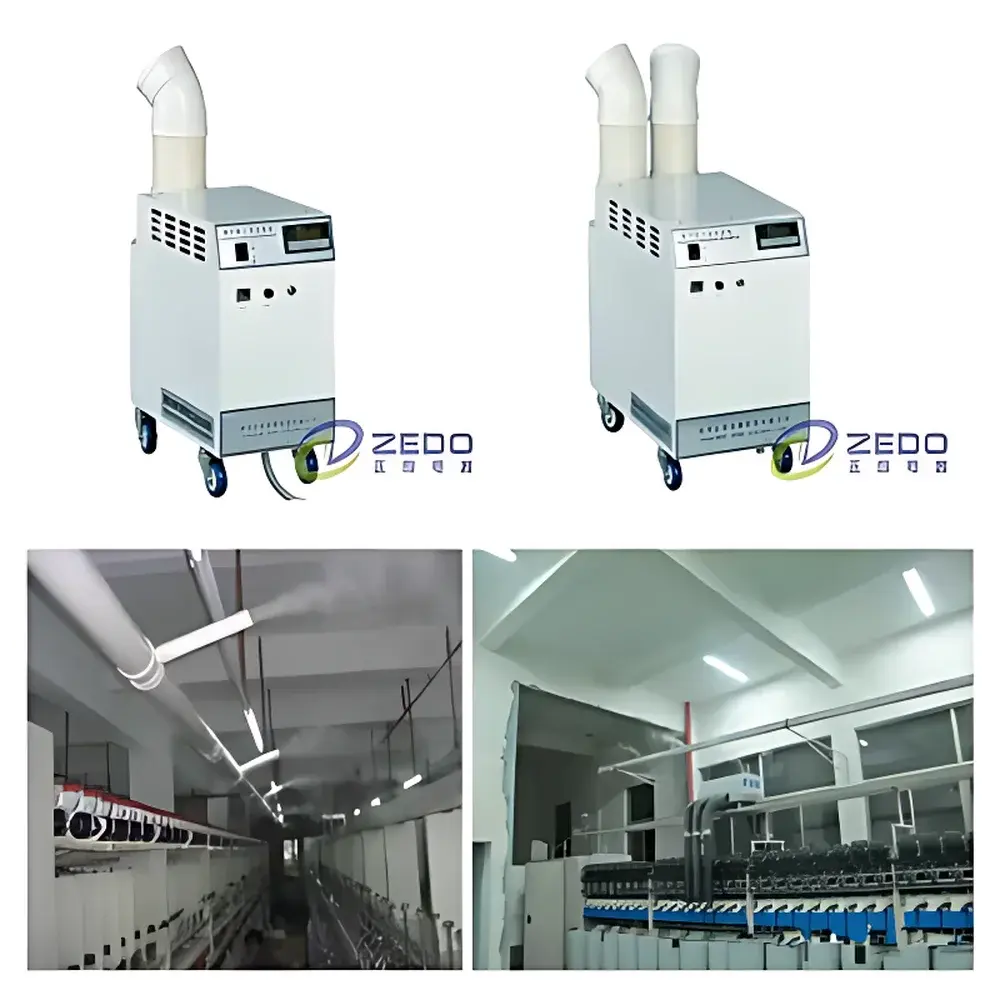
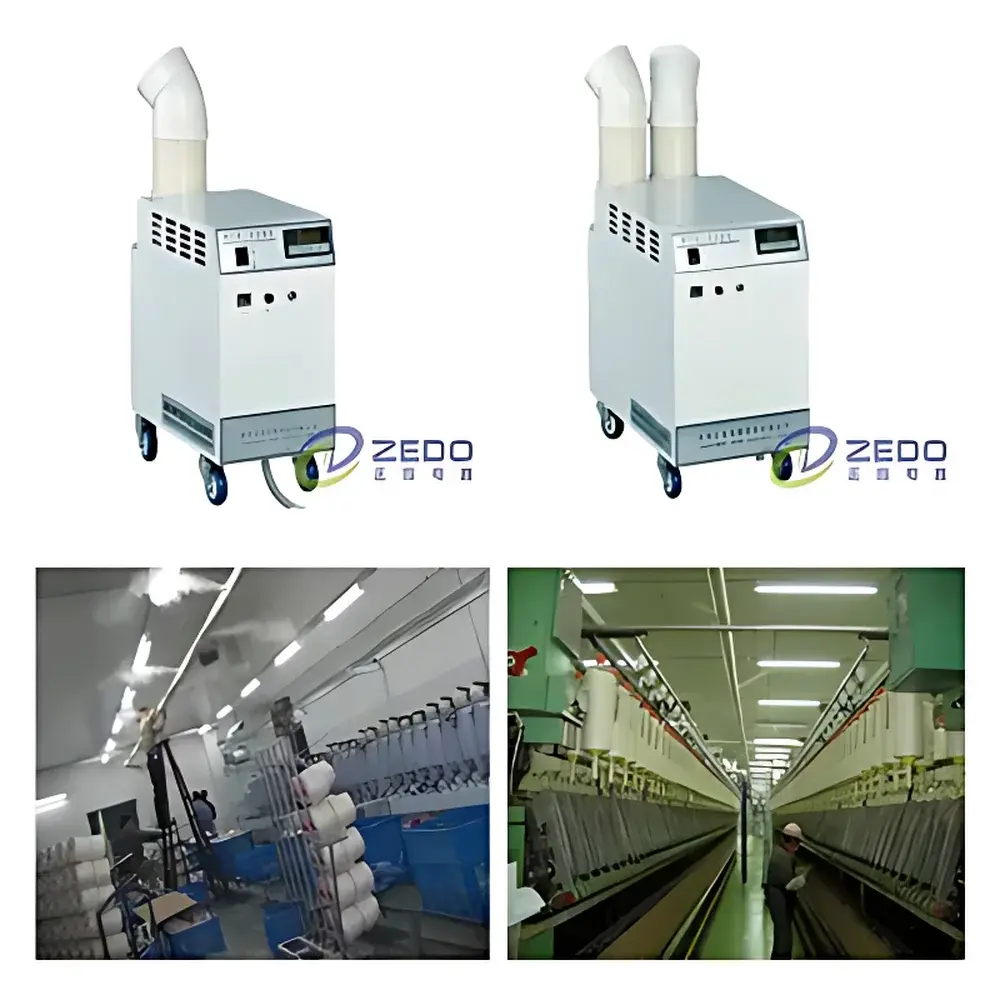
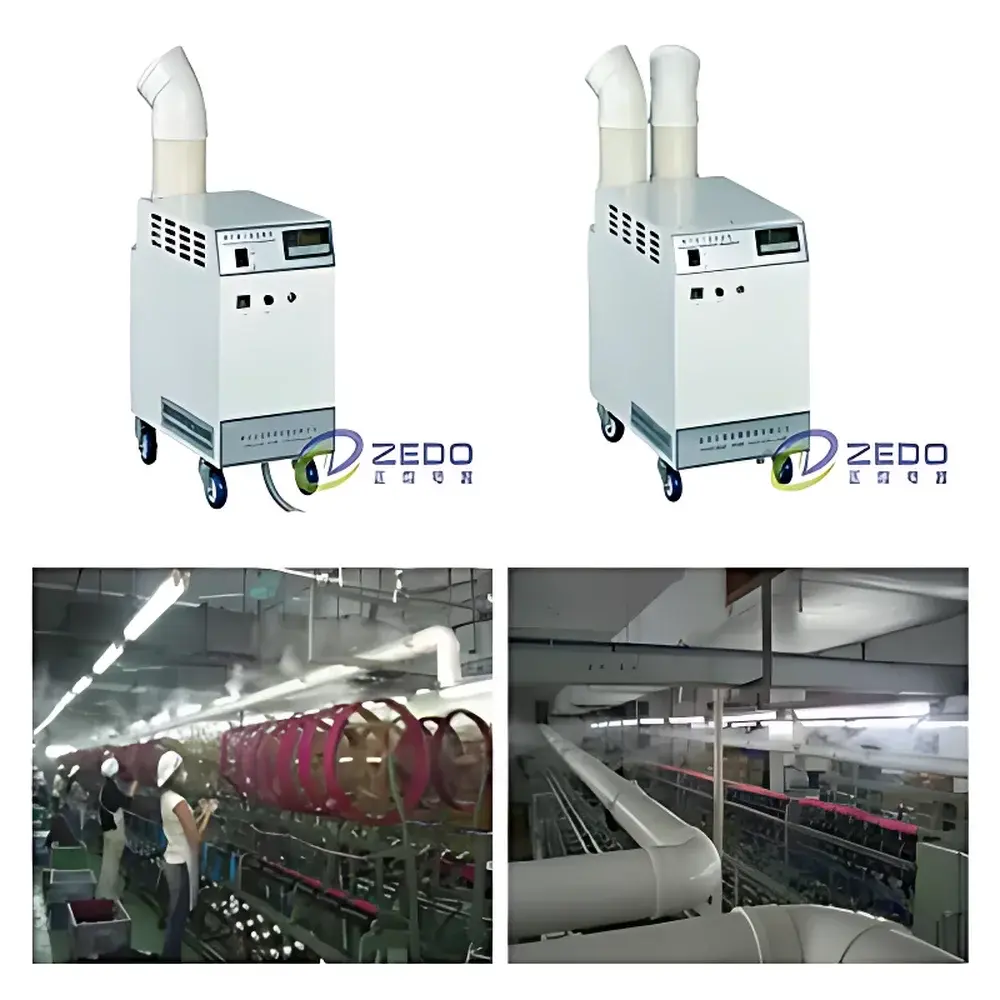
ZEDO ZS-40Z Textile Workshop Industrial Ultrasonic Humidifier
| Brand | ZEDO |
|---|---|
| Origin | Zhejiang, China |
| Manufacturer Type | Direct Manufacturer |
| Model | ZS-40Z |
| Humidification Capacity | 12 kg/h |
| Power Consumption | 1200 W |
| Control Mode | Automatic Humidity Feedback Control (RH Sensor-Based) |
| 雾化方� | �: Single-Tube Ultrasonic Atomization |
| Housing Material | Full Stainless Steel (304) |
| IP Rating | IP68 (Power Supply & Fan) |
| 雾化片 | Alumina Ceramic Transducer (Alkaline/Acid-Resistant, 3000–5000 hr lifespan) |
| Humidity Sensor | Japanese Shinyo High-Accuracy Capacitive RH Sensor (±3% RH, 10–90% RH range) |
| Operating Voltage | 36 V DC (Fan), 220 V AC (Main Unit) |
| Certifications | CE-marked, RoHS-compliant, GLP-aligned documentation support available |
Overview
The ZEDO ZS-40Z Textile Workshop Industrial Ultrasonic Humidifier is an engineered environmental control system designed specifically for precision humidity management in spinning mills, weaving halls, and yarn storage facilities. It operates on the principle of high-frequency ultrasonic vibration (1.7 MHz), where piezoelectric ceramic transducers convert liquid water into sub-10 µm micron-sized droplets—capable of rapid evaporation and uniform dispersion without wetting surfaces or machinery. Unlike evaporative or steam-based systems, this unit delivers immediate, localized, and energy-efficient humidification with no thermal load or mineral residue buildup. Its primary function is to maintain a stable relative humidity (RH) range of 40–60% RH—critical for minimizing electrostatic charge accumulation, reducing fiber brittleness, suppressing airborne lint and dust, and preserving tensile strength and elongation properties of natural and regenerated fibers (e.g., cotton, viscose, wool). The device integrates seamlessly into textile production workflows where hygroscopic equilibrium directly affects yarn evenness, breakage rate, winding stability, and downstream fabric quality.
Key Features
- Full 304 stainless steel enclosure and internal tank—resistant to corrosion, alkali, and repeated cleaning cycles; includes automatic float valve inlet and overflow protection.
- Integrated ultrasonic atomizer module with industrial-grade alumina ceramic transducers—rated for continuous operation in hard-water environments and offering 3,000–5,000 hours of service life with plug-and-replace modularity.
- IP68-rated sealed variable-frequency power supply and control circuitry—submersible up to 1 meter depth, eliminating moisture-induced short circuits and ensuring long-term reliability in high-humidity industrial settings.
- 36 V DC waterproof ball-bearing fan (IP68)—engineered for low-vibration, high-airflow delivery with corrosion-resistant impeller and sealed motor housing.
- Microprocessor-based controller with Japanese Shinyo capacitive RH sensor—provides real-time closed-loop feedback, ±3% RH accuracy across 10–90% RH, and programmable setpoint hysteresis to prevent compressor-style cycling.
- Human-machine interface with tactile membrane keypad, LED status indicators, and auto-diagnostic alerts for low water, transducer fault, or sensor drift.
Sample Compatibility & Compliance
The ZS-40Z is compatible with standard municipal tap water (TDS ≤ 500 ppm); optional inline reverse osmosis pre-filtration is recommended for regions with elevated calcium/magnesium content. It meets CE Directive 2014/30/EU (EMC) and 2014/35/EU (LVD), conforms to RoHS 2011/65/EU restrictions on hazardous substances, and supports audit-ready documentation for GLP-aligned facility operations. While not classified as a medical or pharmaceutical device, its humidity stabilization capability aligns with ISO 18562-1 (biocompatibility of breathing gas pathways) and ASTM D1776 (standard practice for conditioning textiles for testing), supporting consistent sample conditioning prior to tensile, twist, or evenness analysis per ASTM D1445, ISO 2062, or GB/T 3916.
Software & Data Management
The ZS-40Z operates via embedded firmware without external PC dependency. All operational parameters—including target RH, current RH reading, runtime hours, alarm history, and transducer duty cycle—are stored in non-volatile memory with timestamped logging (retention: 30 days). Optional RS-485 Modbus RTU interface enables integration into SCADA or building management systems (BMS) for centralized monitoring across multi-unit deployments. Audit trails comply with data integrity principles outlined in FDA 21 CFR Part 11 when paired with validated third-party BMS platforms—supporting electronic record retention, user-level access control, and change tracking for QA/QC departments.
Applications
- Spinning车间: Stabilizing RH during roving, drawing, and ring-spinning to reduce static-induced wrap-ups, false twist, and end breaks.
- Weaving & Knitting Facilities: Preventing warp breakage and shuttle jamming by maintaining optimal fiber plasticity and surface resistivity.
- Yarn Storage Warehouses: Controlling moisture regain in bales and cones to avoid weight loss, tensile degradation, and dye uptake variability.
- Quality Control Labs: Conditioning samples per ISO 139 (standard atmosphere: 20°C ±2°C, 65% RH ±2%) prior to physical testing.
- Maintenance Zones: Suppressing combustible lint dispersion near high-speed looms and carding machines in accordance with NFPA 99 and local fire safety codes.
FAQ
What is the recommended RH setpoint for cotton spinning operations?
For raw cotton processing, 55–60% RH is optimal to maximize fiber cohesion and minimize static; for synthetic-blend spinning, 45–50% RH typically suffices.
Can the ZS-40Z operate continuously for 24/7 production shifts?
Yes—its IP68-rated components, ceramic transducer durability, and thermal-protected power architecture support uninterrupted operation under rated load conditions.
Does this unit require water softening or demineralization?
Not mandatory, but recommended where TDS exceeds 300 ppm; untreated hard water may gradually reduce transducer efficiency over extended periods.
How does ultrasonic humidification differ from high-pressure mist systems in textile environments?
Ultrasonic systems produce finer aerosols (20 µm) that settle faster and risk lubricant contamination on rollers and spindles.
Is remote monitoring supported out-of-the-box?
Standard configuration includes local HMI only; RS-485 Modbus output is available as a factory-configurable option for integration with existing plant networks.




