
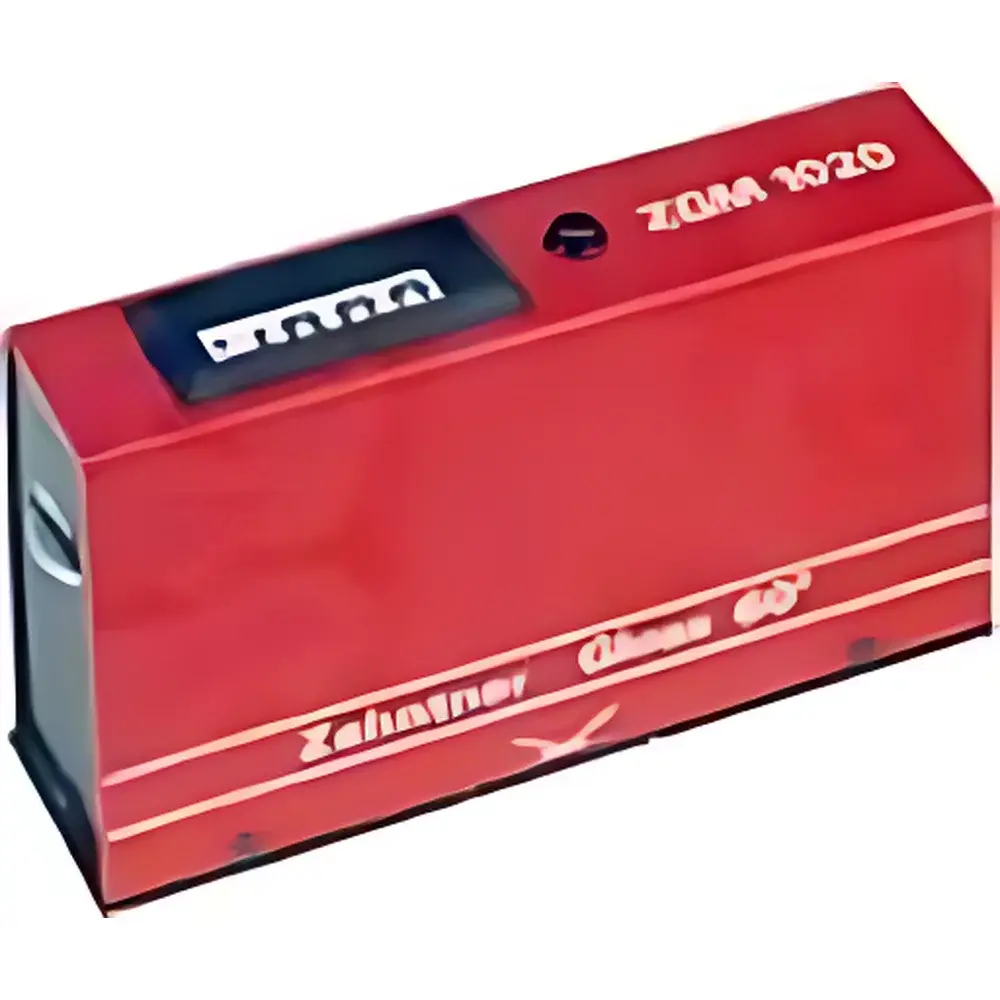
Zehntner ZGM1020/1022/1023 Portable Gloss Meter
| Brand | Zehntner |
|---|---|
| Origin | Switzerland |
| Model | ZGM1020 / ZGM1022 / ZGM1023 |
| Measurement Angles | 20°, 45°, 60°, 75° (configurable per model) |
| Single-Angle Modes | 20°, 45°, 60°, 75°, 85° |
| Dual-Angle Modes | 20°/60°, 20°/75°, 45°/60°, 45°/45° |
| Mirror-Surface Mode | 20° & 60° |
| Repeatability | ±0.1 GU |
| Calibration Standards Included | Medium-Gloss & High-Gloss Reference Tiles with Precision Alignment Pins |
| Compliance | ISO 2813, ASTM D523, DIN 67530, JIS Z8741 |
Overview
The Zehntner ZGM1020/1022/1023 Portable Gloss Meter is a precision optical instrument engineered for reliable, field-deployable measurement of specular gloss across industrial and laboratory environments. Operating on the principle of controlled-angle reflectance photometry, it quantifies the ratio of reflected luminous flux to incident flux at defined geometries—strictly adhering to internationally recognized optical metrology standards including ISO 2813, ASTM D523, DIN 67530, and JIS Z8741. Unlike general-purpose light meters, this device employs a stabilized tungsten-halogen light source, precision-aperture optics, and a silicon photodiode detector calibrated to CIE Standard Illuminant A, ensuring traceable, spectrally consistent measurements independent of ambient lighting conditions. Its compact, ergonomic housing—constructed from anodized aluminum with IP54-rated ingress protection—is optimized for handheld use in manufacturing floors, paint shops, coating inspection labs, and quality control checkpoints where portability and measurement integrity must coexist.
Key Features
- Multi-angle flexibility: Selectable single-angle (20°, 45°, 60°, 75°, or 85°) or dual-angle (e.g., 20°/60°, 20°/75°, 45°/60°) configurations—model-dependent—to characterize surface reflectance behavior across low-, medium-, and high-gloss regimes.
- High metrological stability: Achieves repeatability of ±0.1 gloss units (GU) under controlled environmental conditions (23 ± 2 °C, 50 ± 5 % RH), verified per ISO 2813 Annex B protocols.
- Integrated calibration system: Each unit ships with two certified reference tiles—medium-gloss (~60 GU) and high-gloss (~90 GU)—mounted with mechanical alignment pins to prevent surface abrasion during routine recalibration.
- Intuitive interface: Backlit LCD display with direct-access function keys; no menu navigation required for standard measurements. Power-on self-test and automatic zeroing ensure operational readiness within 3 seconds.
- Ruggedized design: Shock-absorbing rubber overmold, sealed optical path, and battery-operated architecture (4 × AA alkaline, >10,000 readings per charge) support extended use in non-laboratory settings without compromising optical alignment.
Sample Compatibility & Compliance
The ZGM series accommodates flat, curved, textured, and coated substrates—including automotive clearcoats, architectural panels, plastic injection-molded parts, printed packaging, and ceramic glazes—provided surface curvature radius exceeds 150 mm and local roughness (Ra) remains below 0.8 µm. Measurements comply with regulatory frameworks governing surface finish verification in ISO 9001-certified production lines and FDA-regulated medical device packaging facilities. The instrument’s documented calibration traceability (NIST-traceable reference standards), audit-ready calibration log storage, and physical calibration pin mechanism satisfy requirements for GLP-compliant documentation and internal quality audits per IATF 16949 Clause 7.1.5.2.
Software & Data Management
While fully functional as a standalone meter, the ZGM1022 and ZGM1023 models support optional USB-C connectivity for data export to Zehntner’s proprietary ZSoft v4.2 software suite. This platform enables batch statistical analysis (mean, SD, CPK), trend charting over time, pass/fail threshold configuration per job ID, and automated report generation compliant with ISO/IEC 17025 documentation templates. All stored measurements include timestamp, operator ID, instrument serial number, calibration status flag, and environmental metadata—supporting 21 CFR Part 11–aligned electronic record integrity when paired with user-defined digital signatures.
Applications
- Automotive OEMs and Tier-1 suppliers: In-line gloss verification of basecoat/clearcoat systems pre- and post-baking per OEM-specific specifications (e.g., GMW14872, Ford CETP).
- Coating manufacturers: Batch release testing of solvent-based, waterborne, and UV-curable formulations against contractual gloss tolerances.
- Packaging converters: Monitoring gloss consistency of metallized PET, laminated board, and embossed foils across press runs.
- Architectural glass and metal fabricators: Validation of anti-reflective, matte, or high-sheen finishes on façade components prior to installation.
- Academic and materials research labs: Correlating gloss values with surface topography (AFM, profilometry) and chemical composition (XPS, FTIR) in polymer and composite studies.
FAQ
What standards does the ZGM series comply with?
It conforms to ISO 2813, ASTM D523, DIN 67530, and JIS Z8741 for gloss measurement methodology, geometry, and instrumentation performance criteria.
Can the instrument measure curved surfaces?
Yes—within limits: minimum radius of curvature ≥150 mm and local surface deviation <0.8 µm Ra; results should be interpreted with geometric correction factors per ISO 2813 Annex D.
How often must the reference tiles be recalibrated?
Zehntner recommends annual recalibration by an accredited metrology lab (ISO/IEC 17025) using NIST-traceable transfer standards; field verification against master tiles is advised before each shift.
Is the ZGM suitable for ISO 9001 internal audits?
Yes—its built-in calibration verification protocol, traceable reference standards, and optional software-generated audit trails meet Clause 7.1.5.2 requirements for monitoring and measuring resource control.
Does the device require warm-up time?
No—optical and electronic subsystems stabilize within 3 seconds of power-on; no thermal drift compensation is necessary for routine use within 15–30 °C ambient range.




