
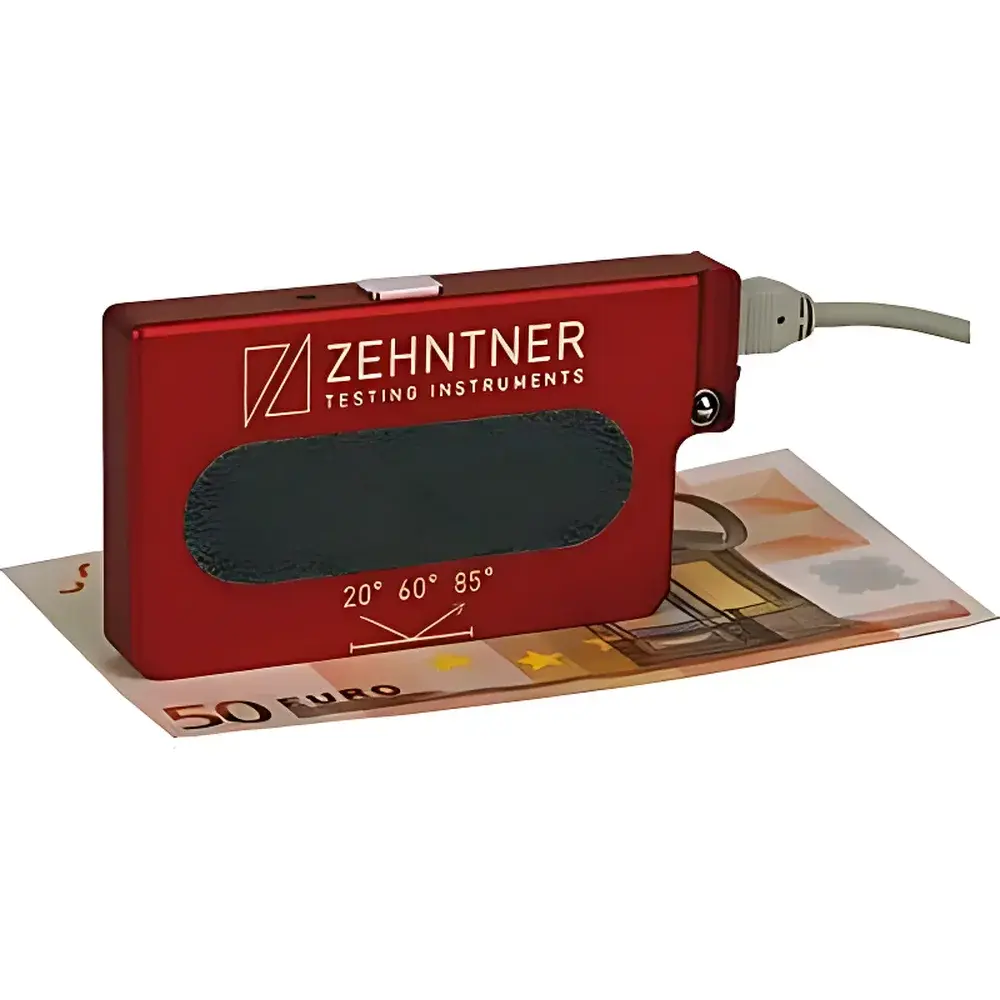
Zehntner ZGM1120 Advanced Tri-Angle Gloss Meter
| Brand | Zehntner |
|---|---|
| Model | ZGM1120 |
| Measurement Angles | 20° / 60° / 85° |
| Gloss Range | 0–2000 GU |
| Accuracy | ±1% of reading |
| Detector | V(λ)-matched photoreceptor |
| Light Source | White LED |
| Power Supply | USB-powered |
| Calibration Standard | BAM-certified reference standards |
| Compliance | ASTM D523, ASTM D2457, BS 3900 Part 5, BS 6161, DIN EN ISO 2813, DIN 67530, JIS Z 8741 |
| Dimensions | ≤99 × 15 × 56 mm (L×W×H) |
| Weight | ≤117 g |
| Warranty | 12 months |
| Software | Gloss Tools v3.x (Windows-based) |
Overview
The Zehntner ZGM1120 is a precision tri-angle gloss meter engineered for high-reproducibility surface reflectance measurement in quality control laboratories, R&D facilities, and production environments. Based on the principle of specular reflectance—defined as the ratio of reflected luminous flux at the specular angle to that of a perfectly reflecting diffuser under identical geometrical and illuminating conditions—the instrument delivers traceable, standardized gloss quantification across three industry-critical angles: 20° (for high-gloss surfaces), 60° (universal reference angle), and 85° (optimized for low-gloss or matte finishes). Its optical architecture integrates a V(λ)-matched silicon photodiode detector and stable white LED illumination, ensuring spectral response aligned with the CIE photopic luminosity function. The compact, handheld form factor (≤99 × 15 × 56 mm; ≤117 g) enables rapid in-line verification without sacrificing metrological integrity. Designed and assembled in Switzerland, the ZGM1120 adheres to stringent manufacturing tolerances and undergoes factory calibration against BAM (Bundesanstalt für Materialforschung und -prüfung) certified reference standards, guaranteeing compliance with international gloss measurement protocols.
Key Features
- Tri-angle measurement capability (20°, 60°, 85°) with automatic angle selection and real-time switching via Gloss Tools software
- High-accuracy optical path: ±1% measurement uncertainty referenced to BAM-traceable standards
- V(λ)-compliant detector ensures photometrically correct weighting across the visible spectrum (380–780 nm)
- USB-powered operation eliminates battery dependency and enables continuous data streaming during extended sessions
- Integrated temperature-stabilized LED source provides consistent spectral output with negligible drift over time
- Rugged anodized aluminum housing rated for industrial environments; IP52-rated against dust and light moisture ingress
- Zero warm-up time and sub-second measurement cycle (≤0.5 s per reading)
Sample Compatibility & Compliance
The ZGM1120 is validated for non-destructive gloss assessment of flat or gently curved rigid substrates—including painted metal panels, coated plastics, laminated glass, printed packaging films, and ceramic tiles—with minimum sample area ≥20 × 20 mm. It supports both single-point and multi-location statistical sampling (n ≥ 2 to n = 99). All measurement modes conform to internationally recognized standards: ASTM D523 (specular gloss of nonmetallic specimens), ASTM D2457 (gloss of plastic films and sheeting), ISO 2813 (paints and varnishes), DIN EN ISO 2813 (identical to ISO 2813), DIN 67530 (German gloss standard), BS 3900-E5 and BS 6161 (UK standards), and JIS Z 8741 (Japanese industrial standard). Instrument calibration documentation includes full traceability to national metrology institutes (NMI) through BAM certification, satisfying audit requirements under ISO/IEC 17025-accredited testing laboratories.
Software & Data Management
Gloss Tools v3.x is a dedicated Windows application supporting full instrument control, real-time data visualization, and structured export. It enables continuous measurement mode with live updating of descriptive statistics—including arithmetic mean, standard deviation, maximum, minimum, and coefficient of variation—for up to 99 sequential readings per batch. All raw data are timestamped and stored with metadata (operator ID, sample ID, angle, date/time, ambient temperature/humidity if logged externally). Export formats include CSV (compatible with Microsoft Excel, Minitab, JMP), PDF reports with embedded calibration certificates, and XML for integration into LIMS or MES platforms. The software maintains full audit trail functionality per FDA 21 CFR Part 11 requirements when deployed with user authentication and electronic signature modules. No cloud dependency—data reside exclusively on local or network drives per organizational IT policy.
Applications
- Automotive OEM and Tier-1 suppliers: Paint finish validation across body panels, bumpers, and interior trims
- Coatings manufacturers: Batch-to-batch consistency monitoring of solvent-based, waterborne, and powder coatings
- Packaging converters: Gloss uniformity assessment of metallized PET, laminated cartons, and UV-cured overprints
- Plastics processors: Surface quality control of injection-molded housings, extruded profiles, and thermoformed parts
- Architectural glazing producers: Reflectance characterization of anti-reflective, low-E, and decorative glass coatings
- Academic and government research labs: Correlation studies between gloss, surface roughness (Ra/Rz), and coating formulation variables
FAQ
Is the ZGM1120 suitable for measuring curved surfaces?
Yes—within curvature radii ≥50 mm and surface gradients ≤5°, provided the measurement aperture remains fully seated and perpendicular to the local tangent plane.
Does the instrument require annual recalibration?
While not mandatory, Zehntner recommends biannual verification using certified reference standards (e.g., BAM 100 GU and 800 GU tiles) to maintain confidence in measurement uncertainty budgets.
Can Gloss Tools interface with LabVIEW or Python?
Yes—Zehntner provides a documented COM API and ASCII command protocol (RS-232 emulation over USB) for custom automation and third-party software integration.
What environmental conditions affect measurement stability?
Ambient temperatures between 10–30 °C and relative humidity below 80% RH (non-condensing) are specified; rapid thermal transients (>2 °C/min) may induce temporary drift until thermal equilibrium is restored.
Is the USB interface compatible with Windows 11 and macOS?
Native drivers support Windows 7 through Windows 11 (64-bit); macOS compatibility requires virtualization or third-party USB-serial bridge utilities—Zehntner does not provide native macOS drivers.




