
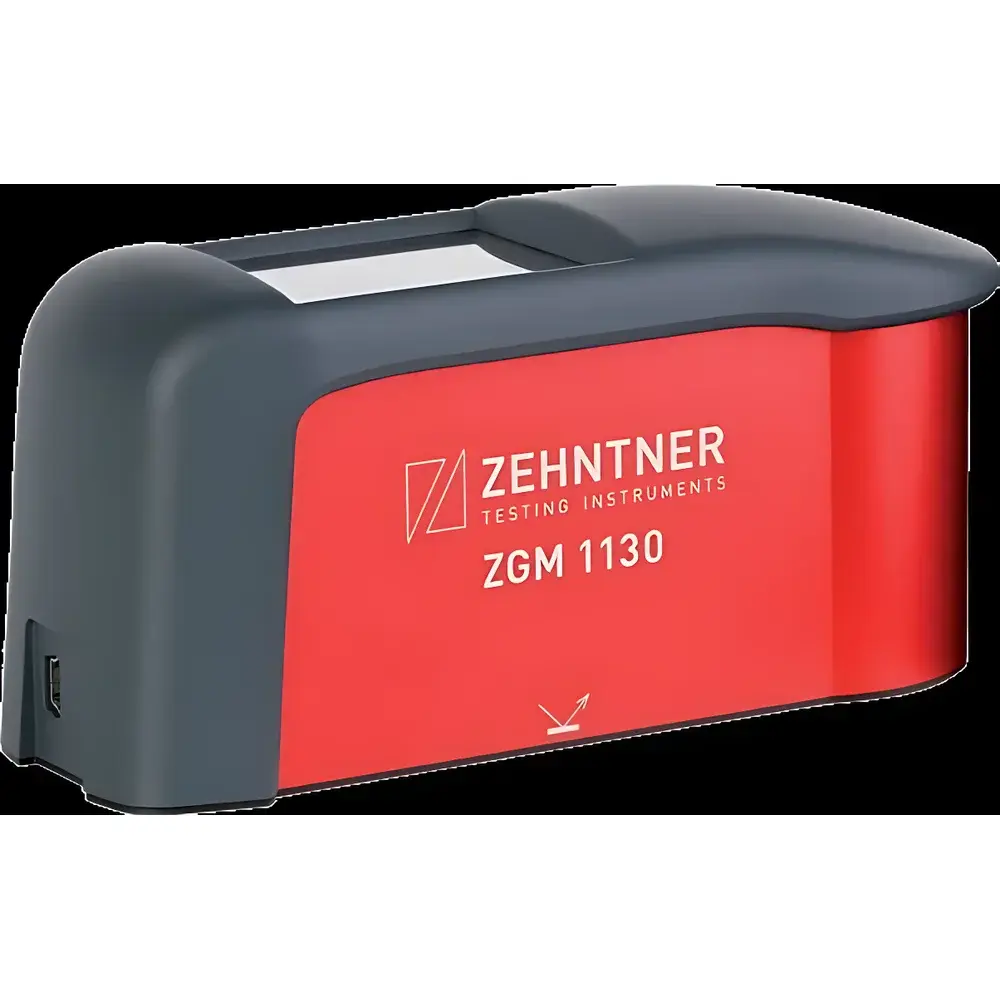
Zehntner ZGM1130 Gloss Meter
| Brand | ZEHNTNER |
|---|---|
| Origin | Switzerland |
| Model | ZGM1130 |
| Measurement Angles | 20°, 60°, and 85° (user-selectable single/dual/triple-angle modes) |
| Gloss Range | 0–2000 GU |
| Resolution | 0.1 GU (0–199.9 GU), 0.2% (200–2000 GU) |
| Accuracy | ±1% of reading |
| Spot Size | 20° (Ø9.8 mm), 60° (15.5 mm × 8.4 mm), 85° (65.5 mm × 14 mm) |
| Detector | V(λ)-matched photodiode |
| Light Source | Stable LED with spectral compliance to CIE illuminant D65 |
| Power Supply | USB-powered (no internal battery) |
| Dimensions (L×W×H) | ≤150 mm × 52 mm × 71 mm |
| Weight | ≤420 g |
| Calibration Standard | BAM-certified reference tile |
| Compliance | ASTM D523, ASTM D2457, ISO 2813, EN ISO 7668, BS 3900-D6/D13, DIN 67530 |
Overview
The Zehntner ZGM1130 Gloss Meter is a precision optical instrument engineered for high-reproducibility gloss measurement across industrial quality control, R&D, and regulatory-compliant surface evaluation workflows. Operating on the principle of specular reflectance—measuring the ratio of reflected luminous flux at a defined geometry relative to a perfectly reflecting diffuser—the ZGM1130 delivers traceable, metrologically sound data in gloss units (GU). Its tri-angle configuration (20°, 60°, and 85°) enables application-specific assessment: 20° for high-gloss surfaces (e.g., automotive clearcoats, polished metals), 60° as the universal reference angle per ISO 2813 and ASTM D523, and 85° optimized for low-gloss and matte finishes (e.g., architectural paints, textured plastics). Designed and assembled in Switzerland, the instrument adheres to stringent optical alignment tolerances and thermal stability requirements essential for field-deployable metrology.
Key Features
- Tri-angle measurement capability (20°/60°/85°) with intuitive hardware-switched or software-selected mode selection—no recalibration required between angles.
- 2.4-inch full-color capacitive touchscreen with ergonomic left/right-hand orientation support and multi-language UI (English, German, French, Spanish, Chinese).
- V(λ)-spectrally matched silicon photodiode detector, calibrated against BAM (Bundesanstalt für Materialforschung und -prüfung) certified reference standards, ensuring CIE photopic response compliance.
- Integrated real-time statistical engine: calculates and displays mean, standard deviation, maximum, and minimum values during continuous measurement sequences—ideal for process capability analysis (Cp/Cpk) and SPC charting.
- USB-powered operation with direct data export: measurement records—including timestamps, angle settings, and statistics—can be saved to host PC or printed via USB-connected thermal printers without proprietary drivers or internet connectivity.
- Self-guided calibration workflow with audible and visual prompts; automatic zero and gain adjustment using the included precision-machined ceramic calibration tile (certified traceable to BAM).
Sample Compatibility & Compliance
The ZGM1130 accommodates flat, curved, and moderately textured substrates within its defined spot sizes: Ø9.8 mm at 20°, 15.5 mm × 8.4 mm at 60°, and 65.5 mm × 14 mm at 85°. Its compact form factor (≤150 × 52 × 71 mm) and sub-420 g mass enable handheld use on production lines, in paint booths, or within confined lab environments. The instrument meets all geometric and photometric requirements of ISO 2813:2014, ASTM D523–22, ASTM D2457–21, EN ISO 7668:2017, BS 3900-D6/D13, and DIN 67530. It supports GLP/GMP-aligned documentation practices through timestamped, non-editable measurement logs and dual-certified calibration documentation (manufacturer certificate + BAM-traceable calibration certificate).
Software & Data Management
While fully functional as a standalone device, the ZGM1130 integrates seamlessly with ZehntnerTools PC software (included on CD, Windows-compatible). This platform enables advanced data management: batch report generation (PDF/CSV), comparative trend analysis across multiple samples or time points, user-defined pass/fail thresholds with automated flagging, and audit-trail-enabled session logging compliant with FDA 21 CFR Part 11 principles (electronic signatures, operator ID, change history). All raw data files are stored in open-format .txt or .csv—ensuring long-term accessibility without vendor lock-in.
Applications
- Automotive OEMs and Tier-1 suppliers: quantifying topcoat gloss uniformity, orange peel assessment, and repair validation per OEM-specific standards (e.g., GMW14872, Ford FLTM BO 113-01).
- Packaging converters: verifying gloss consistency of laminated films, metallized boards, and UV-cured overprints under controlled ambient lighting conditions.
- Architectural coatings laboratories: evaluating matte emulsion performance, anti-graffiti film efficacy, and weathering-induced gloss loss per ISO 11341 accelerated aging protocols.
- Plastics processors: monitoring extrusion die-lip effects, mold surface replication fidelity, and additive dispersion impact on surface reflectance.
- Academic materials science groups: correlating gloss metrics with AFM roughness parameters (Ra, Rq) and contact angle measurements for hydrophobic surface characterization.
FAQ
Does the ZGM1130 require annual recalibration?
Yes—Zehntner recommends annual recalibration against BAM-traceable standards to maintain ISO/IEC 17025-compliant measurement uncertainty budgets. Field verification using the supplied calibration tile should be performed before each measurement session.
Can the instrument measure curved surfaces?
It can assess convex or concave surfaces provided the local radius of curvature exceeds 100 mm and the measurement area remains fully covered by the specified spot size at the selected angle.
Is USB power sufficient for extended operation?
Yes—the device draws <500 mA from standard USB 2.0 ports or powered hubs; no internal battery degradation or runtime limitations apply.
What does “±1% accuracy” refer to?
This denotes the expanded uncertainty (k=2) relative to the true gloss value of a reference standard under controlled laboratory conditions (23 °C ±2 °C, 50% RH ±5%), as verified per ISO/IEC 17025-accredited procedures.
Is firmware upgradable?
Yes—ZehntnerTools software includes secure firmware update functionality; version history and release notes are published on the official Zehntner website (zehntner.com).




