
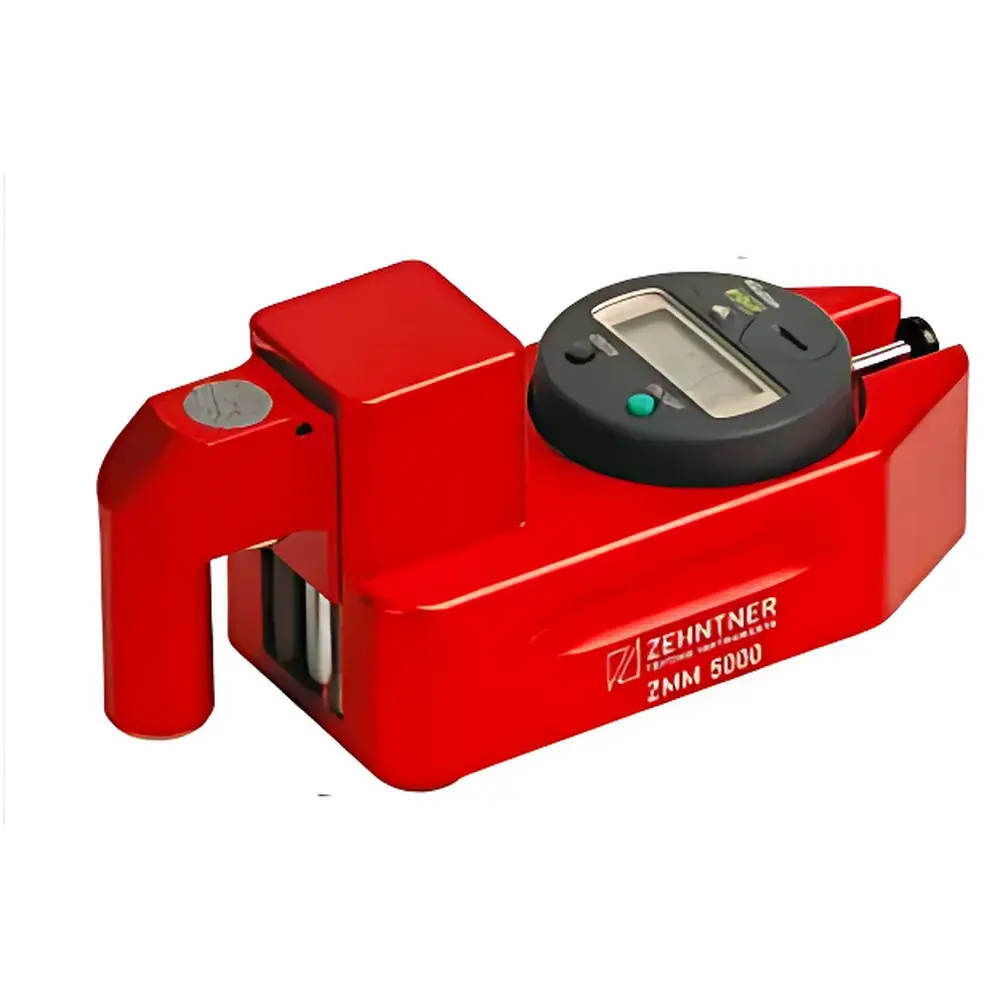
Zehntner ZMM5000 Road Marking Thickness Gauge
| Brand | Zehntner |
|---|---|
| Origin | Switzerland |
| Model | ZMM5000 |
| Measurement Range | ±12.5 mm |
| Resolution | 0.01 mm |
| Body Material | Anodized Aluminum |
| Dimensions | 180 × 70 × 76 mm |
| Weight | 880 g |
| Compliance | EN 13197, EN 13212 |
| Optional Accessories | Measuring Bridge, Thermal Printer, Unit Conversion Display Module |
Overview
The Zehntner ZMM5000 Road Marking Thickness Gauge is a precision-engineered, handheld mechanical gauge designed specifically for non-destructive measurement of dry film thickness (DFT) of road markings—including thermoplastic, cold plastic, paint, and preformed tape systems—directly on asphalt or concrete substrates. It operates on the mechanical displacement principle: a spring-loaded probe contacts the coating surface while a reference foot rests on the adjacent substrate; the vertical gap between them is translated into a linear displacement measured via a high-resolution analog dial or digital display (depending on configuration). Unlike magnetic or eddy-current gauges, the ZMM5000 requires no substrate conductivity or ferromagnetic base—it delivers traceable, repeatable measurements on all common road surface types, including reflective and non-reflective markings with or without glass beads. Its design adheres to the metrological requirements defined in EN 13197 (“Road marking materials — Determination of dry film thickness”) and EN 13212 (“Road marking materials — Specifications”), making it suitable for regulatory compliance verification, quality control audits, and routine field inspection by highway authorities and third-party testing laboratories.
Key Features
- High-precision mechanical sensing mechanism with ±12.5 mm total travel range and 0.01 mm resolution—calibrated traceably to national standards.
- Anodized aluminum housing ensures long-term dimensional stability, corrosion resistance, and thermal drift minimization under ambient field conditions (−10 °C to +50 °C).
- Ergonomic, one-handed operation with tactile feedback and zero-reset function for rapid sequential measurements across multiple points.
- Dual-mode readout capability: standard analog dial (optional digital LCD module available with unit conversion and data hold functions).
- Modular accessory support—including calibrated measuring bridges for curved or recessed markings, and thermal printers for on-site report generation compliant with ISO/IEC 17025 documentation requirements.
- No battery dependency in base configuration; fully functional without power source—ideal for remote infrastructure inspections where charging infrastructure is unavailable.
Sample Compatibility & Compliance
The ZMM5000 is validated for use on all standard road marking materials applied to rigid and semi-rigid pavements. It accommodates variations in surface texture, aggregate exposure, and retroreflective element geometry—including markings containing embedded glass beads or ceramic microspheres. The instrument meets the physical and procedural requirements of EN 13197 for DFT assessment, including probe footprint size, contact pressure limits (< 1 N), and repeatability thresholds (≤ 0.05 mm at 95% confidence). It is routinely deployed in conformity assessments aligned with national road safety regulations (e.g., U.S. MUTCD Chapter 3B, EU Directive 2008/96/EC on road infrastructure safety management) and supports GLP-compliant test records when paired with optional printer modules featuring time-stamped, operator-ID–enabled output.
Software & Data Management
While the base ZMM5000 operates as a standalone mechanical instrument, optional digital interface modules enable integration into structured QA/QC workflows. The unit conversion display module supports mm/μm/inch toggling and stores up to 99 measurement values with timestamp and location tags (when used with external GPS-enabled tablets). Export-ready CSV files can be generated via USB or Bluetooth for import into LIMS platforms or statistical process control (SPC) software such as Minitab or JMP. All digital outputs comply with audit-trail requirements per ISO/IEC 17025:2017 Clause 7.5.2 and support FDA 21 CFR Part 11–aligned electronic record integrity when configured with user authentication and electronic signature protocols.
Applications
- Field verification of road marking thickness during construction handover and post-installation acceptance testing.
- Periodic maintenance surveys to assess coating degradation, wear rate, and remaining service life estimation.
- Quality assurance in road marking manufacturing facilities—measuring wet-film-to-dry-film shrinkage ratios per ASTM D1212.
- Independent forensic analysis following traffic incident investigations where marking visibility or durability is contested.
- Calibration verification of automated laser profilometers and optical thickness scanners used in large-scale pavement asset management programs.
FAQ
Does the ZMM5000 require calibration certification for accredited testing?
Yes—Zehntner provides UKAS-accredited calibration certificates (traceable to METAS) upon request. Annual recalibration is recommended per ISO/IEC 17025 and EN 13197 Annex A.
Can it measure thickness on curved or sloped surfaces?
When used with the optional articulated measuring bridge (ZMB-200), the ZMM5000 maintains perpendicular probe alignment on radii down to 250 mm and cross-slopes up to ±5% without loss of accuracy.
Is operator training required for compliance with EN standards?
Per EN 13197 Section 5.2, users must demonstrate competence in probe placement, surface cleaning protocol, and outlier rejection criteria—Zehntner offers certified technician training modules aligned with ISO/IEC 17024.
How does temperature affect measurement stability?
The anodized aluminum frame exhibits a coefficient of thermal expansion of 23.1 µm/m·K; measurements remain within ±0.02 mm tolerance across −10 °C to +50 °C when performed within 30 seconds of environmental stabilization.
What is the minimum marking width measurable with standard probe configuration?
The standard 8-mm-diameter probe foot requires a minimum unbroken marking width of 12 mm for valid EN 13197–compliant readings; narrower features necessitate the optional 4-mm micro-probe kit (ZMP-4).



