
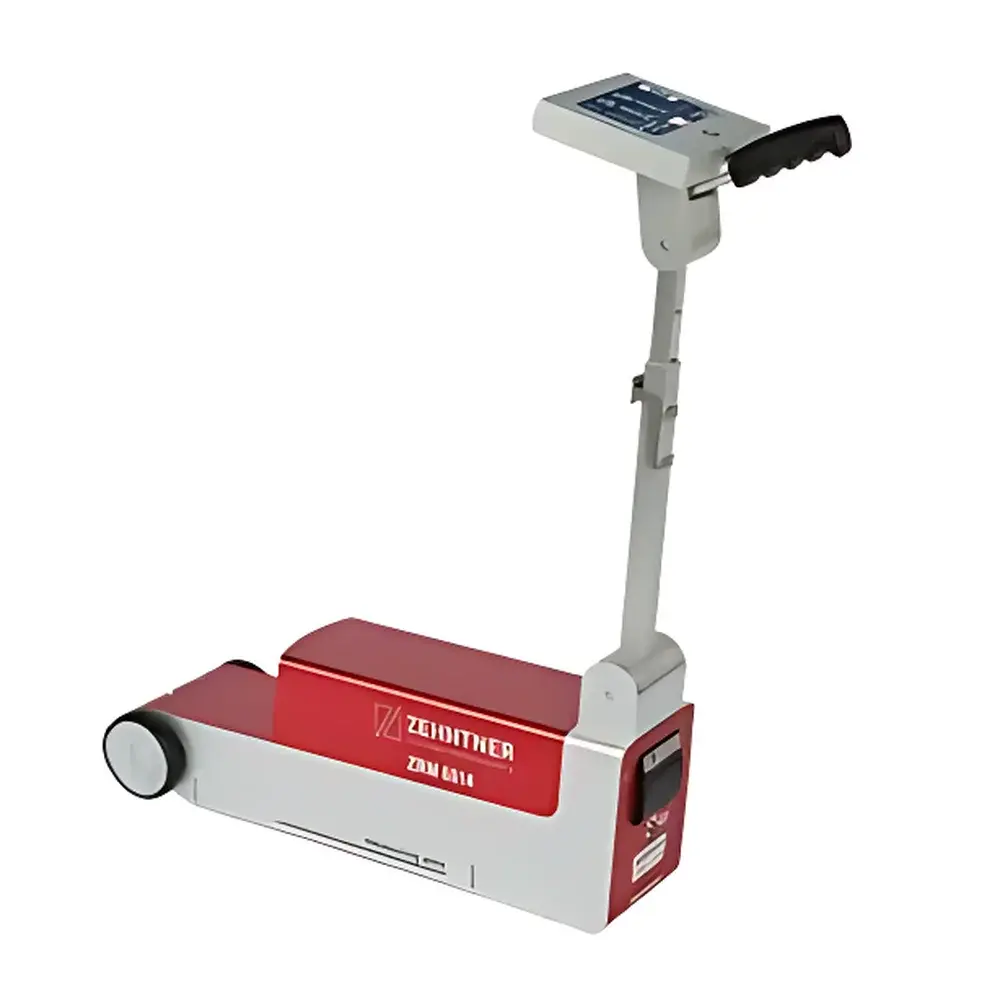
Zehntner ZRM 6014 Retroreflectometer for Road Marking Materials
| Brand | Zehntner |
|---|---|
| Model | ZRM 6014 |
| Origin | Switzerland |
| Measurement Principle | CIE Standard Observer (V(λ))–weighted luminance ratio under defined geometry |
| Compliance | EN 1436, ASTM E1710, ASTM E2177, ASTM E2302 |
| Measurement Modes | RL (Retroreflection Coefficient) and QD (Diffuse Reflection Coefficient) |
| Illumination Angle Options | 1.24° (EN), 88.76° (ASTM E1710 RL), Diffuse (QD) |
| Observation Angles | 2.29° (EN 1436), 1.05° (ASTM E1710) |
| Measuring Aperture | 52 mm × 218 mm |
| Simulated Distance | 30 m |
| RL Range | 0–4,000 mcd·m⁻²·lx⁻¹ |
| QD Range | 0–400 mcd·m⁻²·lx⁻¹ |
| Display | 5.7″ high-resolution capacitive touchscreen |
| Data Storage | 1 GB internal flash memory |
| Power Supply | Rechargeable Li-ion Mn battery (14.8 V / 6.3 Ah) |
| Operating Temperature | −10 °C to +50 °C |
| Dimensions (L×W×H) | 658 × 190 × 408 mm |
| Weight | 7.5 kg |
| Integrated Sensors | GPS module, digital compass, electronic inclinometer, real-time ambient humidity & timestamp |
| Connectivity | Bluetooth 4.2, USB 2.0, CSV/Excel export support |
| Environmental Certification | RoHS-compliant, lead-free |
Overview
The Zehntner ZRM 6014 Retroreflectometer is a field-deployable, metrologically traceable instrument engineered for the quantitative assessment of retroreflective performance of road marking materials—including thermoplastic, paint, tape, and preformed markings—under standardized geometries defined by EN 1436 and ASTM E1710. It operates on the principle of measuring the ratio of luminous intensity (in millicandelas) reflected back toward the light source per unit area (m²) per unit illuminance (lux), expressed as mcd·m⁻²·lx⁻¹. The device implements dual-mode measurement capability: RL (retroreflection coefficient) for regulatory compliance testing of line visibility under vehicle headlight illumination, and QD (diffuse reflection coefficient) for evaluating daytime chromatic performance and material aging effects. Its optical architecture incorporates a CIE 1931 photopic luminosity function V(λ)-filtered detector, ensuring spectral response aligned with human visual perception. Designed for both laboratory validation and in-situ pavement surveys, the ZRM 6014 delivers repeatable, ISO/IEC 17025-compatible results without requiring external calibration references during routine operation.
Key Features
- Field-optimized mechanical design: Rugged anodized aluminum chassis with integrated folding handle and dual swivel casters for stable maneuverability across uneven asphalt or concrete surfaces.
- Dual-standard optical configuration: Programmable illumination and observation angles compliant with EN 1436 (α = 1.24°, β = 2.29°) and ASTM E1710 (α = 88.76°, β = 1.05°), enabling direct cross-jurisdictional data comparability.
- Real-time environmental metadata logging: Onboard GPS geotagging, digital compass heading, electronic inclinometer (±0.1° resolution), ambient humidity sensor, and system clock synchronization ensure full contextual traceability per ISO/IEC 17025 clause 7.7.
- High-fidelity human-machine interface: 5.7″ capacitive touchscreen with intuitive icon-driven navigation; supports multilingual UI (English, German, French, Spanish) and on-device data review with histogram visualization.
- Robust data integrity architecture: Internal 1 GB flash storage retains >100,000 measurement records with embedded timestamps, location coordinates, operator ID, and instrument serial number; exportable via USB mass storage or Bluetooth to Windows/macOS platforms in CSV or Excel-compatible formats.
- Battery-powered autonomy: High-capacity Li-ion Mn pack (14.8 V / 6.3 Ah) enables continuous operation for ≥8 hours at 25 °C; hot-swappable design allows uninterrupted field campaigns.
Sample Compatibility & Compliance
The ZRM 6014 accommodates flat, curved, or textured road marking surfaces with nominal widths ≥50 mm and lengths ≥200 mm. Its 52 mm × 218 mm rectangular aperture ensures representative sampling across heterogeneous markings while minimizing edge diffraction artifacts. The instrument meets the essential requirements of EN 1436:2018 for road marking retroreflectivity classification, ASTM E1710–22 for transportation safety applications, ASTM E2177–21 (wet retroreflection), and ASTM E2302–22 (chromaticity evaluation). All optical components are certified lead-free per Directive 2011/65/EU (RoHS2), and firmware complies with IEC 62304 Class B software safety requirements. Measurement uncertainty budgets are documented per EURAMET cg-19 and validated against NIST-traceable reference standards.
Software & Data Management
Firmware v3.2.x supports audit-trail functionality meeting FDA 21 CFR Part 11 requirements for electronic records: all measurements include immutable digital signatures, user authentication logs, and revision-controlled parameter settings. The Zehntner DataLink desktop application (Windows 10/11, 64-bit) enables batch report generation conforming to EN 1436 Annex D templates, statistical process control (SPC) charting, and GIS-integrated mapping of longitudinal retroreflectivity profiles. Raw datasets retain full metadata—including GPS trajectory, tilt compensation values, and ambient light rejection flags—for third-party analysis in MATLAB, Python (Pandas/NumPy), or LIMS environments.
Applications
- Pre-acceptance testing of thermoplastic and waterborne road marking paints prior to site application.
- Post-installation verification audits mandated by national highway agencies (e.g., FHWA, TRL, Austroads).
- Longitudinal durability monitoring of markings over time (e.g., 6-month, 12-month, 36-month intervals) to inform maintenance scheduling.
- Quality assurance in manufacturing facilities producing reflective glass beads, retroreflective sheeting, or engineered road marking compounds.
- Research into photometric degradation mechanisms under UV exposure, thermal cycling, and abrasion stress.
- Calibration verification of portable retroreflectometers used by municipal road crews.
FAQ
Does the ZRM 6014 require annual recalibration by an accredited laboratory?
Yes. Zehntner recommends traceable recalibration every 12 months against NIST or PTB-certified reference standards, with full uncertainty budget documentation provided in the calibration certificate.
Can the instrument measure wet retroreflectivity per ASTM E2177?
Yes. When equipped with the optional ZRM-WET attachment kit (sold separately), it performs automated water film thickness control and synchronized RL measurement under simulated rainfall conditions.
Is the GPS module compatible with GLONASS or Galileo satellite systems?
The onboard u-blox M8N receiver supports concurrent GPS, GLONASS, and Galileo constellations, delivering <2 m horizontal accuracy under open-sky conditions.
What file formats are supported for data export?
CSV (UTF-8 encoded), XLSX (Microsoft Excel), and GeoJSON for geospatial datasets; no proprietary binary formats are used.
How is measurement repeatability verified during field use?
The instrument includes built-in reference tile verification mode (per EN 1436 §6.3.2), allowing daily drift checks using the supplied ceramic calibration tile (certified RL = 250 ± 5 mcd·m⁻²·lx⁻¹).
Related Products





