
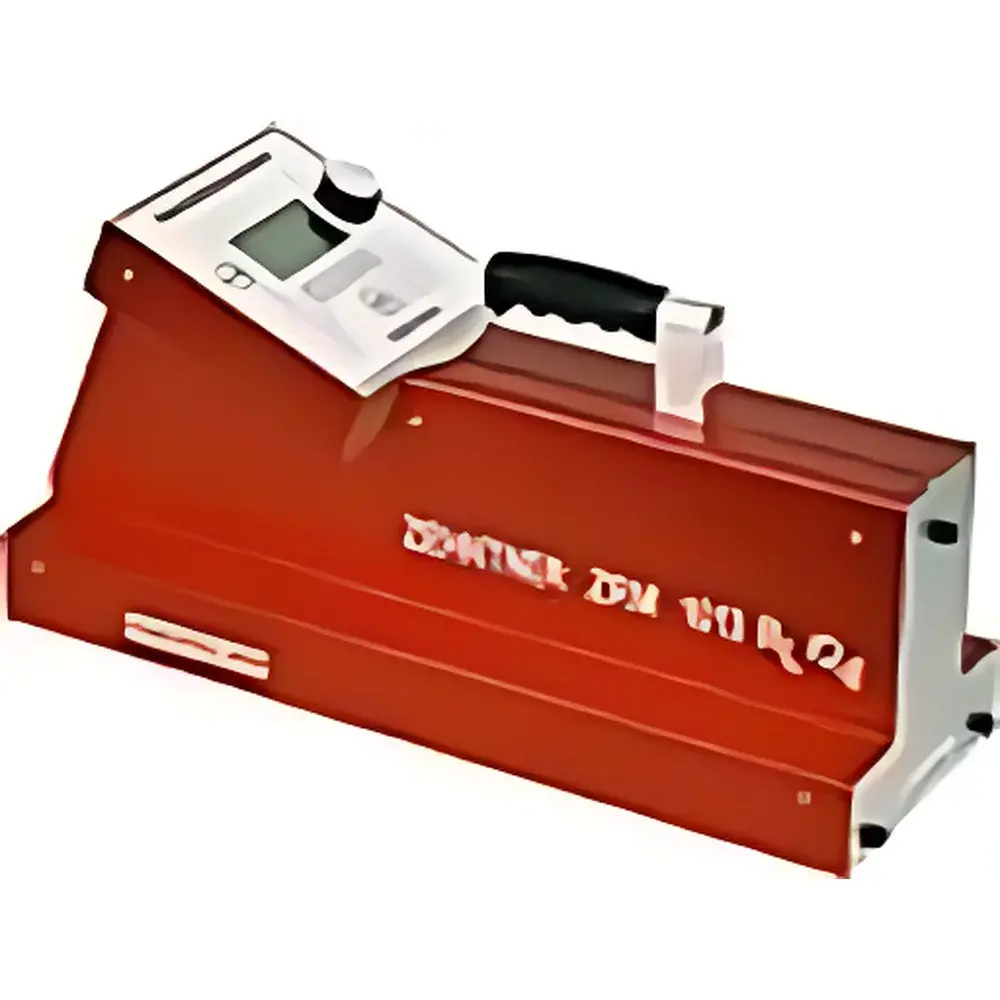
Zehntner ZRM1013+RL/QD Retroreflectometer
| Brand | Zehntner |
|---|---|
| Origin | Switzerland |
| Model | ZRM1013+RL/QD |
| Measurement Principle | CIE Standard Observer (V(λ))–weighted luminance ratio |
| Retroreflection Geometry | RL (RA = 30 m, α = 2.29°, β = 1.24°) and Qd (diffuse illumination, 0°/diffuse viewing) |
| Measurement Area | 50 × 100 mm |
| RL Range | 0–20,000 mcd·m⁻²·lx⁻¹ |
| Qd Range | 0–318 mcd·m⁻²·lx⁻¹ |
| Data Storage | 800 measurements or averaged datasets |
| Display | Backlit LCD |
| Power | Rechargeable Li-ion battery (14.4 V / 5.4 Ah) |
| Dimensions (L×W×H) | 560 × 190 × 280 mm |
| Weight | 7.1 kg (instrument only), 8.4 kg (including ZRC1013+ tripod assembly) |
| Compliance | EN 1436:2018, ASTM E1710-22, ISO 20642:2021 |
Overview
The Zehntner ZRM1013+RL/QD Retroreflectometer is a precision optical measurement instrument engineered for the quantitative assessment of retroreflective performance of road markings under both nighttime and daytime illumination conditions. It operates on the fundamental photometric principle of measuring the luminance coefficient (RA for retroreflected light and Qd for diffuse-reflected light), defined as the ratio of luminance (cd·m⁻²) to illuminance (lx) incident upon the surface — expressed in standardized units of mcd·m⁻²·lx⁻¹. The device replicates two distinct real-world lighting geometries: the RL configuration simulates headlight illumination at a 30-meter viewing distance with an observation angle of 2.29° and an entrance angle of 1.24°, conforming to CEN EN 1436 requirements for road safety evaluation; the Qd mode employs diffuse illumination to emulate ambient daylight or streetlamp conditions, enabling comparative analysis of marking visibility under non-directional lighting. All photometric measurements are spectrally weighted according to the CIE 1931 standard photopic luminosity function V(λ), ensuring metrological traceability to international photometric standards.
Key Features
- Dual-mode optical design supporting both RL (retroreflective) and Qd (diffuse reflectance) measurement geometries in a single handheld platform
- V(λ)-matched silicon photodiode detector calibrated against NIST-traceable standards, delivering high photometric accuracy and long-term stability
- Integrated 30-m reference geometry alignment system with mechanical stops and optical targeting aids for field-deployable repeatability
- Onboard backlit LCD display with real-time parameter readout, unit toggling (mcd·m⁻²·lx⁻¹ or cd·m⁻²·lx⁻¹), and pass/fail threshold indicators
- Rechargeable lithium-ion battery pack (14.4 V / 5.4 Ah) providing >8 hours of continuous operation per charge under typical field conditions
- Ruggedized aluminum housing rated IP54 for dust and water resistance, designed for sustained use in outdoor transport infrastructure environments
Sample Compatibility & Compliance
The ZRM1013+RL/QD accommodates all common road marking materials — including thermoplastic, cold plastic, paint, tape, and preformed polymer markings — across dry, wet, and simulated rain-film conditions. Its 50 × 100 mm measurement aperture ensures representative sampling of heterogeneous surfaces while minimizing edge effects. The instrument meets the full geometric, spectral, and performance requirements of EN 1436:2018 “Road marking materials — Requirements for road marking materials used on roads and other paved areas”, ASTM E1710-22 “Standard Test Method for Measuring the Coefficient of Retroreflected Luminance of Pavement Markings”, and ISO 20642:2021 “Road traffic control devices — Retroreflective materials — Test methods”. It supports regulatory compliance workflows for highway agencies, third-party certification bodies, and pavement maintenance contractors operating under EU Type Approval, FHWA MUTCD, or national road safety directives.
Software & Data Management
Data acquisition and reporting are supported via USB 2.0 interface using Zehntner’s proprietary ZSoft™ desktop application (Windows 10/11 compatible). The software enables batch export in CSV, PDF, and XML formats compliant with ISO/IEC 17025 documentation requirements. Each stored record includes timestamp, GPS metadata (when paired with optional GNSS module), operator ID, environmental notes (e.g., dry/wet status), and full audit trail of calibration events. The system supports 21 CFR Part 11–compliant electronic signatures and user-level access controls when deployed in GLP/GMP-regulated quality assurance environments. Raw measurement files retain unprocessed detector output for forensic reanalysis and uncertainty budgeting per GUM (JCGM 100:2008).
Applications
- Pre-commissioning verification and periodic in-service monitoring of road marking retroreflectivity in accordance with national maintenance thresholds (e.g., ≥150 mcd·m⁻²·lx⁻¹ for white lines in darkness)
- Performance benchmarking of new marking formulations during R&D and accelerated weathering trials
- Contractual acceptance testing between contractors and transportation authorities
- Forensic investigation of low-visibility incidents involving degraded or contaminated markings
- Calibration validation of fixed-site monitoring systems and mobile retroreflectometers
FAQ
What is the difference between RL and Qd measurement modes?
RL measures retroreflected luminance under directional illumination (simulating vehicle headlights), while Qd measures diffuse reflectance under omnidirectional lighting (simulating daylight or streetlights). Both are required for comprehensive visibility assessment.
Does the instrument require annual recalibration?
Yes — Zehntner recommends traceable recalibration every 12 months at an accredited laboratory to maintain compliance with EN 1436 Annex D and ISO/IEC 17025.
Can it measure markings on curved or inclined surfaces?
The probe’s articulated arm and leveling bubble allow stable positioning on gradients up to ±10°; however, measurements on radiused surfaces must be interpreted with geometric correction factors per ASTM E2127.
Is GPS integration available?
Optional external GNSS receivers can be connected via Bluetooth or USB to geotag each measurement with WGS84 coordinates and elevation data.
How is wet-condition testing performed?
A standardized water film thickness of 0.5 mm is applied manually using the included ZWC1000 wetting kit; the instrument then captures Qd and RL values within 30 seconds post-application per EN 1436 Clause 6.4.





