
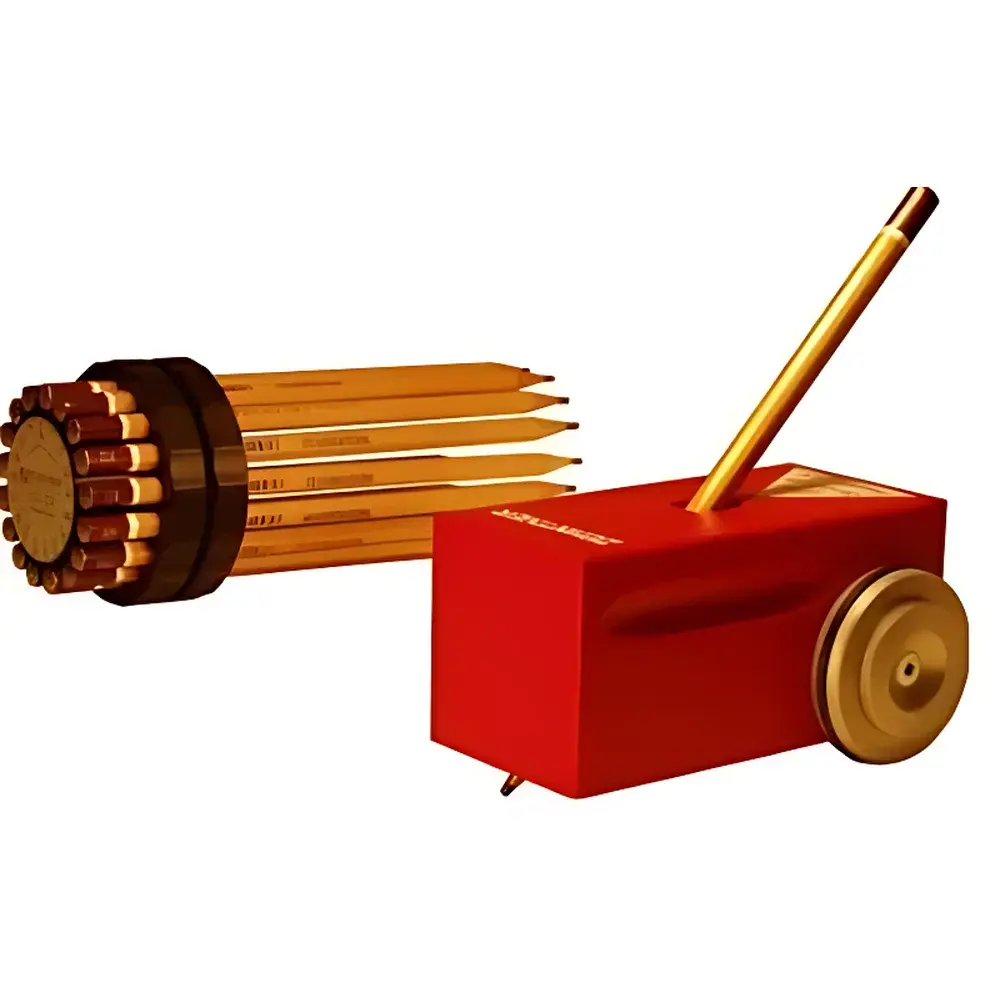
Zehntner ZSH2090 Pencil Hardness Tester
| Origin | Switzerland |
|---|---|
| Manufacturer Type | Authorized Distributor |
| Origin Category | Imported |
| Model | ZSH2090 |
| Price | Upon Request |
| Body Material | Stainless Steel |
| Dimensions (L×W×H) | 102 × 92 × 55 mm |
| Weight | 2.2 kg |
| Standards Compliance | ASTM D3363, ECCA T4, MIL-C-27227, NEN 5350, SIS 184187, SNV 37113 |
| Warranty | 24 months |
| Standard Kit | 1× tester unit, 1 set of 17 graded pencils (6B to 9H), 1× 400-grit abrasive paper, 1× carrying case |
| Optional Accessories | Pencil sharpener, replacement sandpaper, additional pencil sets |
| Manufacturer | Zehntner AG, Switzerland |
Overview
The Zehntner ZSH2090 Pencil Hardness Tester is a precision-engineered manual instrument designed for rapid, standardized evaluation of the hardness resistance of organic coatings—including paints, varnishes, lacquers, and polymer films—applied to rigid substrates such as metal, plastic, or wood panels. Based on the principle of controlled mechanical indentation and scratch resistance, the device applies a fixed load (750 g ± 10 g) via a calibrated spring mechanism while advancing a standardized graphite pencil at a defined 45° angle across the coated surface. The hardness rating is determined by identifying the hardest pencil grade (from 6B to 9H) that does not produce visible substrate cutting or irreversible coating deformation under specified test conditions. This method reflects the cohesive and adhesive integrity of the cured film and provides a repeatable, comparative metric widely accepted in industrial quality control and R&D laboratories.
Key Features
- Robust stainless steel construction ensures long-term dimensional stability and resistance to environmental corrosion during daily lab or production-floor use.
- Precision-machined pencil holder with integrated depth stop guarantees consistent 45° orientation and uniform tip contact geometry across all tests.
- Calibrated spring-loaded loading system delivers reproducible 750 g force without operator-dependent variability—critical for inter-laboratory comparability.
- Ergonomic form factor (102 × 92 × 55 mm) and 2.2 kg mass enable stable handheld operation while minimizing fatigue during sequential testing.
- Compliance with six major international standards—including ASTM D3363 (Standard Test Method for Film Hardness by Pencil Test), ECCA T4 (European Coil Coating Association), and MIL-C-27227—ensures data acceptability in global supply chain audits.
- Integrated alignment guide and tactile feedback mechanism assist operators in maintaining proper stroke direction and speed (10–15 mm/s recommended per standard).
Sample Compatibility & Compliance
The ZSH2090 is validated for use on flat, rigid substrates with smooth, fully cured coatings ≥25 µm thick. It is unsuitable for flexible films, textured surfaces, or thermally unstable materials where localized frictional heating may alter response. All test procedures must adhere strictly to the conditioning requirements specified in ASTM D3363: samples shall be conditioned at 23 ± 2 °C and 50 ± 5 % RH for minimum 24 hours prior to testing. Results are reported as the highest pencil grade (e.g., “4H”) that produces no cutting or gouging; any visible substrate exposure or permanent groove formation constitutes failure. Data generated using this instrument supports compliance documentation for ISO 9001, IATF 16949, and aerospace OEM coating specifications requiring traceable hardness verification.
Software & Data Management
As a purely mechanical, analog measurement tool, the ZSH2090 requires no embedded firmware, power source, or digital interface. However, its standardized output integrates seamlessly into structured quality management systems. Test records—including substrate ID, coating batch number, environmental conditions, pencil grade progression, pass/fail outcome, and operator signature—can be documented manually or imported into LIMS platforms (e.g., LabWare, STARLIMS) via configurable templates. For regulated environments operating under FDA 21 CFR Part 11 or EU Annex 11, handwritten logs must include dated entries, cross-referenced to calibration certificates (traceable to national metrology institutes) and pencil certification reports (per ISO 8503-2). Zehntner provides full traceability documentation for all supplied pencil sets, including hardness grading verification per DIN EN ISO 8503-2.
Applications
- Automotive OEM and Tier-1 suppliers verifying topcoat hardness prior to assembly line release.
- Architectural coating manufacturers conducting QC on coil-coated aluminum and pre-painted steel panels.
- Printing ink developers assessing rub resistance and film integrity on packaging substrates.
- Aerospace maintenance facilities validating touch-up paint hardness against original equipment specifications (e.g., Boeing D6-17487).
- Academic research labs studying crosslink density effects on thermoset polymer film performance.
- Contract coating service providers generating auditable test reports for customer-facing quality dossiers.
FAQ
What is the recommended pencil sharpening procedure before testing?
Pencils must be sharpened using a dedicated abrasive surface (e.g., the included 400-grit sandpaper) until the graphite core is exposed as a clean, flat, non-tapered face—no conical points. This ensures uniform contact area and eliminates bias from variable tip geometry.
Can the ZSH2090 be used on curved surfaces?
No. The instrument is calibrated exclusively for planar substrates. Curved or irregular geometries introduce uncontrolled normal force distribution and violate ASTM D3363’s flat-surface requirement.
How often should the test pencil set be replaced?
Each pencil is intended for single-use per test location. Reuse introduces tip wear and inconsistent hardness response. Full 17-grade sets should be replaced annually or after 500 test cycles, whichever occurs first, with new sets certified to ISO 8503-2.
Is calibration required for the ZSH2090 unit itself?
Yes. Annual verification of applied load (750 g ± 10 g) and angular alignment (45.0° ± 0.5°) is mandatory per ISO/IEC 17025. Zehntner-certified service centers provide traceable recalibration with certificate of conformity.
Does the device meet GLP or GMP requirements?
When operated within documented SOPs—including environmental monitoring, operator training records, pencil traceability, and raw data archiving—the ZSH2090 supports GLP-compliant coating evaluation workflows. Its mechanical design inherently avoids electronic data integrity concerns associated with software-based instruments.



