
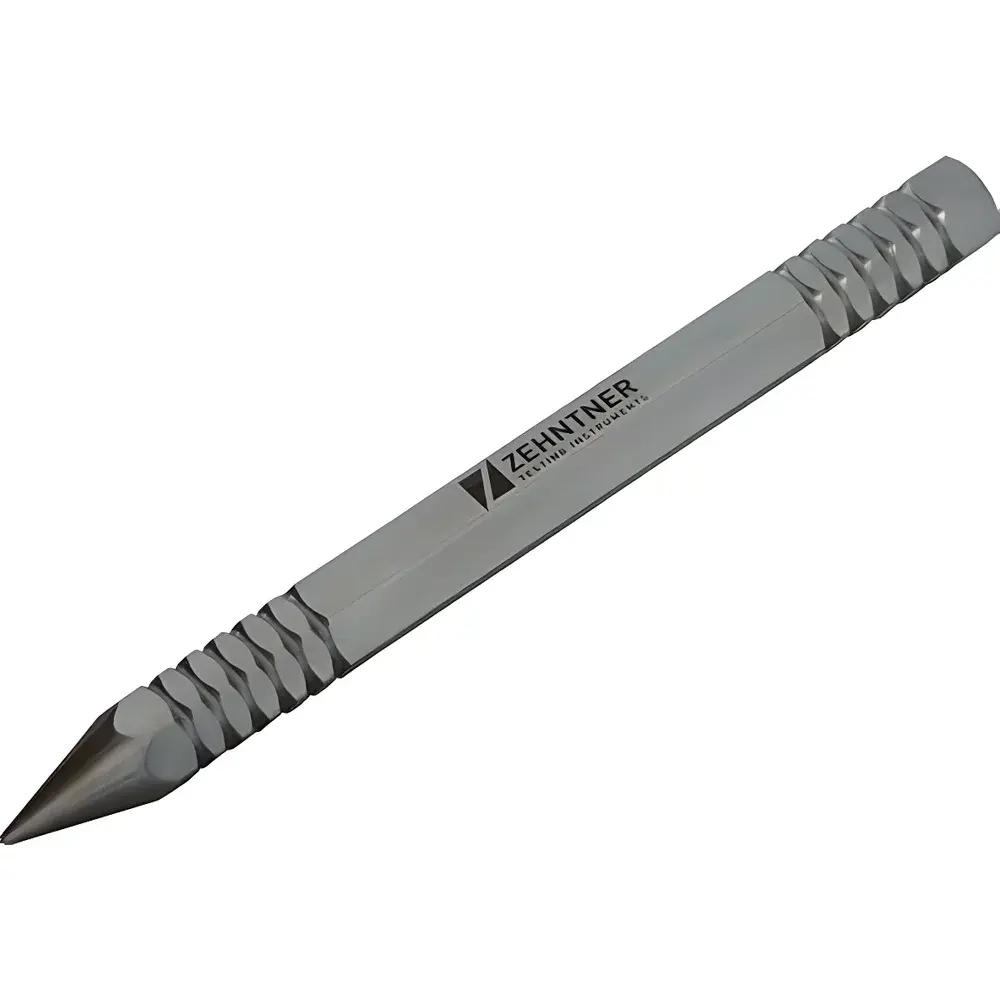
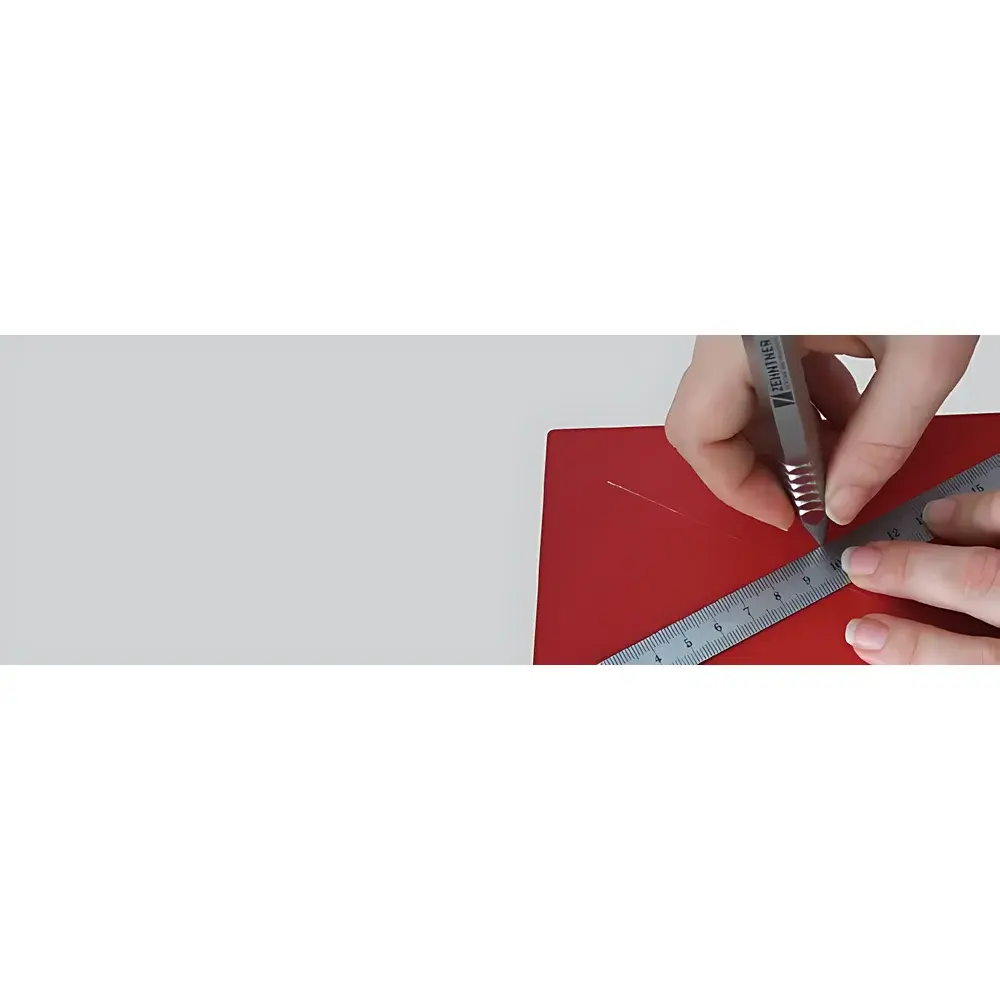
Zehntner ZVL2190 Cross-Cut Scribe for Coating Adhesion Testing
| Brand | Zehntner |
|---|---|
| Origin | Switzerland |
| Model | ZVL2190 |
| Compliance | DIN EN ISO 17872 |
| Cutting Tip Material | Tungsten Carbide |
| Overall Length | 150.50 mm |
| Diameter | Φ13.65 mm |
| Weight | 131 g |
| Warranty | 12 months |
Overview
The Zehntner ZVL2190 Cross-Cut Scribe is a precision hand-held instrument engineered for standardized adhesion assessment of organic coatings on rigid, flat substrates—particularly metallic surfaces. It operates in strict accordance with DIN EN ISO 17872, the internationally recognized standard specifying requirements for cross-cut test tools used to evaluate coating cohesion and substrate adhesion. Unlike automated or motorized systems, the ZVL2190 delivers manual, operator-controlled incision with consistent geometry and reproducible force application—critical for comparative quality control across production batches and laboratory inter-laboratory studies. Its design centers on mechanical fidelity: each scribe features a hardened tungsten carbide cutting tip mounted within a precisely machined aluminum alloy housing, ensuring dimensional stability, resistance to wear-induced blunting, and minimal deviation in cut depth and spacing under repeated use.
Key Features
- Compliance-certified geometry: Blade spacing (1 mm or 2 mm options per ISO 17872 Annex A) and tip angle (30° ± 2°) are factory-verified and traceable to metrological standards.
- Ergonomic cylindrical grip: Textured anodized aluminum body with optimized diameter (Φ13.65 mm) and balanced mass distribution (131 g) minimizes operator fatigue during high-volume testing sessions—essential for QC labs performing ≥50 cross-cuts per shift.
- Tungsten carbide cutting element: Exceptional hardness (≥1500 HV) ensures >10,000 valid cuts without measurable tip deformation or edge rounding, maintaining consistent penetration depth through typical industrial coatings (e.g., epoxy primers, polyurethane topcoats, powder-coated finishes).
- Calibration-ready interface: Integrated reference groove and alignment guide facilitate verification of perpendicularity and linear travel using optical comparators or digital profilometers per ISO/IEC 17025-accredited calibration protocols.
- Chemical resistance: Non-porous anodized surface prevents solvent absorption during cleaning between tests (e.g., acetone, xylene), eliminating cross-contamination risks in multi-coat evaluation workflows.
Sample Compatibility & Compliance
The ZVL2190 is validated for use on coatings applied to planar, non-flexible substrates including cold-rolled steel, aluminum sheet, galvanized steel, and stainless steel panels—provided surface roughness (Ra) remains ≤3.2 µm and coating thickness falls within 20–250 µm per ISO 17872 Clause 4. It is not intended for elastomeric, highly textured, or thermoplastic substrates where blade deflection may compromise cut uniformity. All performance claims align with DIN EN ISO 17872:2022 Edition, and the device supports full auditability under GLP and IATF 16949-compliant quality systems. Traceable calibration certificates (available upon request) include uncertainty budgets per ISO/IEC 17025 requirements.
Software & Data Management
As a manually operated mechanical tool, the ZVL2190 does not incorporate embedded electronics, firmware, or connectivity interfaces. However, it integrates seamlessly into digital QA workflows via standardized documentation templates compliant with ISO 9001:2015 Clause 8.5.2. Test records—including substrate ID, coating batch number, environmental conditions (temperature/humidity per ISO 2812-1), cut grid dimensions, and post-test rating per ISO 2409—are structured to populate LIMS or ELN platforms without proprietary software dependencies. Optional accessories (e.g., Zehntner ZV-CCS alignment fixture) enable repeatable positioning for image-based adhesion analysis using ASTM D3359-compatible digital microscopy systems.
Applications
- Automotive OEM and Tier-1 suppliers: Validation of e-coat adhesion on body-in-white panels prior to topcoat application.
- Powder coating manufacturers: In-process verification of cure integrity and substrate bonding on aluminum extrusions and steel frames.
- Industrial paint laboratories: Comparative screening of primer compatibility across metal substrate alloys (e.g., AA6061 vs. DC04).
- Contract coating service providers: Third-party certification testing for aerospace (AS4520) and marine (ISO 12944-6) coating systems.
- Academic research: Controlled variable studies on interfacial fracture mechanics in multilayer polymer/metal systems.
FAQ
Does the ZVL2190 require periodic recalibration?
Yes—annual calibration against certified reference gauges is recommended per ISO/IEC 17025 Clause 6.5. Calibration verifies tip protrusion tolerance (±0.02 mm), parallelism of cutting edges, and angular deviation.
Can it be used on plastic substrates?
Not per ISO 17872 scope; however, limited empirical use on rigid thermosets (e.g., FR-4 PCB laminates) is documented in internal technical notes—results must be reported as non-standardized assessments.
Is the tungsten carbide tip replaceable?
No—the tip is integral to the scribe body and not user-serviceable. Replacement units are supplied as complete assemblies to preserve geometric integrity.
What environmental conditions must be controlled during testing?
Per ISO 2812-1, ambient temperature shall be maintained at 23 ± 2 °C and relative humidity at 50 ± 5 % RH for ≥24 h prior to testing, with substrate equilibration confirmed via hygrometric measurement.
How does the ZVL2190 differ from the ZVL2180 model?
The ZVL2190 incorporates refined ergonomics (reduced moment arm length), upgraded anodizing for enhanced solvent resistance, and tighter manufacturing tolerances on blade pitch alignment—resulting in 12 % for legacy models.



