
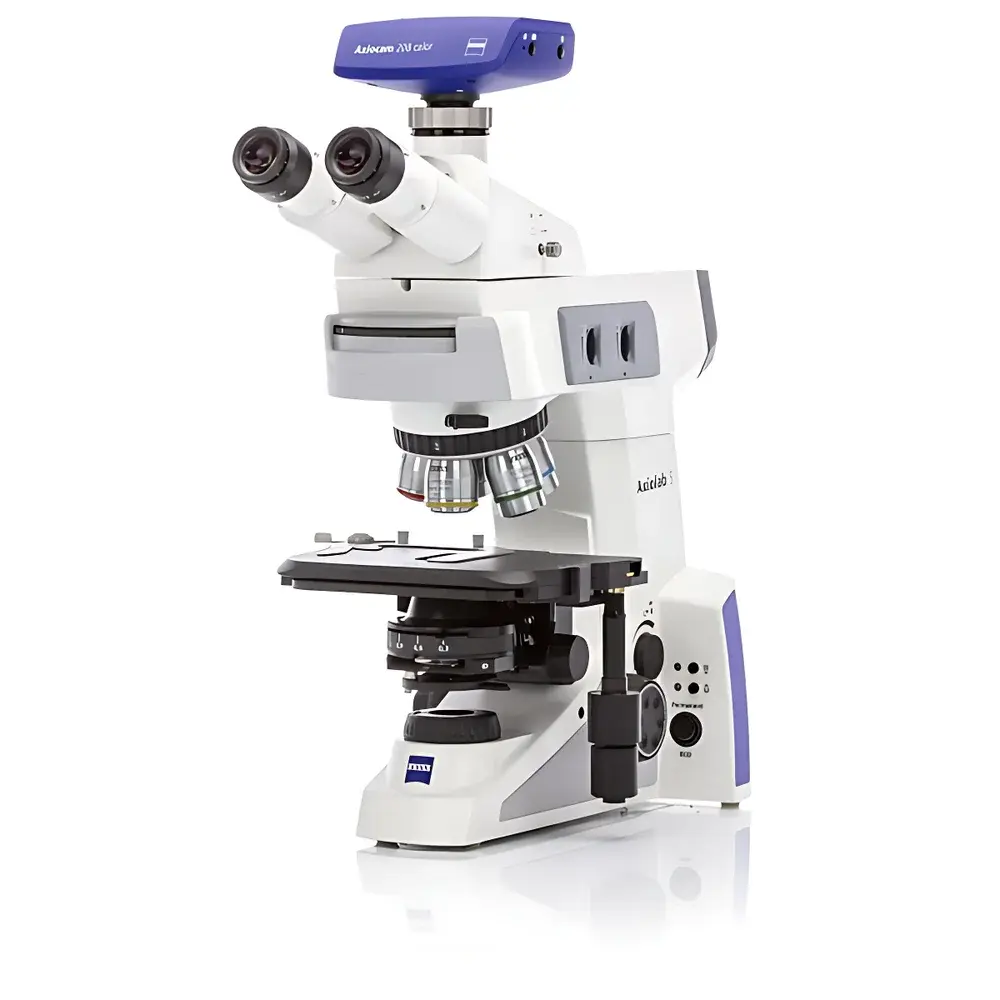
ZEISS Axiolab 5 Widefield Microscope for Materials Research
| Brand | ZEISS |
|---|---|
| Origin | Germany |
| Model | Axiolab 5 Widefield Microscope |
| Dimensions (L×W×H) | ~304 mm × 210 mm × 357.5 mm (base unit without tube, part no. 430037-9011-000) |
| Operating Temperature | +10 °C to +40 °C |
| Relative Humidity | ≤75% at 35 °C (non-condensing) |
| Max. Altitude | 2,000 m |
| Ambient Pressure | 800–1,060 hPa |
| Pollution Degree | 2 |
| Protection Class | IP20 |
| Electrical Safety | Compliant with DIN EN 61010-1 / IEC 61010-1, CSA, UL |
| RF Emission | EN 55011 Class B |
| Immunity | DIN EN 61326/A1 |
| Power Supply | 100–240 V AC, 50–60 Hz |
| Power Consumption | ≤100 VA |
Overview
The ZEISS Axiolab 5 Widefield Microscope is an engineered solution for routine and advanced materials characterization in industrial QA/QC laboratories, academic research facilities, and failure analysis centers. Designed around a robust, modular optical architecture, it employs Köhler illumination and high-NA achromatic objectives to deliver consistent contrast, resolution, and color fidelity across transmitted light (brightfield, darkfield, polarized) and reflected light (incident brightfield, DIC-compatible) modalities. Unlike scanning or electron-based systems, the Axiolab 5 operates on classical widefield optical principles—relying on precise parfocal optics, stable mechanical stage translation, and calibrated magnification paths—to support quantitative morphological assessment of metals, ceramics, polymers, composites, and thin films. Its application scope includes grain size evaluation per ASTM E112, inclusion rating per ASTM E45, phase distribution mapping, coating thickness estimation via focus-depth profiling, and microstructural defect documentation compliant with ISO 17025-accredited workflows.
Key Features
- Integrated intelligent imaging platform: Built-in camera control and real-time preview eliminate dependency on external PCs or third-party software.
- Ergonomic single-hand operation: All primary controls—including focus knobs, mechanical stage drives, brightness adjustment, and dedicated shutter/picture capture button—are positioned for intuitive access without repositioning hands or breaking visual focus.
- Modular optical design: Supports interchangeable observation tubes (e.g., trinocular, ergonomic inclined), objective turrets (up to 6×), and contrast modules (polarizer/analyzer, Bertrand lens, DIC sliders) without tool-assisted alignment.
- Automated image acquisition: With ZEISS Axiocam 208 color camera integration, auto-exposure, auto-white balance, and real-time histogram-based contrast enhancement are applied on-the-fly during capture.
- Metadata-rich digital output: Each saved image embeds objective magnification, numerical aperture, illumination mode, camera settings, scale bar calibration, and instrument serial identification—ensuring traceability for GLP/GMP-regulated reporting.
- Regulatory-ready electrical compliance: Certified to DIN EN 61010-1 (IEC 61010-1), UL/CSA standards, and EN 55011 Class B for electromagnetic compatibility in shared laboratory environments.
Sample Compatibility & Compliance
The Axiolab 5 accommodates standard 25 mm and 32 mm diameter metallurgical specimens (mounted or unmounted), polished cross-sections up to 50 mm × 75 mm, and thin-film wafers on glass or silicon substrates. Its rigid stage with coarse/fine coaxial focusing (2 mm travel, 1 µm fine step resolution) ensures stability under load during extended imaging sessions. The system complies with ISO 9001-aligned manufacturing protocols and supports audit-ready documentation through embedded metadata logging. While not a regulated medical device, its optical performance meets requirements for materials inspection under ASTM E2015 (Standard Guide for Microscopical Examination of Metals), ISO 643 (Steel—Micrographic Determination of Ferrite Content), and ISO 4520 (Electroplated Coatings—Measurement of Thickness by Microscopical Method).
Software & Data Management
No standalone software installation is required. All imaging functions—including live preview, still capture, time-lapse video recording, annotation, measurement (length, area, angle), and export (TIFF, JPEG, PNG)—are executed via the integrated touchscreen interface or optional USB mouse/keyboard. Image files retain EXIF-compliant metadata including objective ID, exposure parameters, scale calibration source, and user-defined naming templates. Exported datasets can be ingested into LIMS or ELN platforms via standard network shares or USB mass storage. For laboratories requiring electronic record integrity, the system supports manual timestamping and operator ID entry prior to acquisition—aligning with foundational expectations of FDA 21 CFR Part 11 for non-electronic-signature workflows.
Applications
- Metallographic analysis: Grain boundary delineation, precipitate identification, and heat-affected zone (HAZ) mapping in weldments.
- Polymer morphology assessment: Spherulite size distribution in semi-crystalline thermoplastics, filler dispersion homogeneity in composites.
- Failure analysis: Crack propagation path tracing, corrosion pit depth estimation, interfacial delamination detection in multilayer coatings.
- Quality assurance: Verification of surface finish roughness trends via focus-stacking-derived topography proxies; verification of plating uniformity per ASTM B487.
- Teaching & training: Standardized curriculum delivery for microscopy fundamentals, including resolution limits, depth of field trade-offs, and contrast mechanism selection.
FAQ
Does the Axiolab 5 require a dedicated computer for image acquisition?
No. All imaging operations—including capture, annotation, measurement, and export—are performed directly on the microscope’s embedded interface.
Can the system be integrated into an existing laboratory network?
Yes. Images and metadata can be saved to network-mounted drives or USB storage devices using standard SMB/CIFS or FAT32 protocols.
Is the Axiolab 5 suitable for polarized light analysis of geological or ceramic samples?
Yes. It accepts optional polarizing filters and a rotating analyzer stage, enabling birefringence assessment and crystallographic orientation screening.
What level of maintenance does the optical train require?
The sealed optical path and dust-resistant design minimize cleaning frequency; routine maintenance is limited to periodic objective lens inspection and illumination source lamp replacement (LED lifetime >25,000 hours).
How is calibration traceability ensured for quantitative measurements?
Scale bars are calibrated using NIST-traceable stage micrometers; calibration data is stored per objective and recalled automatically during image capture.
Related Products





