
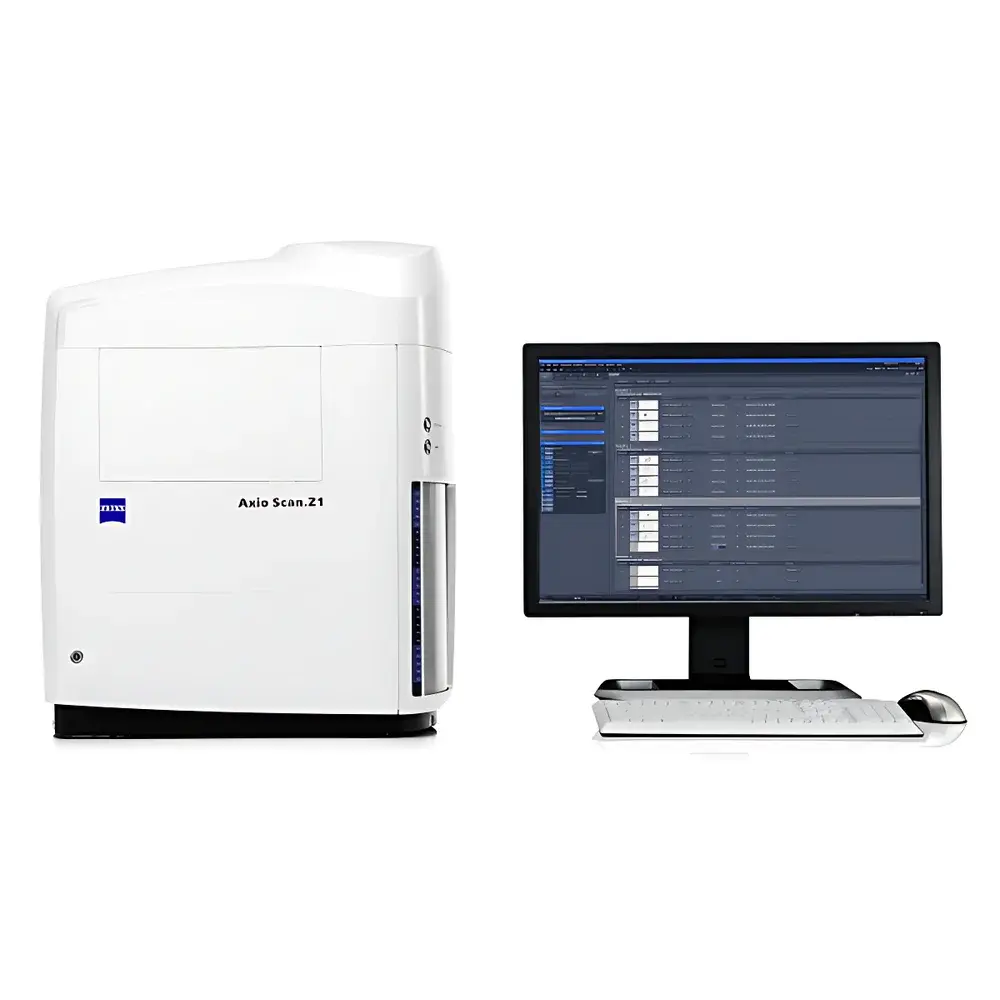
Zeiss Axioscan 7 Geo Automated Digital Slide Scanning System
| Brand | Zeiss |
|---|---|
| Origin | Germany |
| Model | Axioscan 7 Geo |
| Instrument Type | Upright Fluorescence Microscope |
| Optical Design | Plan-Apochromat Objective-Based Widefield Digital Scanner |
| Compliance | CE, ISO 13485 (for IVD-relevant workflows), GLP/GMP-ready data handling |
| Software Platform | ZEN Blue/Core with AI-Assisted Segmentation Module |
| Network Integration | DICOM-Supported PACS & LIMS Connectivity |
| Throughput | Up to 400 standard glass slides per 24 hours (40×, multi-channel fluorescence) |
| Image Format | Multi-resolution pyramidal TIFF (.tif), OME-TIFF, and CZI native |
Overview
The Zeiss Axioscan 7 Geo is an automated widefield digital slide scanning system engineered for high-fidelity, reproducible digitization of histological, geological, and petrographic specimens. Unlike conventional upright microscopes, the Axioscan 7 Geo integrates motorized stage navigation, precision z-stack acquisition, and multi-modal illumination control into a single platform optimized for unattended, high-throughput slide imaging. Its optical architecture centers on Zeiss Plan-Apochromat objectives—corrected for field flatness, chromatic aberration, and spherical distortion across visible and near-UV spectral bands—ensuring sub-micron spatial fidelity and quantitative intensity linearity essential for downstream morphometric and spectral analysis. Designed specifically for laboratories requiring traceable, auditable image data, the system supports full metadata embedding (including objective ID, exposure time, lamp intensity, filter set, and stage coordinates) in every acquired frame, aligning with ISO/IEC 17025 documentation requirements for accredited testing facilities.
Key Features
- Multi-contrast acquisition in a single scan cycle: simultaneous or sequential capture of brightfield, linear polarized (rotatable 0–360°), circularly polarized, and multi-channel fluorescence (up to 7 excitation/emission combinations via motorized filter turret)
- Automated geometric and chromatic calibration: built-in reference slide routines correct for stage drift, lens distortion, and spectral crosstalk without manual intervention
- Intelligent autofocus with dual-sensor feedback: combines infrared reflection and contrast-based algorithms to maintain focus across uneven or tilted geological thin sections (e.g., quartz-mica schists or fractured carbonate reservoir rocks)
- Integrated ZEN software suite with embedded machine learning segmentation: pre-trained models for mineral phase identification (e.g., distinguishing quartz, feldspar, and clay matrix in siliciclastic sediments); custom model training supported via annotated dataset import
- Hardware-synchronized multi-scale correlation: direct export of coordinate-mapped regions-of-interest (ROIs) to Zeiss Crossbeam FIB-SEM systems for correlative light-electron microscopy (CLEM) workflows
Sample Compatibility & Compliance
The Axioscan 7 Geo accommodates standard 1″ × 3″ (25 × 75 mm) glass slides up to 1.2 mm thick—including epoxy-embedded rock thin sections, stained tissue sections, and metallurgical mounts—with optional clip-on adapters for non-standard formats. All imaging protocols adhere to ASTM D5777 (Standard Guide for Petrographic Examination of Rocks) and ISO 14688-1 (Geotechnical Investigation and Testing — Identification and Classification of Soil). Data provenance is maintained through immutable audit trails: ZEN software logs user identity, timestamp, instrument configuration, and processing history in compliance with FDA 21 CFR Part 11 for regulated environments. Export formats include DICOM-SR for integration into clinical or academic PACS infrastructures and OME-TIFF for FAIR-compliant data repositories.
Software & Data Management
ZEN Blue (v3.7+) serves as the unified control and analysis interface, supporting both local workstation operation and centralized server deployment. The system generates pyramidal TIFFs with embedded overviews, enabling rapid zoom/pan navigation in web-based viewers (e.g., OpenSeaDragon or QuPath). Quantitative outputs—including modal mineralogy percentages, grain size distributions (per ASTM E112), and pore-throat aspect ratios—are exportable as CSV or JSON for statistical modeling in Python/R environments. Role-based access control (RBAC), encrypted network transmission (TLS 1.3), and optional SAML 2.0 authentication ensure secure collaboration across distributed research teams.
Applications
- Petrographic analysis: automated quantification of mineral assemblages in igneous, metamorphic, and sedimentary thin sections; porosity/permeability estimation in reservoir rocks (e.g., sandstone, dolomite, shale)
- Teaching & curriculum development: standardized digital slide libraries for undergraduate geoscience labs, with annotation layers and quiz-integrated viewing modes
- Microfossil characterization: high-resolution imaging of calcareous and siliceous microfossils (e.g., foraminifera, radiolarians) under variable polarization states to reveal crystallographic orientation
- Correlative workflow anchoring: generation of fiducial markers and coordinate maps for targeted FIB milling and SEM-EDS analysis of specific textural features
FAQ
Does the Axioscan 7 Geo support oil-immersion objectives?
Yes—optional 63× and 100× Plan-Apochromat oil-immersion objectives are available for enhanced resolution in fluorescence and high-magnification brightfield applications.
Can raw image data be exported without ZEN software?
All acquired data is stored in open, documented formats (OME-TIFF, CZI, and pyramidal TIFF), enabling third-party analysis in ImageJ/Fiji, MATLAB, or commercial AI platforms without proprietary runtime dependencies.
Is remote monitoring of scanning jobs possible?
Yes—via Zeiss Remote Connect, users can monitor real-time progress, receive email/SMS alerts upon job completion, and initiate emergency pause commands from any authenticated device.
How is calibration traceability maintained across instruments?
Each calibration routine references NIST-traceable standards (e.g., NIST SRM 2034 for intensity uniformity), and calibration reports—including uncertainty budgets—are auto-generated and digitally signed per ISO/IEC 17025 Annex A.3 requirements.




