
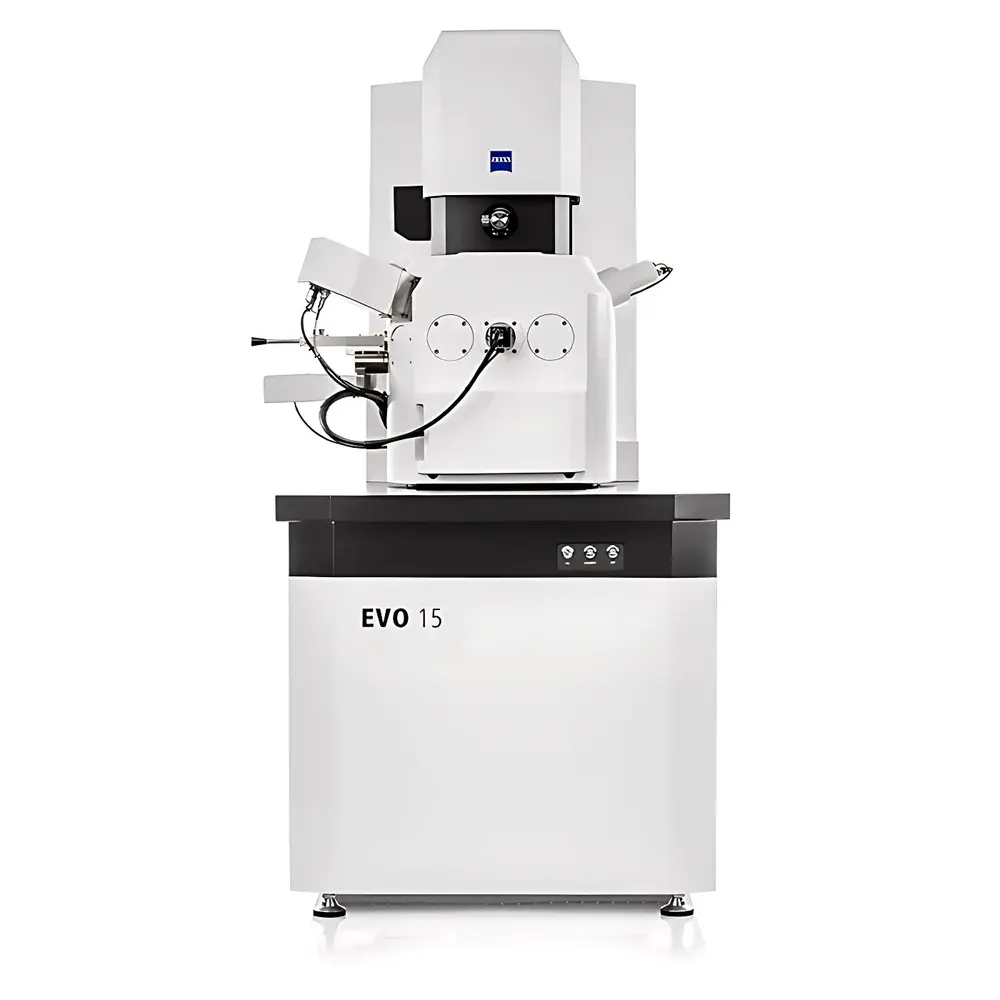
ZEISS EVO Series Scanning Electron Microscope
| Brand | ZEISS |
|---|---|
| Origin | Germany |
| Manufacturer Type | Authorized Distributor |
| Origin Category | Imported |
| Model | EVO |
| Pricing | Upon Request |
Overview
The ZEISS EVO Series Scanning Electron Microscope (SEM) is a high-performance, modular platform engineered for precision imaging and microanalysis across academic research, industrial quality assurance, and failure analysis laboratories. Based on thermionic emission from a lanthanum hexaboride (LaB₆) electron source, the EVO delivers superior signal-to-noise ratio, enhanced contrast, and improved spatial resolution compared to conventional tungsten-filament SEMs—without requiring ultra-high vacuum or cryogenic cooling. Its variable-pressure capability enables direct imaging of non-conductive, hydrated, or beam-sensitive specimens—including biological tissues, polymers, ceramics, and contaminated industrial components—without mandatory metal coating or extensive sample preparation. Designed around user-centric workflow architecture, the EVO series supports seamless integration into multi-modal characterization pipelines, including correlative light and electron microscopy (CLEM), making it a foundational instrument for modern materials science and life science labs operating under GLP/GMP or ISO/IEC 17025-compliant environments.
Key Features
- LaB₆ thermionic electron source providing stable, high-brightness beam with extended lifetime and reduced thermal drift
- Variable-pressure mode (up to 300 Pa) enabling uncoated imaging of insulating and volatile samples
- Modular chamber design with three scalable configurations: EVO 10 (Ø310 × h220 mm), EVO 15 (Ø365 × h275 mm), and EVO 25 (Ø420 × h330 mm)
- Motorized XYZ stage with travel ranges up to 150 × 140 × 150 mm (EVO 25), supporting 5 kg samples at full tilt
- SmartSEM Touch interface: intuitive, gesture-based control optimized for both novice users and expert microscopists
- Integrated detector options including in-lens SE, Everhart-Thornley SE, solid-state BSE, and optional energy-dispersive X-ray spectroscopy (EDS) via Oxford Instruments or Bruker Element systems
- Native support for automated stage mapping, particle analysis, and batch acquisition protocols compliant with FDA 21 CFR Part 11 audit trail requirements
Sample Compatibility & Compliance
The EVO Series accommodates diverse specimen geometries—from standard 3.05 cm diameter stubs to oversized industrial components up to 300 mm in diameter and 230 mm in height. Its pressure-stable column design permits routine analysis of fragile, uncoated, or partially hydrated samples without compromising vacuum integrity or detector performance. All models meet CE marking requirements and conform to IEC 61000-6-3 (EMC) and IEC 61000-6-4 (immunity) standards. When configured with EDS and SmartSEM software, the system supports analytical workflows aligned with ASTM E1508, ISO 16700, and USP guidelines for elemental microanalysis. Data acquisition logs, user permissions, and electronic signatures are fully traceable per GLP and GMP documentation frameworks.
Software & Data Management
SmartSEM software provides unified control of imaging, stage navigation, detector selection, and quantitative analysis. Version 6.x and later include built-in compliance modules for electronic record retention, operator authentication, and change-controlled method templates. Raw image data (TIFF/RAW) and metadata—including acquisition parameters, stage coordinates, detector gain, and beam conditions—are embedded in standardized file headers compatible with third-party analysis platforms (e.g., ImageJ/Fiji, MATLAB, Thermo Scientific Avizo). Batch processing scripts support reproducible particle sizing, phase segmentation, and EDS spectral quantification. Optional ZEISS ZEN Connect enables cross-platform correlation with optical microscope datasets, facilitating CLEM workflows validated under ISO/IEC 17025-accredited testing protocols.
Applications
- Materials science: grain boundary analysis, fracture surface morphology, coating thickness evaluation, and intermetallic phase identification
- Life sciences: intact tissue section imaging, pollen morphology, biofilm architecture, and freeze-dried cellular structures
- Electronics: solder joint inspection, PCB defect mapping, and semiconductor package delamination assessment
- Geosciences: mineral phase distribution, pore network characterization, and shale microstructure quantification
- Quality assurance: incoming raw material verification, production line defect screening, and root-cause failure analysis per ISO 9001 Annex A.6
FAQ
What vacuum levels does the EVO support, and how does that affect sample preparation?
The EVO operates in high vacuum (≤1 × 10⁻⁴ Pa) for maximum resolution or variable pressure mode (up to 300 Pa) to image uncoated, non-conductive, or hydrated samples—eliminating the need for sputter coating in many routine applications.
Can the EVO integrate with existing laboratory information management systems (LIMS)?
Yes—via ZEISS ZEN Connect or custom API interfaces, EVO systems export structured metadata and image files in DICOM-compatible or vendor-neutral formats suitable for ingestion into LIMS or ELN platforms compliant with 21 CFR Part 11.
Is training required for new operators, and what level of expertise is needed?
SmartSEM Touch reduces initial training time to under 30 minutes for basic imaging tasks; advanced microanalysis functions (e.g., EDS quantification, automated particle analysis) are supported by context-sensitive help and pre-validated method templates.
How does LaB₆ compare to field-emission sources in terms of maintenance and operational cost?
LaB₆ offers significantly longer source lifetime (>1,500 hours) and lower operational complexity than cold-FEG systems, with no requirement for ultra-high vacuum pumps or liquid nitrogen cooling—reducing total cost of ownership while maintaining sub-3 nm resolution at 20 kV.
Does ZEISS provide service contracts and remote diagnostics support?
All EVO systems ship with ZEISS ServicePlus coverage options, including predictive maintenance alerts, remote calibration validation, and secure cloud-based diagnostic sessions conducted by certified field application engineers based in EMEA, North America, and APAC regions.



