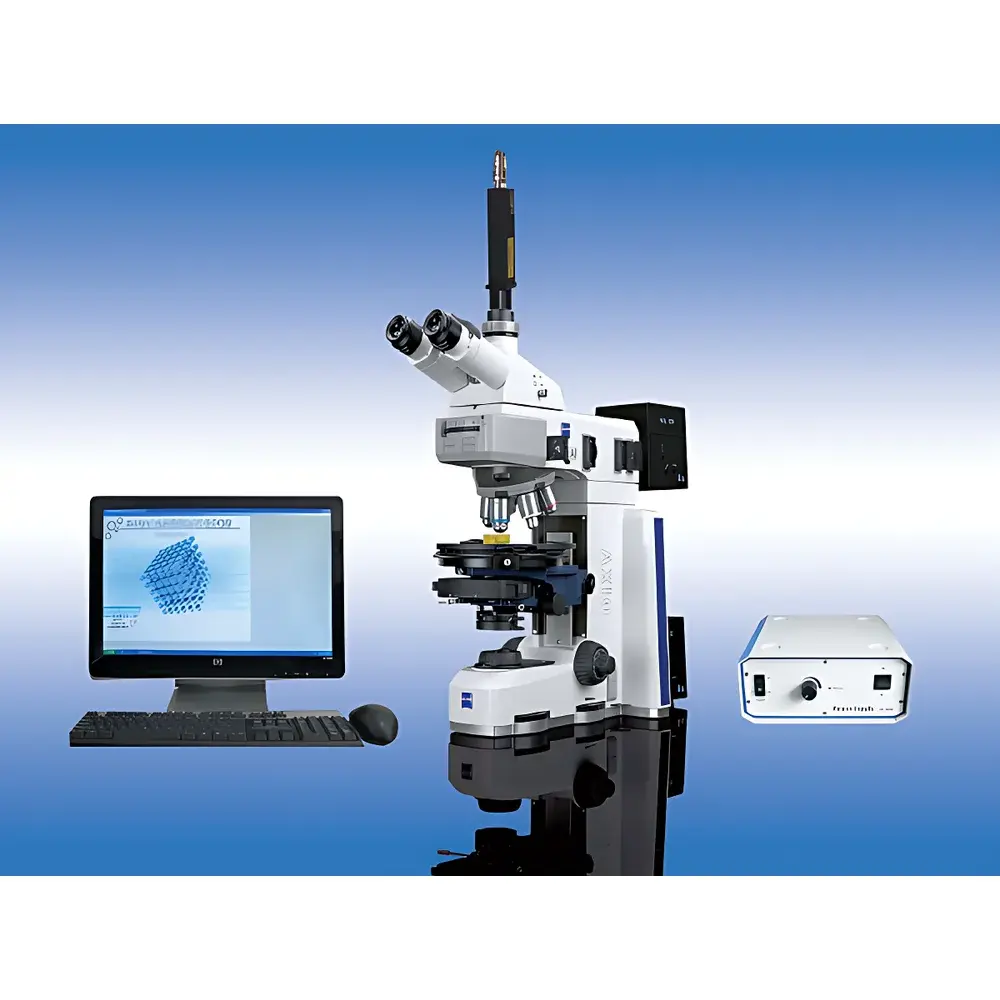
ZEISS MY5000 Fully Automated Digital Maceral Analysis System
| Brand | ZEISS |
|---|---|
| Origin | Germany |
| Model | MY 5000 |
| Compliance | ISO 7404, GB/T 6948 |
| Measurement Principle | Polarized Light Microscopy + Photometric Reflectance Quantification |
| Reflectance Resolution | ≤ 0.01% R<sub>max</sub> |
| Measurement Speed | ≥ 1,000 points/min |
| Minimum Measurable Pore Diameter | 5 µm |
| Temperature Compensation | Automatic, traceable to 20 °C reference |
| Data Output Formats | CSV, Excel, Word, PDF |
| Software Compliance | FDA 21 CFR Part 11–ready audit trail, GLP/GMP-compatible metadata logging |
Overview
The ZEISS MY5000 Fully Automated Digital Maceral Analysis System is an industrial-grade analytical platform engineered for high-precision, statistically robust coal petrography in compliance with ISO 7404 (Coal and Coke — Methods of Petrographic Analysis) and GB/T 6948 (Chinese Standard for Determination of Vitrinite Reflectance). At its core, the system integrates polarized light microscopy with calibrated photometric reflectance quantification to measure vitrinite reflectance (Ro), maceral composition, coke optical texture, and pore structure—critical parameters for coal rank assessment, coking blend optimization, source rock maturity evaluation, and geological correlation. The instrument employs Zeiss ICCS (Improved Contrast and Color Stability) optics, including plan-apochromatic objectives, wide-field binocular observation tubes, and a motorized rotatable compensator synchronized with the analyzer, ensuring uniform illumination, chromatic fidelity, and sub-micron spatial registration across the entire field of view. Unlike manual or semi-automated systems, the MY5000 delivers full automation of stage movement, focus correction, image acquisition, and spectral reflectance integration—enabling reproducible, operator-independent determination of vitrinite reflectance distribution histograms, which serve as the definitive metric for distinguishing single-coal versus blended feedstocks and detecting adulteration in commercial coal procurement.
Key Features
- Automated vitrinite identification and reflectance measurement using adaptive thresholding and morphological filtering—eliminating subjective selection bias and enabling detection of minor admixed components missed by low-point-count methods.
- PerkinElmer-certified photodetector module with ultra-low dark current (< 0.1 pA), < 0.005% linearity deviation, and thermal drift compensation—ensuring long-term stability of reflectance calibration across ambient temperature fluctuations (15–30 °C).
- 4-µm precision aperture alignment system, mechanically referenced to the optical axis of the Zeiss polarizing microscope—meeting and exceeding the 5-µm tolerance specified in ISO 7404-5 for reflectance measurement accuracy.
- Motorized XYZ stage with programmable point-and-line spacing (10–100 µm increments), integrated autofocus loop, and real-time video monitoring via calibrated HD microscale overlay—enabling unattended operation over >10,000 measurement points per sample.
- Temperature-normalized reflectance algorithm: raw measurements are automatically corrected to the standard 20 °C reference state using embedded thermistor feedback and NIST-traceable regression coefficients.
- Dual-mode operation: fully automated reflectance mapping (≤10 min/sample) and semi-automated maceral classification with simultaneous vitrinite reflectance and maceral group quantification (e.g., vitrinite, inertinite, liptinite percentages and vitrinite/inertinite ratio).
Sample Compatibility & Compliance
The MY5000 supports polished coal and coke specimens mounted on standard 25 × 75 mm glass slides with epoxy resin embedding and diamond-lapped surfaces meeting ISO 7404-2 surface roughness requirements (Ra ≤ 0.05 µm). It accommodates both bituminous and anthracitic coals, low-rank lignites (with optional immersion oil correction), and metallurgical coke samples ≥5 mm in diameter. All measurement protocols adhere to ISO 7404 Parts 3–7 (vitrinite reflectance, maceral analysis, coke porosity, optical texture) and ASTM D2798 (Standard Test Method for Microscopic Analysis of Coal and Coke). The system’s software architecture supports configurable reporting templates aligned with national coal classification schemes (e.g., Chinese GB/T 5751, US ASTM D388), including automatic assignment of coal rank, type, and blend coding based on statistical analysis of reflectance distribution shape (bimodality index, peak separation, skewness). Data integrity is enforced through electronic signatures, time-stamped audit logs, and immutable storage of raw intensity profiles—fully compatible with GLP and GMP laboratory environments subject to regulatory inspection.
Software & Data Management
The proprietary ZEISS Maceral Analytics Suite (v5.x) provides a validated, modular interface for acquisition, processing, and archival. Core capabilities include: reflectance histogram deconvolution using Gaussian curve-fitting algorithms; calculation of weighted mean reflectance (Rmean), standard deviation (σ), and bimodal separation thresholds; quantitative reporting of vitrinite content (%), inertinite/liptinite ratios, and optical texture index (OTI) per ISO 7404-6; and synthetic blend modeling using upper/lower limit matching and peak stripping methodologies. All datasets are stored in a relational SQLite database with hierarchical metadata tagging (sample ID, preparation date, technician, instrument calibration ID). Export options include ANSI-compliant CSV files for third-party statistical analysis, formatted Excel reports with embedded charts, and PDF certificates containing digital signatures and calibration traceability statements. The software meets FDA 21 CFR Part 11 requirements through role-based access control, electronic signature workflows, and tamper-evident audit trails covering all user actions, parameter changes, and data exports.
Applications
- Coke Production Optimization: Enables precise prediction of coke strength after reaction (CSR) and coke reactivity index (CRI) by correlating vitrinite reflectance distribution width and bimodality with blend behavior during carbonization.
- Coal Procurement & Adulteration Detection: Identifies blended or adulterated coal shipments via statistical divergence in reflectance histogram morphology—serving as the sole internationally accepted forensic method for coal origin verification.
- Geological Basin Modeling: Supports thermal maturity assessment of coal-bearing strata through automated Rmax mapping, providing inputs for basin modeling software (e.g., PetroMod, BasinMod) used in hydrocarbon generation timing studies.
- Coke Quality Control: Quantifies pore volume distribution, wall thickness statistics, and optical texture composition (e.g., isotropic vs. anisotropic domains) in accordance with ISO 7404-7 and GB/T 4000, directly linking microstructure to blast furnace performance.
- Research & Standardization: Facilitates inter-laboratory round-robin studies under ISO/IEC 17043 guidelines, with built-in tools for repeatability (within-lab) and reproducibility (between-lab) assessment per ISO 5725.
FAQ
What standards does the MY5000 comply with for vitrinite reflectance measurement?
The system conforms to ISO 7404-5, ASTM D2798, and GB/T 6948, with hardware calibration traceable to NIST SRM 2900a (vitrinite reflectance standard).
Can the MY5000 differentiate between natural coal blends and intentional adulteration?
Yes—its statistical analysis of reflectance distribution shape (e.g., bimodality index, peak separation >0.15% Ro) provides objective evidence of blending, consistent with ISO 7404-3 Annex B criteria.
Is temperature compensation mandatory for accurate reflectance values?
Yes—reflectance is temperature-dependent; the MY5000 applies real-time correction using embedded thermal sensors and a polynomial model validated across 15–30 °C.
Does the software support multi-user environments with audit trail requirements?
Yes—the system implements 21 CFR Part 11–compliant electronic signatures, role-based permissions, and immutable audit logs covering all data modifications and report generations.
What is the minimum detectable pore size in coke analysis mode?
The system resolves pores ≥5 µm in diameter using calibrated brightfield imaging and edge-detection algorithms compliant with ISO 7404-7 Annex A.
How is calibration verified between routine measurements?
Daily verification uses certified ZEISS reflectance standards (Ro = 0.85%, 1.52%, 2.20%) with automated drift tracking and alert thresholds set at ±0.02% Ro.