
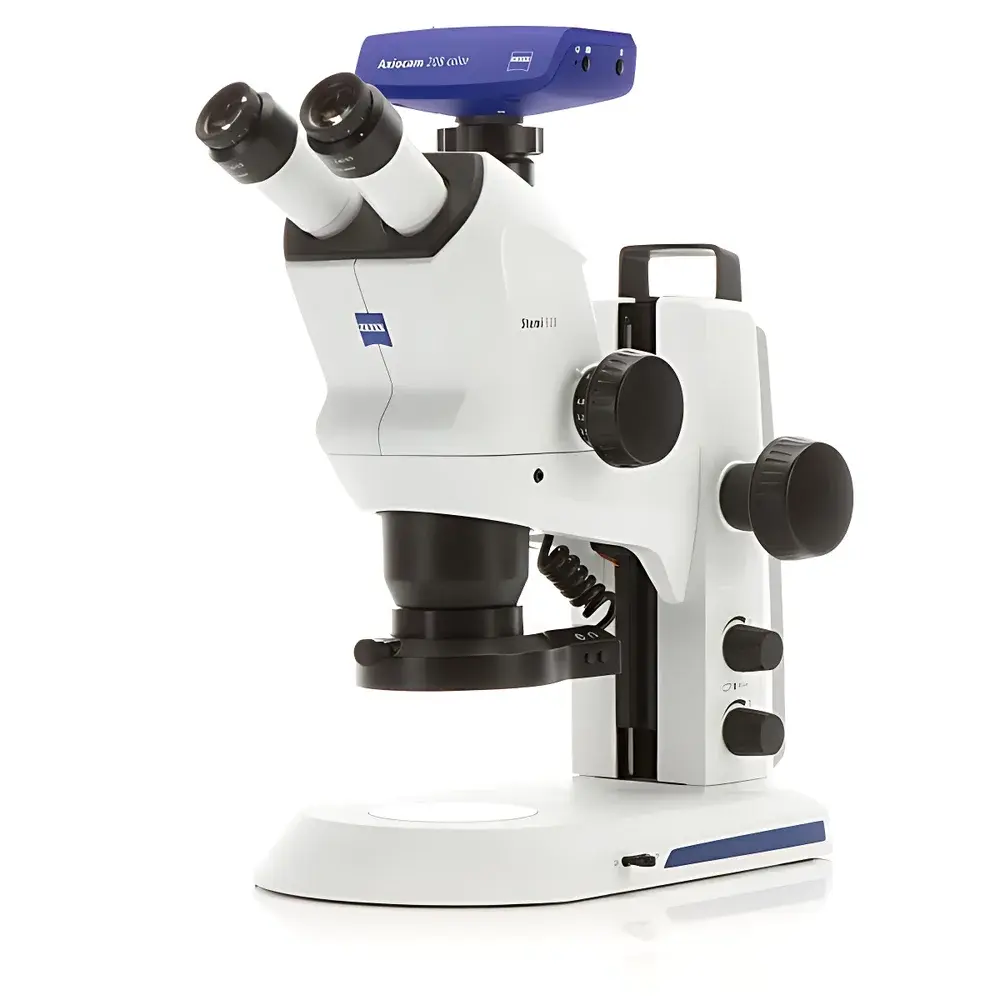
ZEISS Stemi 508 Greenough Stereo Microscope with 8:1 Zoom Ratio
| Brand | ZEISS |
|---|---|
| Origin | Germany |
| Model | Stemi 508 Greenough 8:1 |
| Zoom Ratio | 8:1 (0.63×–5.0×) |
| Standard Magnification Range (with 10× eyepieces, no auxiliary lens) | 6.3×–50× |
| Extended Magnification Range (with interchangeable objectives & eyepieces) | 1.9×–250× |
| Working Distance | 35–287 mm |
| Resolution (Rayleigh criterion, test target) | up to 450 lp/mm (g = 2.2 µm) |
| Minimum Resolvable Structure | 1.1 µm |
| Maximum Field Diameter | 122.7 mm |
| Eyepiece Field Number | 23 mm |
| Interpupillary Distance Adjustment | 55–75 mm |
| Viewing Angle | 35° |
| Optional Imaging Ports | 100% beam split (Stemi 508 doc) or 50/50 permanent beam splitter (Stemi 508 trino), both with replaceable 0.5× C-mount adapter (60NC type) |
| Base Compatibility | M-series mechanical base (M and M LED variants), including integrated LED illumination electronics, fiber-optic coupling interfaces (2× M8), transmission stage interface (Ø84 mm), polarizer mounting interface (Ø45 mm), and central aperture (40 mm) |
| Stand Load Capacity | 5 kg |
| Focusing Stand Travel | 360 mm height / 190 mm vertical lift |
Overview
The ZEISS Stemi 508 Greenough Stereo Microscope is an industrial-grade, apochromatically corrected stereomicroscope engineered for high-fidelity three-dimensional visualization in demanding laboratory, quality control, and manufacturing environments. Built upon the time-proven Greenough optical architecture—characterized by two independent, angled objective paths—the system delivers true stereoscopic depth perception without reliance on beam-splitting prisms. This dual-path design inherently supports superior contrast, minimal optical aberration, and exceptional image fidelity across the full zoom range. The 8:1 continuous zoom optics (0.63×–5.0×) are fully apochromatic, eliminating chromatic fringing and ensuring consistent color accuracy and sharpness at all magnifications. When combined with interchangeable apochromatic front lenses (e.g., 0.5×, 1.0×, 1.6×, 2.0×) and wide-field eyepieces (10×/23 mm or 15×/23 mm), the system achieves a total magnification range of 1.9× to 250× while maintaining parfocality—meaning focus remains stable during zoom transitions. With a maximum working distance of 287 mm and a field diameter up to 122.7 mm, the Stemi 508 accommodates large, bulky, or multi-layered specimens—ideal for PCB inspection, precision assembly, failure analysis, and biological dissection where spatial orientation and ergonomic access are critical.
Key Features
- Greenough-style dual-path optical design enabling natural 3D perception and high contrast without central obscuration
- Apochromatic zoom optics (0.63×–5.0×) with 10 detent positions for repeatable, tactile magnification selection
- Parfocal zoom mechanism ensuring constant focus throughout the entire magnification range
- Ergonomic 35° viewing angle and adjustable interpupillary distance (55–75 mm) supporting extended operator comfort
- Modular imaging architecture: Stemi 508 doc offers 100% light routing to camera; Stemi 508 trino provides permanent 50/50 beam splitting for simultaneous observation and documentation
- Standard 0.5× C-mount adapter (60NC type) compatible with ZEISS Axiocam and third-party DSLR/machine vision cameras
- M-series base system with mechanical or integrated LED illumination options, including fiber-optic coupling (2× M8 ports), transmission stage interface (Ø84 mm), and polarizer mounting (Ø45 mm)
- Robust focusing stand with 190 mm vertical lift, 360 mm total height, and adjustable friction control for precise, vibration-resistant positioning
Sample Compatibility & Compliance
The Stemi 508 supports a broad spectrum of specimen types—from reflective metallic components and solder joints to translucent polymer films, botanical samples, and microelectronic substrates—without requiring coverslips or immersion media. Its long working distance (35–287 mm) enables unobstructed manipulation using tweezers, probes, or micromanipulators beneath the objective. Optional accessories include rotating/tilting polarizing stages, sliding mechanical stages, and specialized illumination modules (e.g., KM series LED reflector/transmission units) compliant with IEC 62471 photobiological safety standards. The system’s optical calibration and documentation workflows align with GLP and GMP requirements; optional audit-trail-enabled imaging software (e.g., ZEN core) supports 21 CFR Part 11-compliant metadata logging when paired with validated acquisition hardware.
Software & Data Management
While the Stemi 508 operates as a standalone optical platform, its imaging ports are fully interoperable with ZEISS ZEN software (core or blue edition) for annotation, measurement (length, area, angle), multi-focus stacking, and report generation. Image metadata—including magnification, objective ID, illumination mode, and timestamp—is embedded directly into TIFF or JPEG files. For regulated environments, ZEN Connect enables secure user authentication, role-based access control, and electronic signature capture. All camera interfaces adhere to USB3 Vision and GenICam standards, ensuring compatibility with third-party machine vision SDKs (e.g., HALCON, OpenCV) for integration into automated inspection pipelines.
Applications
- Electronics manufacturing: SMT component placement verification, solder joint inspection (IPC-A-610), and counterfeit detection
- Materials science: Fracture surface analysis, coating thickness estimation, and particle morphology assessment
- Life sciences: Dissection of model organisms, histological slide screening, and embryonic development monitoring
- Forensics: Toolmark comparison, fiber identification, and document examination
- Quality assurance labs: Dimensional verification per ISO 10360, defect mapping, and ASTM E2933-compliant stereomicroscopic evaluation
- Education and training: Modular configuration supports curriculum-aligned demonstrations of optical principles, resolution limits, and depth-of-field behavior
FAQ
What distinguishes Greenough optics from Common Main Objective (CMO) stereomicroscopes?
Greenough systems use two separate objective paths angled toward the specimen, producing inherent stereopsis and higher contrast. CMO designs share a single objective, offering greater depth-of-field uniformity but reduced native 3D perception and increased susceptibility to stray light.
Can the Stemi 508 be integrated into automated production lines?
Yes—via its standardized C-mount port, USB3 Vision–compliant cameras, and programmable illumination controllers, the system supports trigger-synchronized image capture and real-time feature extraction when deployed with industrial vision software.
Is apochromatic correction maintained at all zoom settings?
Yes—the entire zoom train is designed as a matched apochromatic set, eliminating lateral chromatic aberration and ensuring color fidelity across 0.63× to 5.0×, regardless of auxiliary lens combination.
What regulatory documentation is available for validation purposes?
ZEISS provides Factory Calibration Certificates (traceable to PTB/DKD), Optical Performance Verification Reports, and IQ/OQ protocols upon request—supporting FDA, ISO 13485, and ISO/IEC 17025 compliance efforts.
How does the 35° viewing angle improve ergonomics compared to conventional 45° or 60° heads?
A lower viewing angle reduces cervical flexion and shoulder elevation, significantly decreasing musculoskeletal strain during prolonged use—validated in occupational health studies of microscopy-intensive workflows.




