
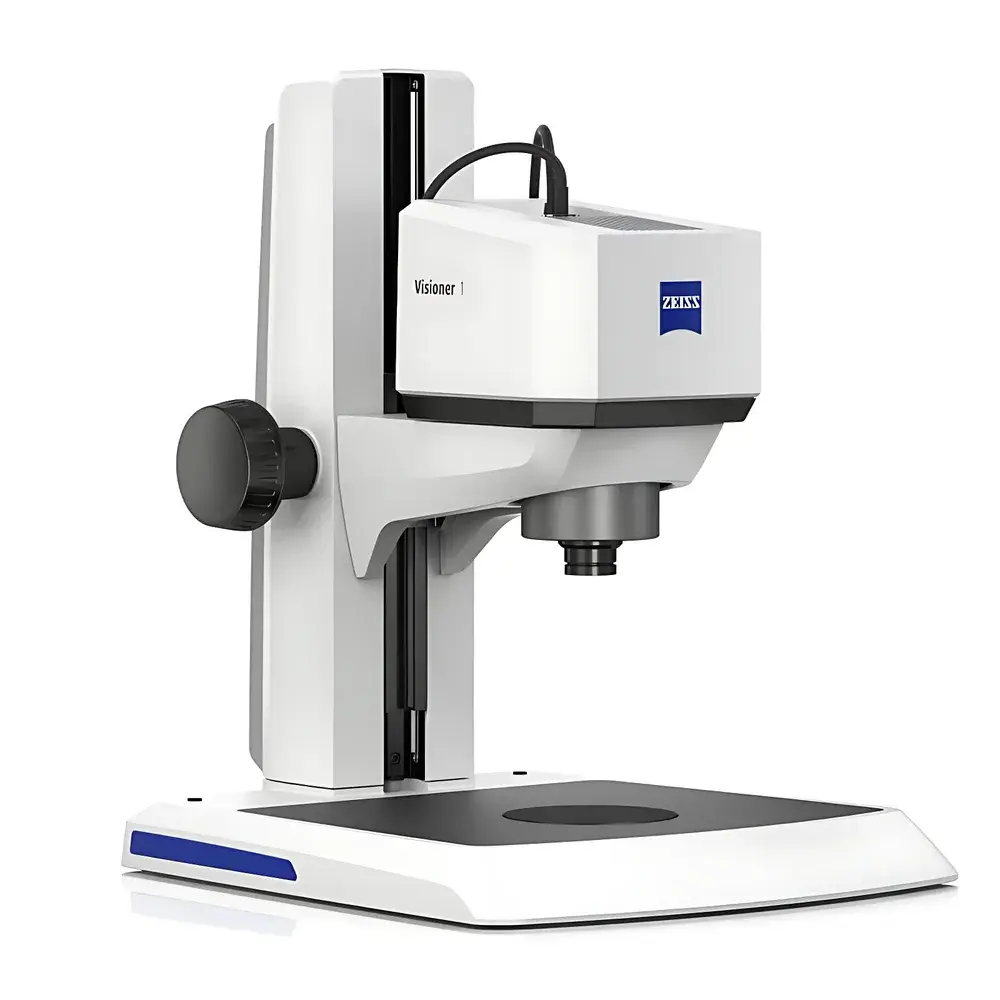
ZEISS Visioner 1 Digital Microscope with MALS™ Technology for Real-Time Extended Depth of Field Imaging
| Brand | ZEISS |
|---|---|
| Origin | Germany |
| Model | Visioner 1 |
| Technology | Micro-Mirror Array Lens System (MALS™) |
| Max. Height Difference Coverage | 69 mm |
| Micro-Mirror Size | ~100 × 100 µm |
| Mirror Actuation | Independent rotation and lateral translation |
| EDoF Enhancement Factor | Up to 100× vs. conventional optical microscopy |
| Imaging Mode | Real-time, focus-free, full-field extended depth of field |
| Compliance | Designed for ISO/IEC 17025-aligned inspection environments, compatible with GLP/GMP documentation workflows |
Overview
The ZEISS Visioner 1 is a high-precision digital microscope engineered for industrial quality control, failure analysis, and R&D applications where rapid, distortion-free visualization of topographically complex surfaces is critical. Unlike conventional optical microscopes constrained by shallow depth of field—especially at medium to high magnifications—the Visioner 1 employs ZEISS-developed Micro-Mirror Array Lens System (MALS™) technology to overcome fundamental optical limitations. MALS™ is not a computational post-processing method; it is a hardware-based, real-time optical solution that dynamically reshapes the wavefront using an array of individually addressable reflective micro-mirrors (~100 × 100 µm each). By coordinating minute rotations and lateral displacements of these mirrors, the system synthesizes a continuously variable, virtual lens surface with programmable curvature—enabling simultaneous in-focus imaging across vertical height differences of up to 69 mm. This eliminates reliance on mechanical Z-axis scanning, stack-based focus fusion algorithms, or time-consuming refocusing maneuvers. The result is true optical extended depth of field (EDoF), delivering full-resolution, aberration-corrected images in real time—without latency, stitching artifacts, or loss of spatial fidelity.
Key Features
- Real-time extended depth of field (EDoF) enabled by proprietary MALS™ optical architecture—no Z-stack acquisition or software-based focus stacking required.
- Optical height coverage up to 69 mm across a single field of view, supporting inspection of multi-level PCBs, machined components, additive manufacturing parts, and layered biomedical specimens.
- Micro-mirror array with >10,000 individually actuated elements, each capable of sub-microradian angular control and nanometer-scale lateral positioning for precise wavefront modulation.
- Native integration with ZEISS INSPECT software platform for measurement annotation, dimensional reporting (ISO 1101-compliant GD&T), and automated pass/fail classification.
- Ergonomic, screen-centric workflow: eliminates ocular fatigue associated with binocular eyepieces; supports touch-enabled annotation, zoom, and pan via integrated display or external monitor.
- Modular illumination options including coaxial LED, ring light, and dark-field modules—optimized for contrast enhancement across metallic, translucent, and highly reflective surfaces.
Sample Compatibility & Compliance
The Visioner 1 accommodates a broad range of sample geometries—from flat wafers and thin films to irregularly shaped mechanical assemblies and 3D-printed prototypes—without requiring stage repositioning or tilt compensation. Its large working distance (configurable from 45 mm to 120 mm depending on objective) ensures safe interaction with fragile or heat-sensitive specimens. The system complies with essential requirements of ISO 10110 (optical component testing), ISO 4287 (surface roughness metrology), and ASTM E2927-21 (digital microscopy for metallurgical analysis). Data integrity is maintained through audit-trail-capable software logging aligned with FDA 21 CFR Part 11 principles, supporting traceability in regulated environments such as medical device manufacturing and aerospace component certification.
Software & Data Management
ZEISS INSPECT software provides seamless control of MALS™ parameters—including dynamic focus plane selection, curvature ramp rate, and depth-slicing thresholds—via intuitive graphical interface. All image capture, measurement metadata, and operator annotations are stored in vendor-neutral TIFF or ZVI formats with embedded EXIF and XMP tags. Batch export supports CSV-based statistical process control (SPC) integration and direct linkage to MES/QMS platforms via RESTful API. Version-controlled firmware updates ensure long-term compatibility with evolving industry standards, while role-based user permissions enforce procedural consistency in multi-shift production labs.
Applications
- Electronics: Solder joint inspection on high-density interconnect boards, wire bond verification, and conformal coating uniformity assessment.
- Automotive: Surface defect detection on cast engine blocks, gear tooth profile validation, and friction material wear analysis.
- Additive Manufacturing: Layer-by-layer porosity mapping, support structure removal verification, and overhang geometry quantification.
- Medical Devices: Sterile packaging seal integrity evaluation, microfluidic channel clarity inspection, and implant surface finish characterization per ISO 13485.
- Academic Research: In situ observation of dynamic processes such as droplet coalescence, particle sedimentation, or thermal deformation—without motion blur induced by autofocus lag.
FAQ
How does MALS™ differ from conventional focus-stacking software?
MALS™ performs optical wavefront manipulation in real time using physical micro-mirrors—no image acquisition delay, no computational fusion artifacts, and no resolution loss due to pixel interpolation.
Can the Visioner 1 be integrated into automated production lines?
Yes—via GigE Vision and GenICam compliance, the system supports trigger-synchronized capture, PLC handshake protocols, and OEM SDK integration for custom machine vision pipelines.
Is calibration traceable to national standards?
ZEISS provides factory calibration certificates traceable to PTB (Physikalisch-Technische Bundesanstalt), with optional on-site recalibration services adhering to ISO/IEC 17025 requirements.
What magnification ranges are supported?
Standard configuration covers 20×–200× optical magnification (with digital zoom up to 800×); modular objectives extend usable range from 5× to 500× depending on working distance and resolution needs.
Does the system support quantitative 3D surface reconstruction?
While primarily optimized for 2D+Z qualitative and semi-quantitative analysis, optional ZEISS TOPO module enables height profiling with sub-micron vertical repeatability under controlled environmental conditions.



