
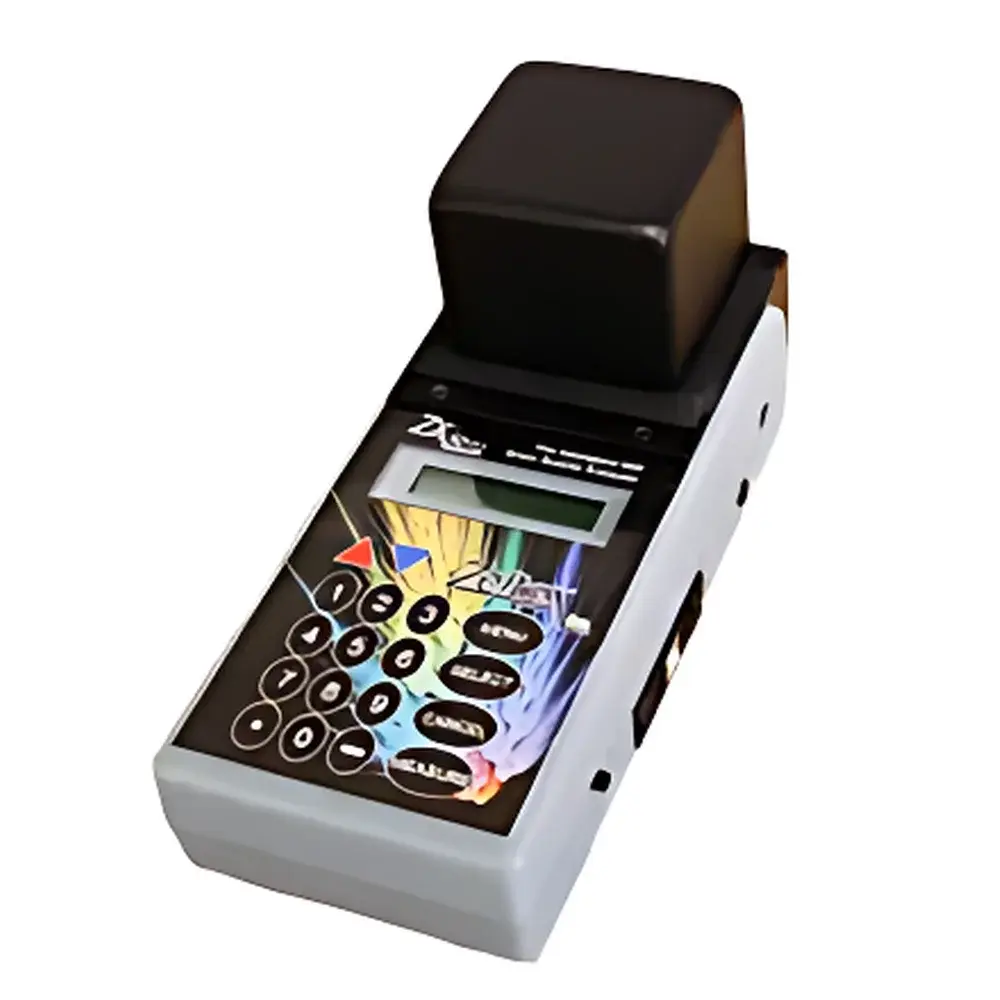
Zeltex ZX-50IQ Handheld Near-Infrared Grain Analyzer
| Brand | Zeltex |
|---|---|
| Origin | USA |
| Model | ZX-50IQ |
| Instrument Type | Portable |
| Application Domain | Cereal & Oilseed Grains |
| Operating Principle | In-situ and Portable NIR Spectroscopy |
| Wavelength Range | 893–1045 nm |
| Scan Rate | 10 scans/second |
| Data Acquisition Interval | 10 Hz |
| Measurement Mode | Diffuse Reflectance / Transmission |
| Chemometrics Software | RIMP |
| Compliance Standard | GB/T 24870–2010 |
Overview
The Zeltex ZX-50IQ Handheld Near-Infrared Grain Analyzer is an engineered solution for rapid, non-destructive quantification of key compositional parameters—including crude protein, total fat (ether extract), and moisture—in intact cereal and oilseed grains. Based on diffuse reflectance and transmission near-infrared spectroscopy (NIRS) in the 893–1045 nm spectral window, the instrument leverages second-derivative preprocessing and PLS regression models calibrated against reference wet-chemistry methods. Its optical architecture integrates a stabilized LED cold light source with temperature-independent output characteristics, enabling consistent spectral acquisition across ambient conditions from –10 °C to +45 °C. Designed explicitly for field-deployable operation, the ZX-50IQ eliminates sample grinding, drying, or solvent extraction—supporting real-time decision-making at critical points in the grain supply chain: harvest fields, receiving docks, silos, railcars, and truckloads.
Key Features
- Compact ergonomic form factor (26 × 12 × 9 cm; 1.5 kg) optimized for one-handed operation and extended field use
- Dual-mode optical interface supporting both diffuse reflectance (for whole kernels) and transmission (for ground or thin-layer samples)
- High-speed spectral acquisition at 10 Hz, delivering full-spectrum data capture and real-time averaging to improve signal-to-noise ratio
- Integrated 3.5-inch LCD display with intuitive menu navigation and immediate parameter visualization—no external device required for basic operation
- Flexible power system: six AA alkaline batteries (≥8 hours continuous operation), 12 V DC input via automotive cigarette lighter socket, or optional AC adapter
- LED-based illumination with >50,000-hour lifetime and minimal thermal drift—eliminating warm-up delays and calibration drift associated with tungsten-halogen sources
- Ruggedized housing rated IP54 for dust resistance and limited water exposure, suitable for industrial grain handling environments
Sample Compatibility & Compliance
The ZX-50IQ is validated for direct analysis of intact, unprocessed grains including wheat, barley, maize (corn), soybeans, rapeseed (canola), and soybean meal. Calibration models are traceable to AOAC Official Methods and aligned with GB/T 24870–2010 for crude protein and crude fat determination in soybeans. While not certified to ISO/IEC 17025 under third-party accreditation, the system supports laboratory quality assurance protocols through built-in performance verification checks (e.g., wavelength accuracy verification using internal reference bands, intensity stability monitoring). All spectral data files include embedded metadata (timestamp, operator ID, instrument serial number, measurement mode), facilitating GLP-compliant recordkeeping when used in conjunction with validated RIMP software workflows.
Software & Data Management
The proprietary RIMP chemometrics platform provides full model development, validation, and deployment capabilities. Users can import reference laboratory data (e.g., Kjeldahl protein, Soxhlet fat, Karl Fischer moisture), generate PLS or PCR calibration models, perform outlier detection via Mahalanobis distance, and apply robust cross-validation (e.g., leave-one-out, k-fold). The software enforces audit-trail functionality compliant with FDA 21 CFR Part 11 requirements—including electronic signatures, user access levels, and immutable change logs—when deployed on networked Windows systems under controlled IT governance. Spectral data exports support common formats (.csv, .jdx, .spc) for integration into LIMS or enterprise analytics platforms.
Applications
- On-site grading and pricing of incoming grain deliveries based on protein/fat/moisture specifications
- Real-time blending optimization during feed mill formulation to meet nutritional targets
- Quality control screening of soybean meal batches prior to shipment or storage
- Harvest-time assessment of nitrogen-use efficiency in precision agriculture trials
- Verification of contract compliance for export-grade cereals under national standards (e.g., USDA FGIS, GAFTA, GACC)
- Research applications in plant breeding programs requiring high-throughput phenotyping of seed composition traits
FAQ
Does the ZX-50IQ require daily calibration with physical standards?
No. It employs factory-established optical and electronic baselines; routine verification uses internal reference features. Optional NIST-traceable ceramic tiles may be used for periodic performance checks.
Can RIMP models be transferred between different ZX-50IQ units?
Yes—models are instrument-agnostic and portable across devices running identical firmware versions. Inter-unit transfer requires secure export/import via encrypted USB drive.
Is the instrument compatible with USDA or EU regulatory reporting frameworks?
While not pre-certified for official regulatory submission, its measurement uncertainty profiles and documentation structure align with principles outlined in ISO 12099 and ASTM E1655, supporting method validation under client-specific regulatory quality systems.
What is the minimum sample volume required for reliable measurement?
For whole-kernel reflectance mode: ≥50 g of freely flowing grain, evenly distributed in the sampling cup. No grinding or homogenization is needed.
How is spectral data security managed during field use?
All measurements are timestamped and tagged with operator ID; local storage uses AES-256 encryption. When synced to RIMP desktop software, data integrity is enforced via SHA-256 hashing and version-controlled database logging.







