
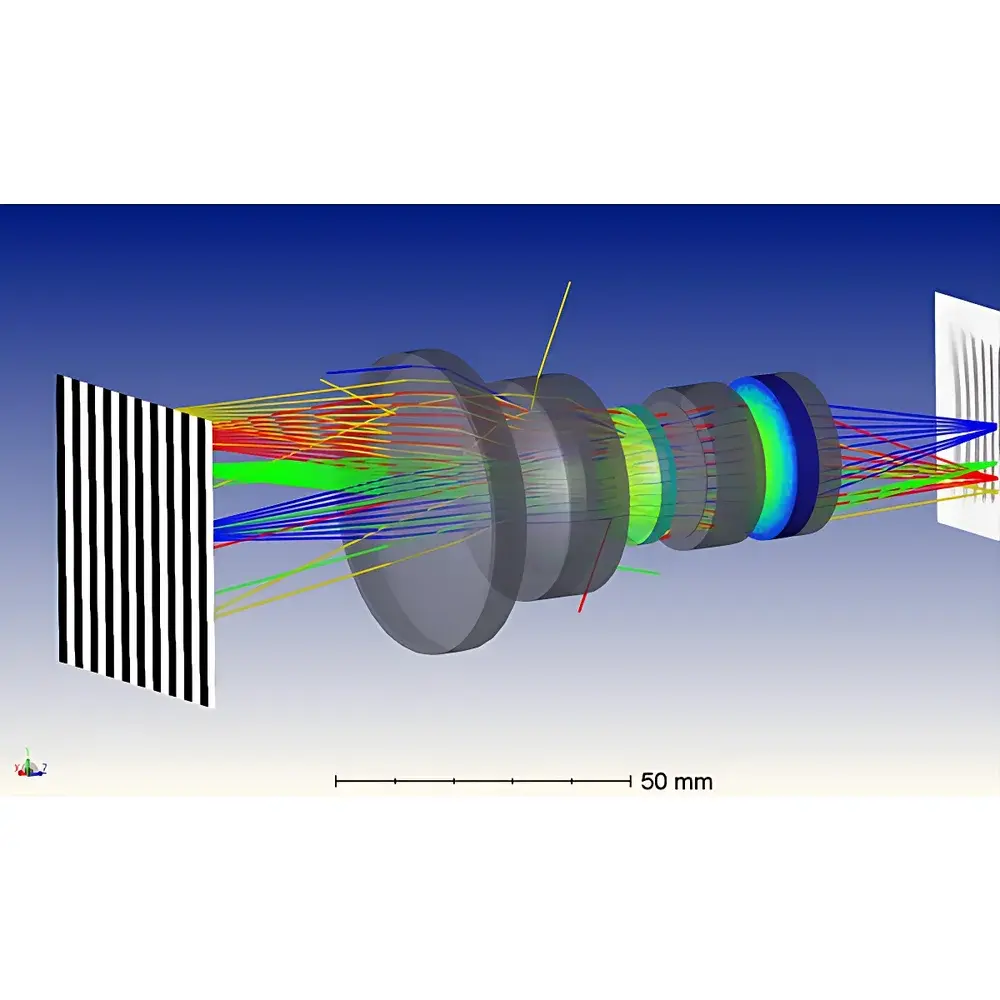
Zemax OpticStudio 2017 — Professional Edition
| Origin | USA |
|---|---|
| Manufacturer Type | Authorized Distributor |
| Import Status | Imported |
| Model | OpticStudio 2017 |
| Price Range | USD $7,200 – $14,400 (based on perpetual license tiers) |
Overview
Zemax OpticStudio 2017 Professional Edition is a comprehensive, physics-based optical design and analysis platform engineered for precision in both sequential and non-sequential ray tracing environments. Unlike general-purpose CAD or simulation tools, OpticStudio implements rigorous scalar and vector ray propagation models—grounded in Snell’s law, Fresnel coefficients, polarization matrix formalism, and surface scattering theory—to enable predictive modeling of imaging performance, illumination uniformity, stray light behavior, and system-level tolerancing. The 2017 release introduced enhanced thermal expansion modeling, improved MTF computation algorithms for high-NA systems, and expanded support for freeform and diffractive optical element (DOE) optimization—making it suitable for applications ranging from lithographic projection optics and AR/VR waveguides to automotive head-up displays and biomedical endoscopic systems. As a desktop-installed, Windows-native application, it operates independently of cloud infrastructure while maintaining strict numerical reproducibility across installations—a critical requirement for ISO 9001-compliant optical development workflows and FDA-regulated medical device design documentation.
Key Features
- Unified Sequential & Non-Sequential Environment: Seamlessly transition between paraxial layout, aberration-balanced imaging design, and complex illumination modeling—including Monte Carlo photon transport, surface scatter emulation, and detector response convolution—within a single project file.
- Advanced Optimization Engine: Implements damped least-squares, orthogonal descent, and global search algorithms with customizable merit functions; supports constraints on wavefront error, spot size, modulation transfer function (MTF), encircled energy, and illumination efficiency.
- Comprehensive Tolerancing Framework: Integrates statistical tolerance analysis (RSS, Monte Carlo), sensitivity analysis, and assembly-induced misalignment modeling—including decenter, tilt, spacing errors, and surface figure deviations—with automated compensation strategies and yield prediction reporting.
- Native CAD Interoperability: Supports bidirectional STEP, IGES, SAT, and STL import/export; enables dynamic linking with SolidWorks, Autodesk Inventor, and Creo Parametric for mechanical integration and optomechanical co-design.
- Extensive Optical Database: Ships with over 600 optical glasses (Schott, Ohara, Hoya, CDGM), >1,200 coating designs, >300 standardized lens blanks, and spectral data for >800 materials—including temperature-dependent refractive index models per ISO 10110-4.
- Programmability & Automation: Includes ZPL (Zemax Programming Language), MATLAB® interface via ZOS-API, Python-compatible COM bindings, and full scripting access to all optical properties, solvers, and analysis routines.
Sample Compatibility & Compliance
OpticStudio 2017 Professional Edition supports the full spectrum of optical component geometries—including spherical, aspheric, toroidal, polynomial freeform, Zernike-surface, and diffractive optical elements—as well as user-defined surface types via DLL integration. It accepts measured surface metrology data (e.g., interferometric phase maps in .ZBF or .DAT formats) for realistic ghost image and stray light prediction. The software complies with industry-standard documentation practices required under ISO 10110 (optical drawing specifications), MIL-PRF-13830B (surface quality), and ANSI Z80.10 (ophthalmic lens testing). While not a regulated medical device itself, its output files (e.g., .ZOS, .ZMX, tolerance reports) are routinely used in Design History Files (DHF) for FDA 510(k) submissions and meet traceability requirements under 21 CFR Part 11 when deployed with validated IT infrastructure and audit-log configurations.
Software & Data Management
OpticStudio 2017 employs a deterministic, file-based project architecture (.ZOS extension) ensuring bit-for-bit reproducibility across platforms and versions. All analyses—including PSF convolution, FFT-based MTF, and non-sequential detector irradiance mapping—are computed using double-precision floating-point arithmetic. The software includes built-in version control metadata, automatic backup snapshots, and timestamped change logs for each optimization iteration or tolerance run. License management utilizes hardware-bound USB keys (FlexNet-based) or network-based floating licenses compliant with IEEE 802.1X authentication protocols. Software updates (Service Packages SP1–SP3 for 2017) are distributed as signed binaries with SHA-256 checksums; update history and patch notes are archived in the Zemax Knowledgebase (KB#) system, accessible via embedded help browser or web portal. No telemetry or cloud-based analytics are enabled by default—data residency remains fully under user control.
Applications
- Design and tolerancing of high-resolution microscope objectives and confocal scanning systems
- Stray light analysis for spaceborne telescopes per ECSS-E-ST-32-01C guidelines
- Illumination engineering for LED-based surgical lighting and automotive adaptive driving beams
- Freeform reflector synthesis for compact AR near-eye displays
- Laser beam shaping and fiber coupling efficiency optimization for industrial laser processing systems
- Diffraction-limited spectrometer design with grating and prism dispersion modeling
- Biomedical optics: OCT probe design, endoscope relay systems, and ophthalmic diagnostic instrument modeling
FAQ
Is OpticStudio 2017 compatible with Windows 10 and modern multi-core processors?
Yes—OpticStudio 2017 Professional Edition is certified for Windows 7 SP1 through Windows 10 (64-bit only) and leverages OpenMP parallelization for ray tracing and optimization tasks across up to 64 logical cores.
Does the Professional Edition include non-sequential ray tracing capabilities?
Yes—unlike the Standard Edition, the Professional Edition provides full non-sequential mode with detector object modeling, scattering surface definitions, source geometry customization, and hybrid sequential/non-sequential system linking.
Can I upgrade from Standard or Professional Edition to the Flagship Edition post-purchase?
Yes—Zemax offers paid upgrade paths with prorated credit for remaining maintenance periods; upgrades include LightningTrace™ acceleration, fluorescence/phosphorescence modeling, and Radiant Source database licensing.
What technical support options are included with perpetual licenses?
All perpetual licenses include 24/5 email and remote-desktop support from Zemax-certified optical engineers, plus access to the Knowledgebase, video tutorials, and quarterly live webinars—all covered for the first year; extended support contracts are renewable annually.
Are there academic or government pricing options available?
Yes—Zemax offers institutional licensing programs for universities and national laboratories, including classroom site licenses, research group bundles, and government procurement contract vehicles (GSA Schedule 70, NSN availability).




