
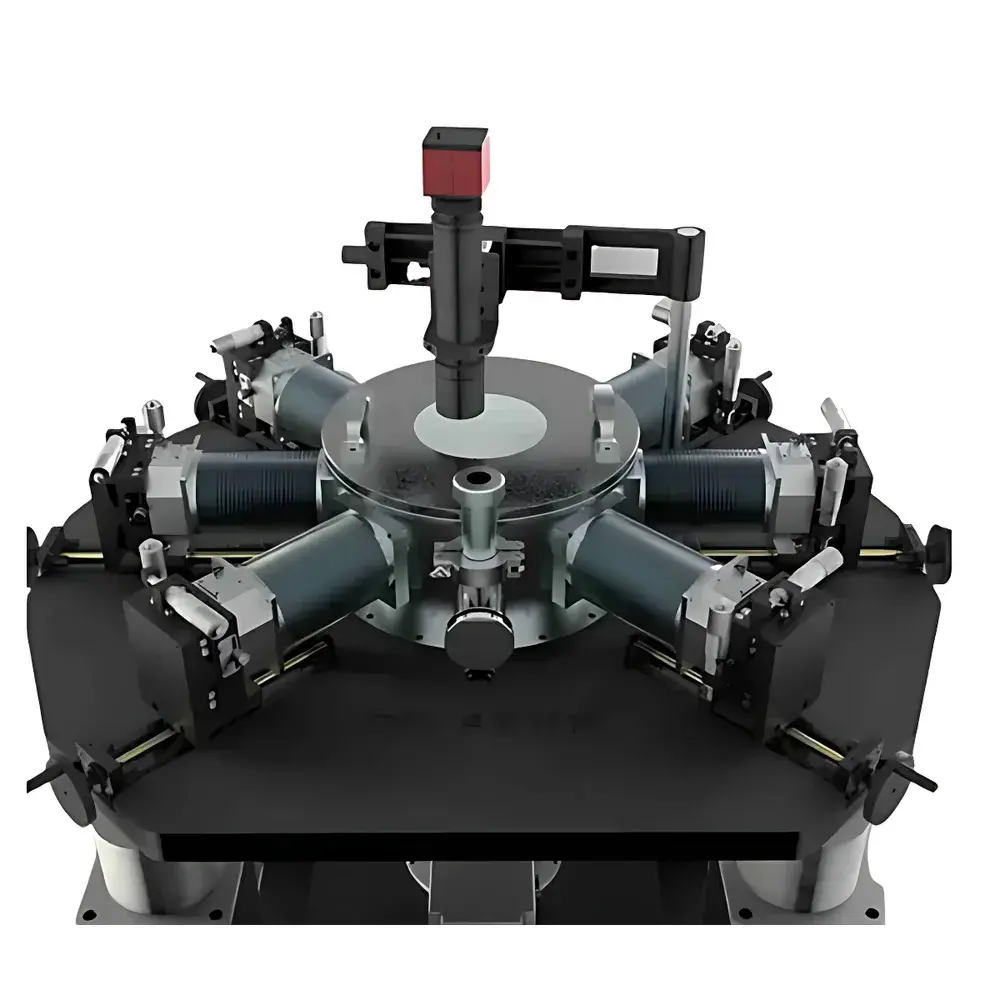
ZEPTOOLS LHe-6H-06 Dry Cryogenic Probe Station for Liquid Helium Temperature Range
| Brand | ZEPTOOLS |
|---|---|
| Origin | Guangdong, China |
| Manufacturer Type | Original Equipment Manufacturer (OEM) |
| Product Origin | Domestic |
| Model | LHe-6H-06 |
| Pricing | Upon Request |
| Base Temperature | 6 K |
| Operating Temperature Range | 6 K to 400 K |
| Temperature Stability | ±0.05 K (auto-controlled) |
| Vacuum Base Pressure | <6×10⁻⁴ Pa (pre-cooling), <6×10⁻⁵ Pa (at 6 K) |
| Sample Stage Diameter | 50 mm |
| Stage Temperature Uniformity | ±0.01 K |
| Probe Arm Count | 6 |
| Probe Motion Range | 50 mm × 50 mm × 30 mm |
| Positioning Resolution | <10 µm |
| Microscope Optical Magnification | 1.4×–9× (with optional 2× auxiliary lens) |
| Video Magnification | ~700× |
| Imaging Resolution | <2 µm |
| Camera | Full HD digital with coaxial + annular LED illumination |
| Electrical Leakage | <1 pA (DC) |
| RF Capability | Up to 100 GHz (optional) |
| Vacuum Feedthroughs | 2 × KF40 flanges |
| Cryocooler | Sumitomo F-50 continuous-flow cryocooler |
| Control Interface | Touchscreen HMI + LabVIEW-compatible drivers |
| Included Vacuum System | Imported turbomolecular pump set + full-range vacuum gauge |
| Integrated Triax Cabling | 6 × Triax probe cables + 1 × additional Triax on stage base |
| Optional Fiber Integration | Replaceable electrical probes with single-mode or multimode optical fibers |
| System Power Consumption | 2.5 kW |
| Net Weight | 200 kg |
Overview
The ZEPTOOLS LHe-6H-06 is a high-precision, dry-cryogenic probe station engineered for low-temperature electrical, optoelectronic, and quantum transport characterization under ultra-high vacuum (UHV) conditions. Unlike traditional liquid helium immersion systems, the LHe-6H-06 employs a Sumitomo F-50 continuous-flow cryocooler to achieve stable base temperatures down to 6 K without cryogen handling—eliminating boil-off losses, operational downtime, and contamination risks associated with wet cryostats. Its integrated thermal architecture includes radiation shielding via a cooled anti-radiation window, enabling accurate measurement of large-area or high-emissivity samples while minimizing parasitic heat load. Designed specifically for non-destructive in situ probing, the system supports direct electrical contact, RF signal injection, and optical coupling—all within a single UHV-compatible platform. The station operates across a wide thermal range (6 K to 400 K) with active temperature stabilization better than ±0.05 K, making it suitable for studies requiring precise thermal ramping, hysteresis mapping, or phase-transition analysis in quantum materials.
Key Features
- Dry cryogenic operation using Sumitomo F-50 closed-cycle cryocooler—no liquid helium refills required; eliminates condensation, ice formation, and operator exposure hazards.
- UHV-compatible stainless-steel vacuum chamber with ultimate pressure <6×10⁻⁵ Pa at 6 K, verified by full-range capacitance manometer and imported turbomolecular pumping system.
- Six independently adjustable probe arms with sub-10 µm mechanical resolution over 50 mm × 50 mm × 30 mm travel range; each equipped with Triax low-leakage cabling (<1 pA DC leakage) for noise-sensitive measurements.
- Motorized and manual dual-focus optical microscope: continuous zoom (1.4×–9×), optional 2× auxiliary lens, full-HD CMOS camera, coaxial + ring LED illumination, and optical resolution <2 µm—enabling real-time alignment of nanoscale devices.
- 50 mm-diameter variable-temperature sample stage with active control from 30 K to 400 K (±0.01 K stability); compatible with calibrated PT100 sensors and programmable thermal ramps.
- RF-capable configuration available up to 100 GHz with impedance-matched probe tips and shielded feedthroughs; optional fiber-optic integration allows simultaneous optical excitation/detection via replaceable Triax-to-fiber adapters.
- Intuitive touchscreen HMI with embedded PID algorithms and LabVIEW-compatible drivers for seamless integration into automated test sequences and data acquisition frameworks.
Sample Compatibility & Compliance
The LHe-6H-06 accommodates wafers up to 50 mm diameter, diced chips, MEMS cantilevers, 2D material flakes (graphene, TMDs), superconducting thin films, quantum dot arrays, and nanowire heterostructures. Its modular KF40 flange ports permit integration of gas dosing lines (for in situ doping), additional electrical feedthroughs, or external optical access. All internal surfaces are electropolished and baked to meet ISO Class 5 cleanroom standards. The system complies with IEC 61000-6-2/6-4 for electromagnetic compatibility and conforms to CE safety directives. For regulated environments—including academic core facilities, national labs, and industrial R&D centers—the platform supports audit-ready documentation packages aligned with GLP and GMP principles, including calibration certificates for temperature sensors and vacuum gauges.
Software & Data Management
Control firmware supports both local touchscreen operation and remote PC-based scripting via TCP/IP or USB. Native LabVIEW VIs enable synchronized triggering of temperature sweeps, bias voltage ramps, and data capture from external lock-in amplifiers or source-measure units (SMUs). All temperature setpoints, probe positions, and vacuum logs are timestamped and stored in CSV-compatible format. Optional add-ons include Python API wrappers, MATLAB instrument drivers, and export modules compliant with HDF5 for long-term archival in FAIR-compliant repositories. Audit trails record user login sessions, parameter changes, and system alarms—meeting traceability requirements under FDA 21 CFR Part 11 when deployed in regulated semiconductor process development workflows.
Applications
- Quantum transport in topological insulators, Majorana nanowires, and Josephson junctions at milli-Kelvin-equivalent stability.
- DC/RF characterization of GaN HEMTs, SiC power devices, and cryo-CMOS circuits under thermal stress.
- In situ photoluminescence (PL) and electroluminescence (EL) spectroscopy of quantum dots and perovskite nanocrystals.
- Mechanical resonance testing of NEMS resonators with piezoresistive readout at cryogenic temperatures.
- Superconducting transition-edge sensor (TES) calibration and noise spectral density analysis.
- Non-contact dielectric spectroscopy of ferroelectric oxides using guarded electrode configurations.
FAQ
What cooling method does the LHe-6H-06 use, and is liquid helium required?
No liquid helium is required. The system uses a Sumitomo F-50 continuous-flow cryocooler to reach 6 K dryly, eliminating cryogen logistics and enabling 24/7 unattended operation.
Can the system be upgraded for microwave-frequency measurements?
Yes—optional RF probe arms with GSG configurations support frequencies up to 100 GHz, with calibrated S-parameter compensation and vector network analyzer (VNA) synchronization.
Is the microscope compatible with fluorescence imaging at low temperatures?
The optical path supports external laser coupling via side-port KF40 flanges; optional filter wheels and EMCCD adapters enable confocal or time-resolved PL measurements.
How is thermal uniformity ensured across the sample stage?
The 50 mm copper stage features embedded heater/sensor arrays and multi-zone PID tuning; spatial uniformity is validated using calibrated thermal imaging during qualification testing.
Does the system support automated wafer mapping?
Yes—when integrated with third-party XY stages and coordinate referencing tools, the LHe-6H-06 can execute scripted probe landing sequences across predefined die locations, with positional repeatability <5 µm.




