
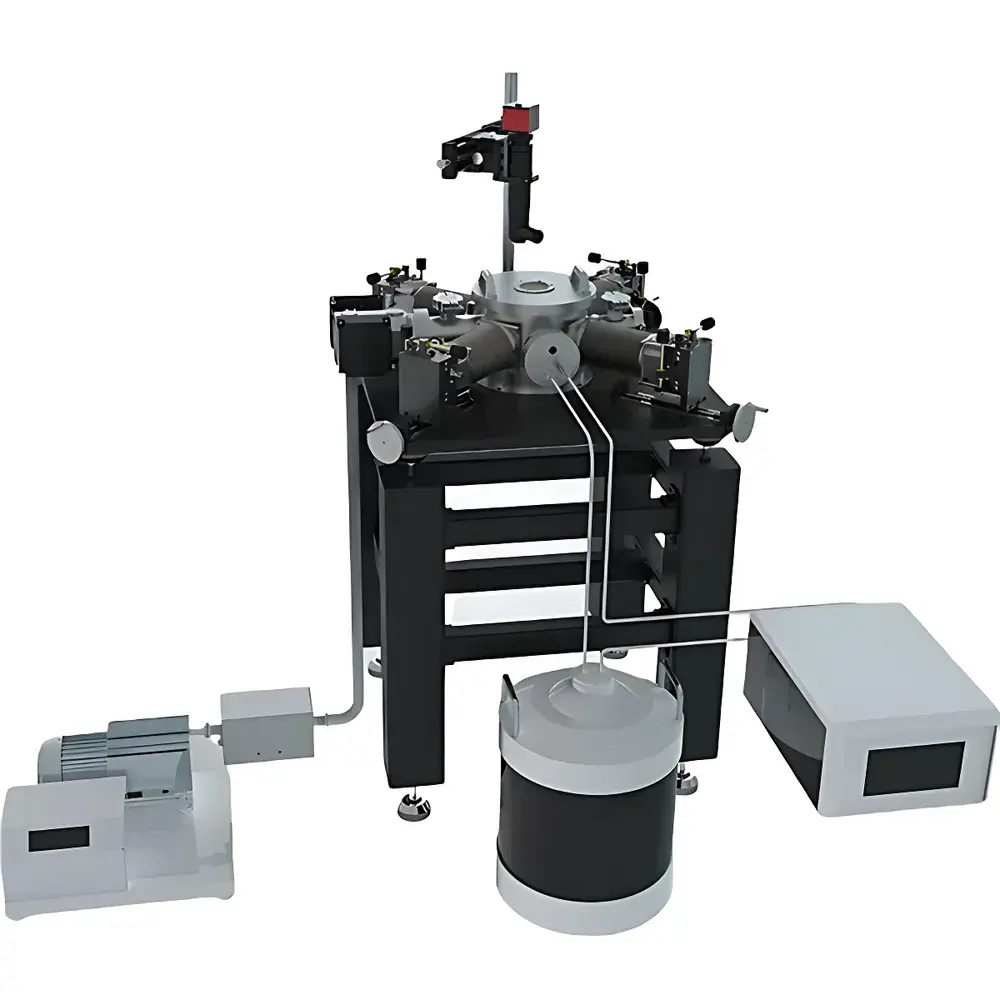
ZEPTOOLS LN-4H-06 Cryogenic Liquid Nitrogen Probe Station
| Brand | ZEPTOOLS |
|---|---|
| Origin | Guangdong, China |
| Manufacturer Type | Direct Manufacturer |
| Model | LN-4H-06 |
| Vacuum Base Pressure | <6×10⁻³ Pa (pre-cooling), <6×10⁻⁴ Pa (at 77 K) |
| Probe Arm Count | 4 standard |
| Probe Positioning Range | 50 mm × 50 mm × 30 mm |
| Probe Positioning Resolution | <10 µm |
| Sample Stage Diameter | 50 mm |
| Temperature Range | 77 K–400 K |
| Temperature Stability | ±0.5 K |
| Microscope Optical Magnification | 0.58×–7× (with 1× objective) |
| Microscope Resolution | <2 µm |
| Camera | Full HD digital with coaxial + annular LED illumination |
| Focus Mechanism | Dual mechanical + optical fine focus |
| Electrical Leakage | <1 pA (DC) |
| Included Vacuum System | Imported turbomolecular pump set + full-range vacuum gauge |
| Temperature Controller | Intelligent PID-based digital controller |
| Optional Fiber Integration | Yes (replaces electrical probes) |
| RF Capability | Up to 100 GHz (optional probe configurations) |
| Chamber Diameter | 245 mm |
| X-Y Stage Accuracy | ±0.01 mm |
| Probe Shaft Stroke | 110 mm |
Overview
The ZEPTOOLS LN-4H-06 Cryogenic Liquid Nitrogen Probe Station is a high-precision, vacuum-compatible instrumentation platform engineered for low-temperature electrical, optoelectronic, and transport characterization of microscale and nanoscale devices under controlled thermal and environmental conditions. Designed around a robust stainless-steel vacuum chamber and integrated liquid nitrogen (LN₂) cooling system, the LN-4H-06 enables stable operation from 77 K (liquid nitrogen boiling point) up to 400 K, supporting both cryogenic physics experiments and elevated-temperature reliability testing. Its core architecture follows established principles of cryogenic probe station design—namely, thermal isolation via multi-stage cold shielding, ultra-low leakage signal routing using Triax cabling, and vibration-damped optical-mechanical integration—to ensure measurement integrity in sensitive DC, low-frequency AC, and high-frequency RF domains (up to 100 GHz with optional RF-grade probes). The system is routinely deployed in academic and industrial laboratories conducting fundamental research on 2D materials, van der Waals heterostructures, quantum dots, MEMS/NEMS devices, and semiconductor junctions where non-destructive, in-situ electrical probing at defined temperatures is essential.
Key Features
- Vacuum chamber with ultimate pressure <6×10⁻⁴ Pa at 77 K, equipped with two user-accessible CF flanges for gas dosing, auxiliary cabling, or optical fiber feedthroughs.
- Four independently adjustable probe arms with 50 mm × 50 mm × 30 mm travel range and sub-10 µm positioning resolution; each arm includes a Triax low-leakage cable and tungsten or铍-copper probe tip (customizable).
- Integrated continuous-zoom monocular microscope (0.58×–7× optical magnification with 1× objective; ~280× digital video magnification), featuring <2 µm resolution, coaxial and ring LED illumination, and dual mechanical/optical focusing for precise probe alignment.
- 50 mm diameter variable-temperature sample stage with PID-controlled heating/cooling, achieving ±0.5 K thermal stability across the full 77–400 K operating range.
- Ultra-low DC leakage performance (<1 pA) validated under vacuum and cryogenic conditions—critical for high-impedance measurements including single-electron transport and 2D material channel characterization.
- Complete vacuum subsystem: imported turbomolecular pump, full-range capacitance manometer, and automated pressure monitoring interface.
- Optional fiber-optic integration pathway: one or more electrical probe positions can be replaced with SMA- or FC-terminated optical fibers for combined optoelectronic or photoluminescence excitation/detection experiments.
Sample Compatibility & Compliance
The LN-4H-06 accommodates wafers up to 12-inch diameter (with optional stage adapters), discrete dies, TEM grids, and custom substrates mounted on standard pin carriers or copper sample plates. Its modular flange configuration supports compliance with common laboratory vacuum standards (ISO-KF, CF) and facilitates integration into existing UHV or HV infrastructure. While not certified to ISO/IEC 17025 or GLP out-of-the-box, the system’s traceable temperature control (via calibrated Pt-100 sensor), documented vacuum performance, and low-noise electrical architecture make it suitable for data generation under ASTM F398 (Standard Practice for Electrical Characterization of Semiconductor Devices) and IEEE 1118 (Low-Temperature Semiconductor Testing). All Triax cabling and grounding schemes adhere to best practices for minimizing triboelectric noise and ground loops—key considerations for reproducible low-current metrology per IEC 61000-4-8.
Software & Data Management
The LN-4H-06 operates with vendor-supplied intelligent temperature controller firmware supporting ramp/soak profiles, real-time logging (≥1 Hz sampling), and export in CSV/Excel format. Vacuum status, stage temperature, and pressure readings are accessible via RS-485 or Ethernet interface for integration into LabVIEW, Python (PySerial/PyVISA), or MATLAB automation frameworks. Although no proprietary acquisition software is bundled, the platform is fully compatible with third-party source-measure units (Keysight B2900 series, Keithley 4200-SCS), lock-in amplifiers (Zurich Instruments HF2LI), and RF network analyzers (Keysight PNA series) via standard GPIB, USB-TMC, or LAN connections. Audit-trail functionality—including operator ID tagging, parameter change timestamps, and thermal profile versioning—is achievable through external LIMS or ELN systems when interfaced via API or OPC UA.
Applications
- Transport property mapping of 2D transition metal dichalcogenides (e.g., WSe₂, MoS₂) across temperature-dependent bandgap transitions.
- Gate-dependent IV and transfer characteristic analysis of field-effect transistors under cryogenic bias stress.
- Variable-temperature Hall effect and magnetotransport measurements on topological insulators and correlated oxide heterostructures.
- In-situ electrostatic force microscopy (EFM) or scanning gate microscopy (SGM) with simultaneous DC/RF probing.
- Optoelectronic coupling studies using integrated fiber ports—for example, photoresponse quantification of perovskite nanowires under 77 K illumination.
- Reliability assessment of MEMS switches and RF MEMS resonators across thermal cycling protocols (−196 °C to +127 °C).
FAQ
What is the base temperature achievable with standard liquid nitrogen cooling?
The LN-4H-06 reaches a base temperature of 77 K using standard liquid nitrogen fill; with optional cryoshroud enhancement and radiation shielding, base temperatures down to ~65 K may be attained under high-vacuum, low-heat-load conditions.
Can the system be upgraded for helium-based cooling?
Yes—the chamber and cold stage mechanical interface are compatible with exchangeable cold fingers for liquid helium or closed-cycle refrigerator integration; contact ZEPTOOLS engineering for mechanical and thermal interface specifications.
Is electromagnetic compatibility (EMC) shielding included?
The vacuum chamber provides inherent magnetic shielding via mu-metal-lined inner shields (optional); RF-tight gasketing and filtered feedthroughs are available as add-on kits for EMI-sensitive applications.
How is probe-to-sample contact verified optically?
Real-time visual confirmation is enabled by the high-resolution microscope with dual illumination modes and fine-focus capability; crosshair overlays and pixel-scale calibration allow sub-micron positional referencing relative to device markers.
What maintenance intervals are recommended for the turbomolecular pump?
Per manufacturer guidelines, the imported turbomolecular pump requires annual bearing inspection and oil replacement in the backing pump; full system bake-out is advised after extended atmospheric exposure or contamination events.




