
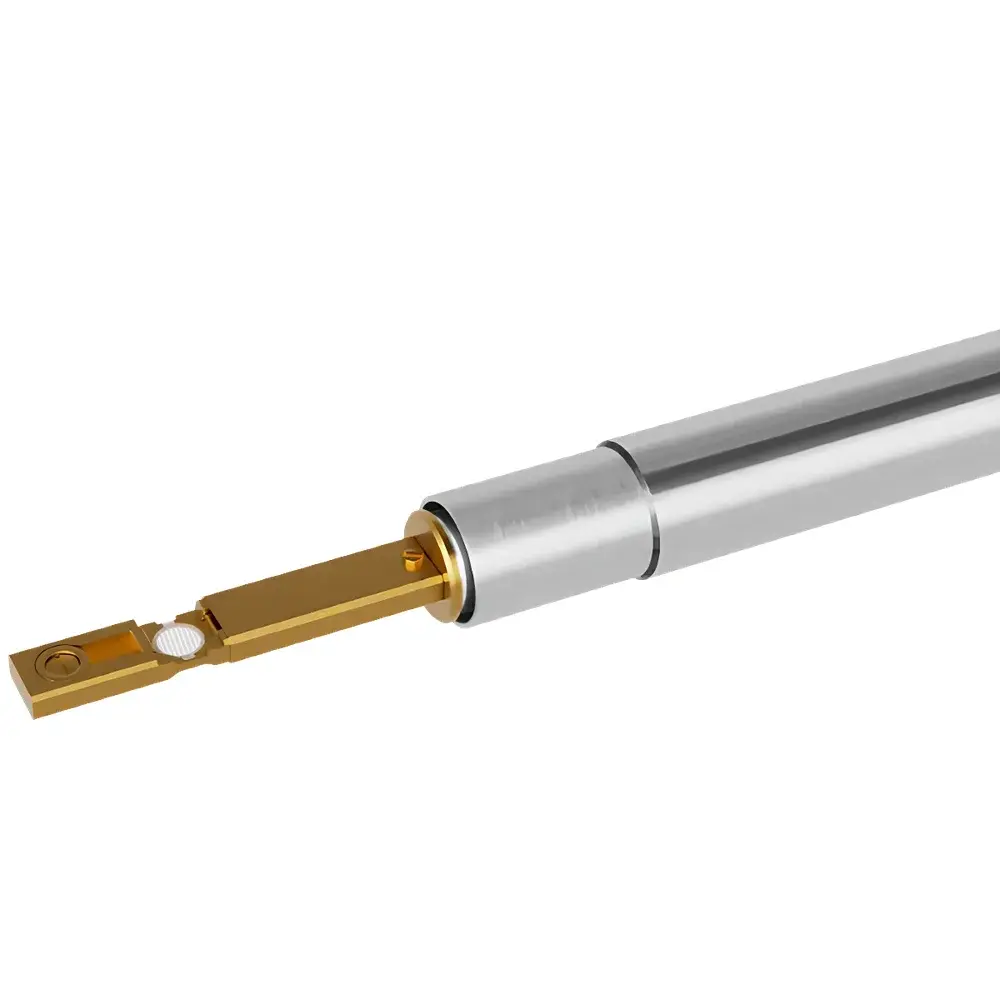
ZEPTOOLS PicoFemto In Situ Cryo Sample Holder Series for Transmission Electron Microscopy
| Brand | ZEPTOOLS |
|---|---|
| Origin | Beijing, China |
| Manufacturer Type | OEM Manufacturer |
| Product Category | Domestic |
| Model Series | PicoFemto In Situ Cryo Sample Holder |
| Instrument Classification | In Situ Cryogenic TEM Holder |
| Application Field | Materials Science |
| Cooling Medium | Liquid Nitrogen |
| Minimum Temperature | ≤ –170 °C (≤ 103 K) |
| Temperature Stability | < ±0.1 K |
| Cool-down Time to Minimum Temperature | ≤ 45 min |
| Dewar Capacity | 180 mL |
| Cryo Hold Time | ≥ 4 h |
| Resolution Compatibility | < 0.3 nm TEM Imaging |
| Dual-Tilt Range (β) | ±25° |
| Vacuum Bake Temperature | 120 °C |
| Base Vacuum (with Pre-pump System) | 6×10⁻⁵ Pa |
| Integrated Plasma Cleaning Power | 5–50 W (ICP mode) |
| Modular Interface Slots | 4 |
| Compatible TEM Platforms | Thermo Fisher Scientific (TFS), JEOL, Hitachi |
| Optional Functional Modules | Heating, Electrical Biasing, Mechanical Actuation (MEMS), STM Integration, High-Angle Tilt, Porous-Sample Support |
Overview
The ZEPTOOLS PicoFemto In Situ Cryo Sample Holder Series is a high-precision, vacuum-compatible cryogenic specimen holder engineered for transmission electron microscopy (TEM) applications requiring atomic-scale structural characterization under controlled low-temperature conditions. Built upon standardized TEM sample rod geometry, each holder integrates a high-efficiency liquid nitrogen (LN₂) Dewar with advanced vacuum-conduction cooling and multi-layer thermal insulation architecture. This design enables stable operation at temperatures ≤ –170 °C (≤ 103 K), significantly suppressing beam-induced damage in radiation-sensitive materials—including soft matter, biological macromolecules, hydrated interfaces, and metastable crystalline phases such as cubic ice (Ice Ic). The system supports both static cryo-observation and dynamic in situ experiments, delivering thermal stability better than ±0.1 K—critical for quantitative diffraction analysis, time-resolved lattice imaging, and low-dose tomographic reconstruction.
Key Features
- Vacuum-conduction cryocooling architecture ensures minimal thermal drift and eliminates mechanical vibration from cryogenic gas flow, preserving high-resolution TEM performance (< 0.3 nm resolution compatible).
- Integrated 180 mL LN₂ Dewar achieves ≥ 4 hours of continuous cryo-hold time without refilling; cool-down to ≤ –170 °C completed in ≤ 45 minutes under standard TEM column vacuum conditions.
- Dual-tilt configuration (±25° β-tilt) maintains full angular access while retaining cryogenic integrity—enabling crystallographic zone-axis alignment and tilt-series acquisition without thermal compromise.
- Four modular expansion slots support seamless integration of optional functional units: MEMS-based mechanical actuators, resistive heating stages (up to 800 °C), electrical biasing circuits (±10 V, 100 mA), and integrated scanning tunneling microscopy (STM) probes.
- On-board ICP plasma cleaning module (5–50 W adjustable power) enables in situ surface decontamination prior to insertion, reducing hydrocarbon contamination and improving signal-to-noise ratio in low-dose imaging.
- Full compatibility with major TEM platforms—including Thermo Fisher Scientific (Titan Krios, Talos, Glacios), JEOL (ARM, JEM-ARM), and Hitachi (HT7800, HF5000)—via standardized Gatan-style or custom pole-piece adapters.
Sample Compatibility & Compliance
The PicoFemto series accommodates standard 3 mm TEM grids (including lacey carbon, graphene oxide, silicon nitride membranes, and ultrathin Au/Pd supports) as well as specialized substrates for epitaxial ice growth or electrochemical cell integration. All components are fabricated from ultra-high-vacuum (UHV)-compatible stainless steel and oxygen-free copper, with surface finishes meeting ISO 14644-1 Class 5 cleanroom standards. The holder’s bake-out capability (120 °C under vacuum) ensures compliance with UHV protocols required for contamination-sensitive experiments. Designed to operate within the constraints of standard TEM pole-piece gaps, it meets ASTM E2941-22 guidelines for cryo-TEM specimen handling and supports GLP-aligned experimental workflows via audit-trail-capable control software.
Software & Data Management
Temperature setpoint, ramp rate, tilt angle, and plasma cleaning parameters are controlled via a dedicated touchscreen interface or optional PC-based software (Windows/Linux compatible) with TCP/IP communication. The software logs all operational metadata—including timestamped temperature profiles, tilt history, LN₂ level estimates, and plasma exposure cycles—in HDF5 format, ensuring traceability per FDA 21 CFR Part 11 requirements when configured with electronic signature modules. Real-time synchronization with TEM acquisition software (e.g., Velox, DigitalMicrograph, EM-MENU) enables trigger-based image capture during thermal transitions or mechanical actuation events.
Applications
- In situ structural evolution of metastable ice polymorphs (e.g., Ice Ic stacking faults) under controlled thermal cycling.
- Atomic-resolution imaging of beam-sensitive MOFs, perovskites, and 2D heterostructures at cryogenic temperatures.
- Cryo-correlative studies combining TEM with pre- or post-column energy-filtered imaging (EFTEM) and electron energy loss spectroscopy (EELS).
- Mechano-electrical coupling analysis in nanoscale devices using integrated MEMS + cryo-TEM configurations.
- Low-dose tomography of vitrified biological specimens with minimized specimen drift and enhanced contrast stability.
FAQ
What TEM models are certified for use with the PicoFemto cryo holder?
The holder is mechanically and electrically validated for Thermo Fisher Scientific Titan Krios™, Talos F200X™, Glacios™; JEOL ARM-200F™, JEM-ARM300F™; and Hitachi HT7800™ and HF5000™ systems. Custom pole-piece adapters are available upon request.
Is remote temperature monitoring supported during data acquisition?
Yes—real-time temperature telemetry is streamed via RS-232 or Ethernet and can be synchronized with frame acquisition timestamps in Velox or DigitalMicrograph.
Can the plasma cleaning module be used inside the TEM column?
No—the ICP plasma unit operates exclusively during pre-insertion conditioning in the load-lock or transfer chamber to avoid ion bombardment of column optics.
Does the dual-tilt functionality affect minimum achievable temperature?
No—thermal performance remains unchanged across the full ±25° β-tilt range due to symmetrical cold-finger routing and optimized heat sink geometry.
Are calibration certificates provided for temperature and tilt accuracy?
Each unit ships with NIST-traceable temperature calibration data (at –100 K, –150 K, and –170 K) and angular encoder verification reports compliant with ISO 230-2:2020.




