
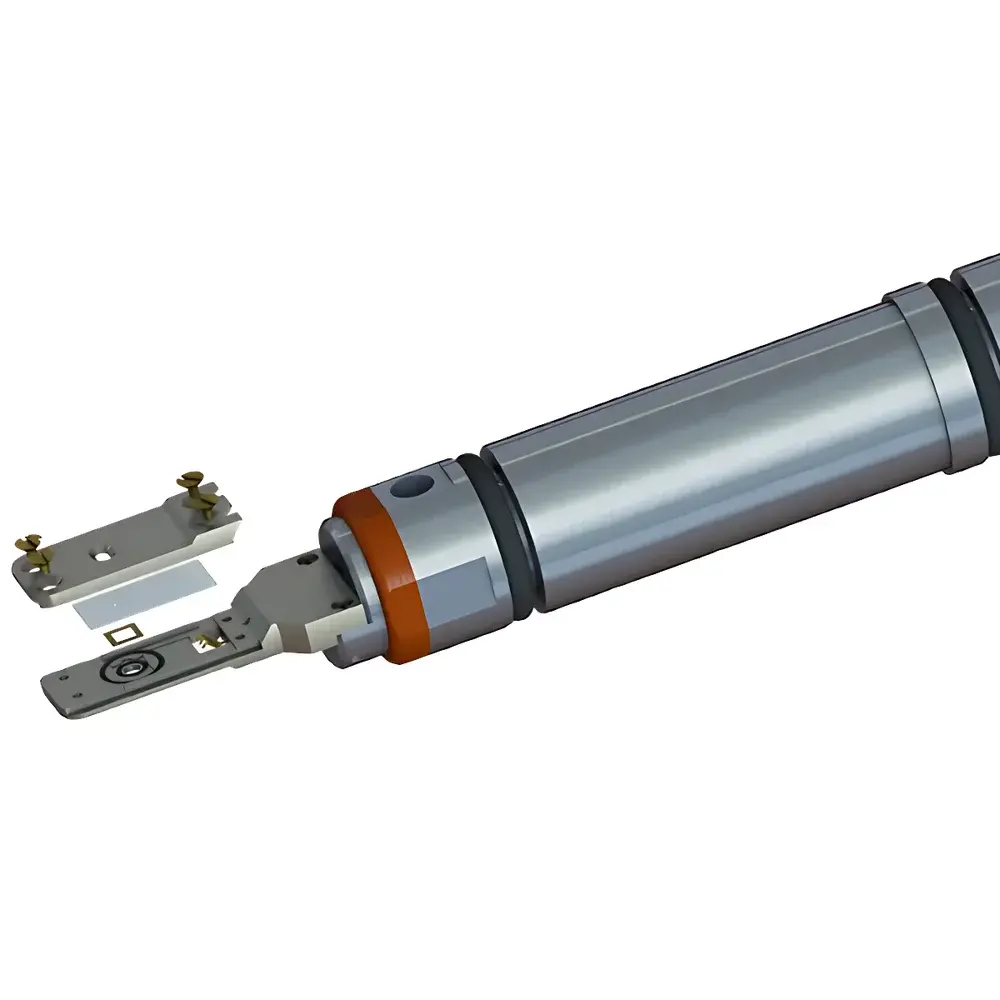
ZEPTOOLS PicoFemto In Situ MEMS Gas/Liquid TEM Sample Holder Series
| Brand | ZEPTOOLS |
|---|---|
| Origin | Guangdong, China |
| Manufacturer Type | Original Equipment Manufacturer (OEM) |
| Product Category | Domestic |
| Model | PicoFemto In Situ MEMS Gas/Liquid TEM Sample Holder Series |
| Pricing | Upon Request |
| Instrument Classification | In Situ Gas Holder |
| Application Domain | Materials Science |
Overview
The ZEPTOOLS PicoFemto In Situ MEMS Gas/Liquid TEM Sample Holder Series is an engineered platform for real-time, atomic-scale observation of dynamic processes inside transmission electron microscopes (TEM). Built upon standard 3.5 mm diameter TEM sample holder geometry, it integrates dual-sided MEMS-based microchips—fabricated with electron-transparent silicon nitride (SiNx) membranes—to form a sealed, sub-microliter reaction microchamber directly within the TEM column. This architecture enables controlled gas-phase or liquid-phase environments while preserving high-resolution imaging and analytical capabilities (including HRTEM, STEM, EDS, and EELS). The system operates on core principles of in situ electron microscopy: precise environmental control (gas composition, pressure, temperature), electrochemical biasing, and thermal stimulation—all synchronized with beam illumination and signal acquisition. It transforms conventional TEMs into functional nanolaboratories capable of probing catalytic surface reactions, solid–liquid interfacial dynamics, nanomaterial growth kinetics, electrochemical dissolution/deposition, and corrosion mechanisms under operationally relevant conditions.
Key Features
- MEMS-fabricated dual-chip architecture with <10 nm thick SiNx windows enabling high electron transparency and mechanical stability under vacuum and environmental stress
- Integrated heating module supporting continuous operation from ambient to 800 °C with thermal stability better than ±0.1 °C (verified via embedded thermocouple feedback and closed-loop PID control)
- Three-channel mass flow controller (MFC)-based gas delivery system supporting programmable mixing of H2, N2, O2, He, Ar, CO, CO2, and hydrocarbons at pressures up to 1 bar absolute
- Electrochemical measurement capability: bipolar voltage output range ±200 V (resolution ±5 μV); current sensing from ±100 fA to ±1.5 A with auto-ranging and low-noise front-end design
- Sub-nanometer mechanical stability: sample drift <0.7 nm/min under active thermal and electrical loading, validated via in situ image correlation tracking
- Modular chip options: static liquid cells, flow-through liquid cells, optically transparent liquid cells (for correlative optical-TEM), and hermetically sealed electrochemical cells
Sample Compatibility & Compliance
The PicoFemto holder accommodates standard 3 mm TEM grids (e.g., Cu, Ni, Au, SiN) and supports diverse specimen types including nanoparticles, 2D materials (graphene, TMDs), nanowires, catalysts, battery electrode particles, and biological macromolecular assemblies. All MEMS chips comply with ISO 9001-certified fabrication protocols and are tested for vacuum integrity (leak rate <1×10⁻⁹ mbar·L/s) and electron-beam-induced contamination resistance. System design aligns with TEM safety standards per IEC 61000-6-3 (EMC) and meets mechanical compatibility requirements for JEOL, Thermo Fisher Scientific (FEI), and Hitachi TEM platforms. For regulated research environments, full audit trails—including parameter logs, timestamped voltage/current profiles, and temperature ramps—are exportable in CSV/JSON formats compliant with GLP/GMP documentation workflows.
Software & Data Management
ZEPTOOLS provides the PicoFemto Control Suite—a cross-platform (Windows/macOS/Linux) application supporting synchronized control of gas flow, temperature ramping, electrochemical biasing, and external data acquisition (e.g., potentiostat, spectrometer). The software implements configurable experiment templates (e.g., “CO oxidation at 450 °C”, “Li-ion SEI formation at 0.5 mV/s”), real-time parameter overlay on live TEM images, and automated metadata embedding (EXIF-style tags) into acquired DM3/EMD files. All operational parameters—including MFC setpoints, thermocouple readings, voltage sweeps, and current integrals—are time-stamped with microsecond resolution and stored in encrypted SQLite databases. Export modules support ASTM E1455-compliant reporting structures and FDA 21 CFR Part 11–ready electronic signatures for validation-critical applications.
Applications
- In situ observation of heterogeneous catalysis: tracking structural evolution of Pt, Co, or Ni nanoparticles during redox cycling under tunable H2/O2 ratios
- Electrochemical interface science: visualizing solid-electrolyte interphase (SEI) nucleation on Si anodes during lithiation/delithiation
- Nanoscale corrosion studies: monitoring pitting initiation and chloride-induced dissolution of stainless steel grain boundaries in aqueous NaCl
- Low-dimensional material synthesis: observing vapor–solid–liquid (VLS) growth of GaAs nanowires in controlled AsH3/H2 atmospheres
- Biomineralization dynamics: resolving early-stage CaCO3 crystallization pathways in confined liquid cells with pH-controlled electrolytes
FAQ
Is the PicoFemto holder compatible with aberration-corrected TEMs operating at 200–300 kV?
Yes—mechanical and electrical designs meet JEOL ARM series and Thermo Fisher Titan Krios dimensional and grounding specifications; SiN window thicknesses are optimized for minimal multiple scattering at high acceleration voltages.
Can users perform simultaneous EELS and electrochemical biasing?
Yes—the holder’s low-noise analog front-end and shielded cabling minimize electromagnetic interference; EELS acquisition has been validated during constant-current cycling up to 1 A.
Are custom chip geometries available for specialized experiments?
Yes—ZEPTOOLS offers co-design services for application-specific MEMS chips, including multi-electrode arrays, integrated reference electrodes, and UV-transparent quartz windows for photoelectrochemical studies.
What vacuum compatibility level does the gas manifold achieve?
The integrated UHV-rated gas manifold maintains base pressure <5×10⁻⁸ mbar after bake-out and demonstrates no measurable outgassing during 48-hour hold tests at 1 bar differential pressure.
Does the system support automated long-duration experiments (e.g., >24 h)?
Yes—thermal and electrical subsystems include watchdog timers, over-temperature cutoffs, and graceful failure logging; continuous operation for >72 h has been demonstrated in accelerated aging tests.




